
- National
- Bangladesh
- Business
- International
- Sports
- Entertainment
- Politics
- Technology
- Life Style
- Religion
- Opinion
- FIFA World Cup 2026
Saturday, 18 July 2026

After 246 years, the remains of an unknown soldier who died in one of the American Revolution's most devastating battles finally have a name: Private John Pumphrey.
Through advanced DNA testing and meticulous historical detective work the Maryland teenager who perished at the Battle of Camden in South Carolina can now take his rightful place in history, just in time for the 250th anniversary of the nation he helped create.

A Battlefield Discovery
Pumphrey died on August 16, 1780 when British General Charles Lord Cornwallis routed patriot forces led by Major General Horatio Gates. Of the 900 Americans killed many were abandoned where they fell on the battlefield.

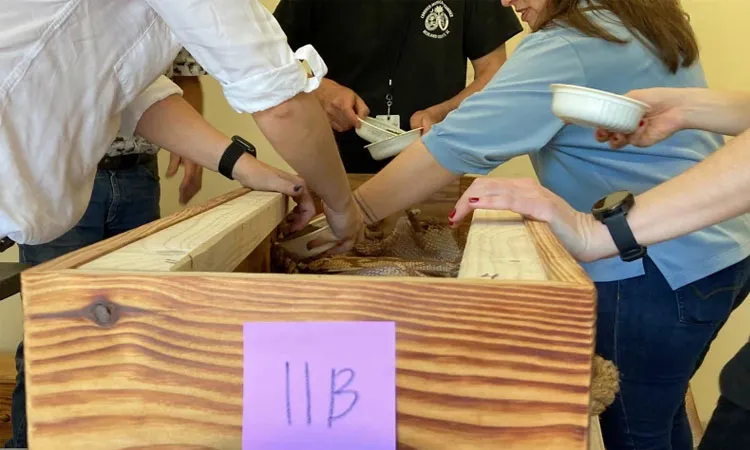
In 2020, archaeologists surveying the Camden site discovered human bones protruding from the earth. They eventually unearthed 14 sets of remains. Twelve were identified as Continental soldiers and were later reinterred with full military honors.

Among them was a soldier temporarily dubbed "Camden 9B" buried beneath a shallow layer of dirt alongside four comrades. His new headstone read simply: "UNKNOWN. REV WAR. BATTLE OF CAMDEN. AUG 16 1780."
Unlocking a 240-Year-Old Genetic Mystery
To identify the soldiers, the Richland County Coroner’s Office partnered with Texas-based FHD Forensics. Founder Allison Peacock described Pumphrey as "America’s oldest John Doe."

Extracting DNA from centuries-old remains is incredibly difficult due to soil and water contamination. Samples were sent to Astrea Forensics in California. While forensic experts typically extract DNA from teeth, the teeth in this case yielded no usable profiles.

Instead, scientists successfully extracted DNA from the petrous portion of the temporal bone a dense, delicate structure located at the base of the skull behind the ear. This generated Pumphrey’s entire genome marking the oldest sample Astrea Forensics has ever successfully used to reconstruct a family tree.
The genetic profile was uploaded to genealogical databases, resulting in 20,000 matches.
The Life of an Orphan Soldier
One crucial DNA match led researchers to Russ Hudson, a retired federal agent from Pennsylvania. Hudson, who shares a maternal bloodline with the soldier volunteered to dive into archival research.
Their investigation revealed that Pumphrey was an orphan from Anne Arundel County, Maryland. While no birth records exist, forensic analysis of his knee growth plates indicated he was a teenager when he died. Historical records suggest he enlisted in the Baltimore militia at just 13 years old signing his reenlistment papers with an "X."
Pumphrey’s military record was extensive for his young age. Serving with the 7th Maryland Regiment that he endured the brutal winter at Valley Forge with George Washington. He fought in major Northern Theater conflicts with the battles of Brandywine, Germantown and Monmouth marching an estimated 1,000 miles before his death in South Carolina.
Because no skeletal trauma was found, forensic experts believe Pumphrey likely died from a soft tissue wound, such as a bayonet strike.
A Family Reunited
Last month, descendants and researchers gathered for an emotional ceremony at the historic Benson-Hammond House in Maryland to honor Pumphrey's newly discovered legacy.
"The fact that some archaeologists just happened to stumble on bones and knowing that it would be difficult to identify those people by DNA, I just found it really exciting" said Becky Berman, Pumphrey’s first cousin several times removed.
Meanwhile, forensic work continues on another set of remains "Camden 11A," who remarkably turned out to be a distant relative of FHD Forensics founder Allison Peacock.
For Hudson, the journey is not quite over. The retired agent is now pushing for the U.S. government to officially verify the research and replace his fifth great-uncle’s generic gravestone with one bearing his true name.
"He sacrificed himself along with some others" Hudson said "for the sake of this new nation."
