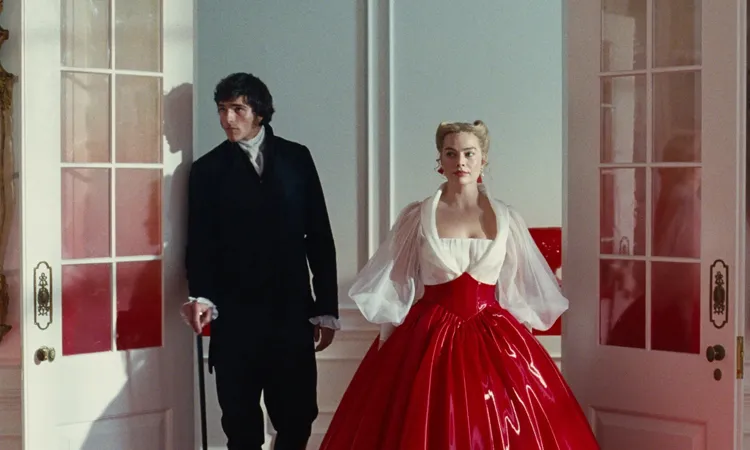
Director Emerald Fennell’s reimagining of Wuthering Heights aims to shock and provoke, but ends up hollow and emotionally thin. Despite its striking visuals, the film struggles with weak characterisation, heavy sexualisation and miscast leads.
The story begins with young Cathy Earnshaw, played by Charlotte Mellington, who grows close to Heathcliff, an orphan brought home by her father. As adults, Cathy is played by Margot Robbie, while Heathcliff is portrayed by Jacob Elordi. Their intense bond turns destructive after Cathy chooses to marry wealthy neighbour Edgar Linton, played by Shazad Latif.

Fennell removes key elements from Emily Brontë’s original novel, including Cathy’s brother Hindley and the layered narrative structure. There is no Mr Lockwood to guide the audience. Instead, the film moves in a straight timeline, expecting viewers to accept that Cathy and Heathcliff’s passion alone explains the devastation that follows.

The director leans heavily on explicit sexual imagery, often at the cost of emotional depth. Several scenes feel excessive rather than revealing, while modern music choices, including tracks by Charli XCX, add little impact. Historical inaccuracies appear in both costume and production design, weakening the film’s setting.
Visually, the film is often impressive. Cinematographer Linus Sandgren delivers beautifully lit frames, and some shots are genuinely striking. However, once the visual polish fades, little remains to engage the viewer. The central romance, despite its graphic portrayal, feels oddly dull.
The casting is a major weakness. Robbie’s Cathy lacks the recklessness and emotional complexity central to the character, gradually becoming one-dimensional. Elordi’s Heathcliff feels restrained and misjudged, missing the rage and obsession that define the role. His performance never captures Heathcliff’s thirst for revenge or inner turmoil.
Supporting roles also suffer. Nelly, one of literature’s most layered characters, is reduced to a figure of misplaced jealousy in Hong Chau’s portrayal. Only Alison Oliver, as Isabella, manages to leave a positive impression.
Fennell has described the film as just one “version” of the novel, following earlier adaptations such as Wuthering Heights starring Laurence Olivier, and the 1992 version with Ralph Fiennes. But by sidelining themes of class, power and social constraint in favour of shock value and sexual display, this version loses the novel’s core.
Ultimately, the film turns a dark tale of obsession and fate into a shallow love story. It feels more interested in provocation than understanding its source. What remains is a glossy but empty adaptation — visually bold, yet emotionally vacant.
Comment