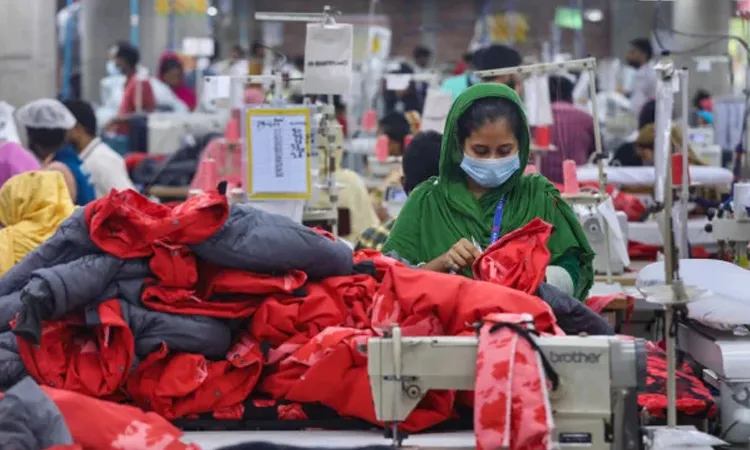
Proposed import duty hikes on key industrial raw materials in the FY2025-26 budget have triggered widespread concern among Bangladesh’s plastic and textile manufacturers, who warn the move will drive up production costs and consumer prices.
Under the proposed finance bill, import duties on PVC and PET resin will double from 5% to 10%, while the duty on polyester staple fibre (PSF) will rise from 1% to 5%. While the government aims to protect domestic manufacturers, downstream industries argue that local production falls far short of market demand. The Impact on Plastic Manufacturing
PVC resin and PET resin are foundational materials for producing water tanks, pipes, packaging, beverage bottles, electronics, and pharmaceuticals. Industry insiders reveal that Bangladesh’s annual demand stands at 500,000 tonnes for PVC resin and 850,000 tonnes for PET resin. However, local capacity meets only 150,000 tonnes and 100,000 tonnes respectively—leaving over 70% of the market reliant on imports.
Riad Mahmud, Managing Director of National Polymer Group, stated that local resin is already more expensive than imports despite domestic suppliers meeting just 27% of market demand.
"We will now have to import at a higher cost, which will increase product prices and reduce consumer demand," Mahmud told The Business Standard. He warned that the policy risks creating monopolistic market conditions by favoring a handful of large producers. Textile Sector Left Vulnerable
The tariff hike on polyester staple fibre has similarly alarmed textile manufacturers. Man-made fibre (MMF)-based products account for nearly 70% of the global apparel market and currently generate about 25% of Bangladesh’s garment export revenue, drawing major investments from giants like Square Textiles, Noman Group, and Ha-Meem Group.
Yet, local PSF producers cover only 10% to 15% of domestic demand. Mill owners warn the duty hike will escalate yarn and fabric production costs across nearly 40 MMF-focused mills.
Saleudh Zaman Khan, Managing Director of NZ Group, noted that the cost of producing one kilogram of PSF-based yarn will jump from $3 to $3.15.
"This will weaken our competitiveness against India, where manufacturers already enjoy government incentives and cost advantages," Khan said. He argued that the government should support raw-material producers through subsidies or low-cost financing rather than taxing downstream industries.
Representatives also fear the policy may inadvertently strain foreign exchange reserves. Since exporters can import raw materials duty-free under bonded warehouse licenses, higher local production costs might incentivize companies to import finished yarn and fabric rather than buying locally. Protectionism vs. Market Reality
The primary beneficiaries of the new tariffs are prominent local conglomerates, including Meghna Group and TK Group. Meghna PVC Limited produces both PVC and PET resins, while TK Group’s Modern Poly Industries Limited and Modern Syntex dominate the domestic PSF market.
Conglomerate executives have strongly defended the policy. BM Islam, Senior Executive Director of Meghna Group, dismissed supply shortage concerns. "We can meet around 65% of PVC resin demand and nearly 100% of PET resin demand. We can expand further if demand rises," Islam countered.
An anonymous senior official from TK Group added that their current production capacity handles roughly 48% of domestic demand.
"A 5% duty is not excessive protection. If Bangladesh wants to build local industries, some level of protection is necessary. Otherwise, we remain import-dependent," the official said, adding that self-reliance is critical as Bangladesh graduates from Least Developed Country (LDC) status and faces stricter local value-addition rules.
Downstream manufacturers maintain, however, that forcing higher costs onto the supply chain will ultimately stifle local production and drive the economy toward heavier import reliance.