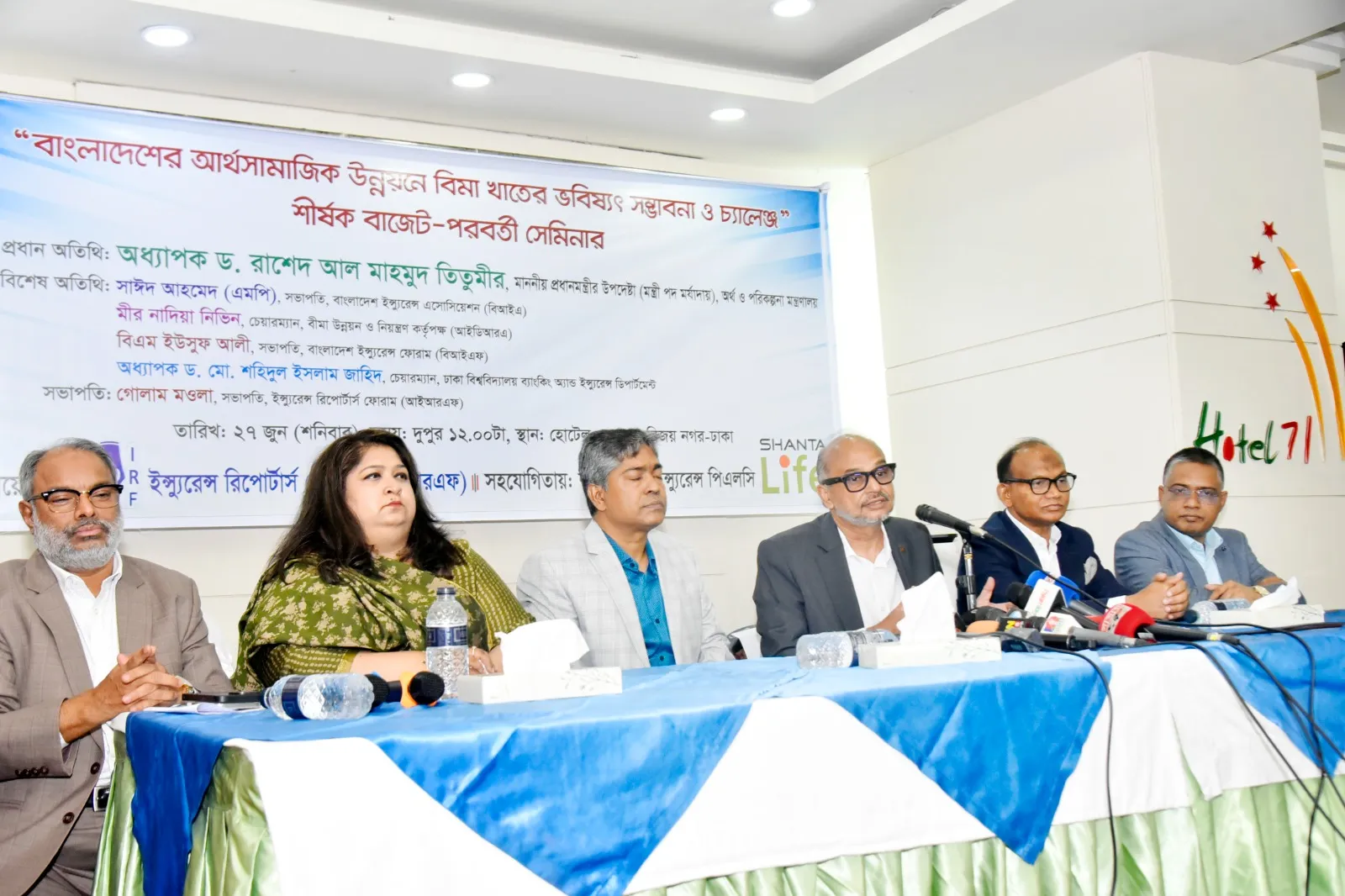
Dr. Rashed Al Mahmud Titumir, Advisor to the Ministry of Finance and Planning, has underscored the urgent need for digital transformation, improved governance, and a robust regulatory framework to revitalize the insurance sector in Bangladesh.
He stated that the sector has been suffering from a deep-seated crisis of public confidence due to regulatory weaknesses, limited technological adoption, and lack of transparency.
"To transform the insurance industry into an effective, sustainable, and trust-based sector, there is no alternative to embracing digitalization and ensuring strict governance," he said while addressing a seminar titled "Post-Budget Insurance Sector: Possibilities and Challenges" at Hotel Ekattor in the capital on Saturday. The event was organized by the Insurance Reporters Forum (IRF).
Dr. Titumir pointed out that the lack of expected digitalization has hindered customer service, claim settlements, and data management. "Technological integration will not only enhance customer satisfaction but also ensure transparency, accountability, and efficiency," he added.
He also highlighted the importance of insurance in climate risk mitigation, noting that Bangladesh is one of the most climate-vulnerable countries in the world. "A strong insurance sector is essential to manage disaster-related losses and ensure economic security," he observed.
Keynote Findings
Monir Hossain, Business Editor of Jugantor, presented the keynote paper, highlighting that while Bangladesh is the 35th largest economy in the world, its insurance sector ranks 60th. He noted that the country lags behind its neighbors in insurance penetration and per capita expenditure.
He identified the core crises as a lack of trust, weak governance, inadequate regulatory capacity, and excessive numbers of insurance companies leading to unhealthy competition.
IDRA’s Stance and Challenges
Mir Nadia Nevin, Chairman of the Insurance Development and Regulatory Authority (IDRA), acknowledged that around BDT 7,000 crore in insurance claims remain unsettled.
"We are taking various initiatives to resolve these issues. Our priority is to restore customer confidence, strengthen regulatory structures, and boost human resource capacity," she said. She also advocated for the expansion of insurance into new areas such as agriculture, climate risk, and micro-insurance.
Industry and Academic Perspectives
Sayeed Ahmed, MP, President of the Bangladesh Insurance Association (BIA), called for keeping the insurance commission free from commercial interests and irregularities, while also urging the mandatory implementation of motor insurance.
BM Yusuf Ali, President of the Bangladesh Insurance Forum (BIF), suggested that the positive aspects of the industry—such as companies settling claims within 24 hours—should be highlighted more to improve the sector's public image.
Prof. Dr. Md. Shahidul Islam Zahid of Dhaka University’s Banking and Insurance Department warned that the sector remains neglected despite its potential. He cited weak regulatory systems, a short-term profit-seeking mentality, and a lack of long-term planning as the primary hurdles.
The seminar was presided over by IRF President Golam Mawla and attended by CEOs of various insurance companies, researchers, and journalists.
The speakers unanimously agreed that without political will, integrated efforts from stakeholders, and strict adherence to good governance, the sector will struggle to meet its potential contribution to the national economy.