


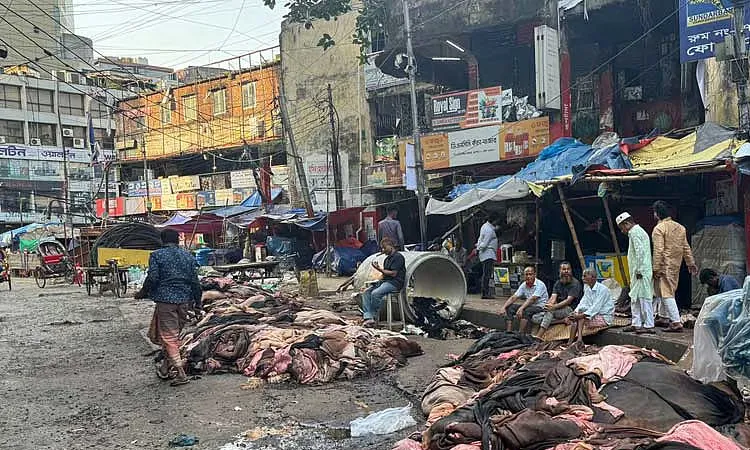
The Bangladesh Tanners Association (BTA) and Department of Livestock Services confirmed that while official salted hide rates were raised by Tk 2 per sq ft for 2026, raw, unsalted hide prices fell to as low as Tk 550 by Eid evening due to high preservation costs and market debt.
By late afternoon on Eid day in Gulshan-2, seasonal hide trader Halim was already counting his losses. Since Thursday morning, he had combed nearby neighbourhoods, buying fresh cattle hides from sacrificial households to resell to middlemen near the Gulshan circle.
At dawn, large hides sold for Tk 900. By 5:00 PM, buyers offered just Tk 700. After grueling rounds of bargaining, Halim gave in.
"There is no price," he said. "They took this hide for Tk 700 now. In the morning, the exact same size fetched Tk 900."
His frustration echoed across the capital. From affluent Gulshan to the historic wholesale alleys of Posta, Bangladesh’s sacrificial hide market slipped into a familiar cycle of collapsing prices, panic sales, and mutual blame—completely overwhelming the government's upwardly revised official rates.
At the Gulshan collection point, Abdul Rashid, representing Islam Traders, dismissed the sellers' complaints.
"People will always say prices are low," Rashid said, noting his hides go directly to Hemayetpur, the country’s central leather-processing hub. "We are paying Tk 35 to Tk 40 per square foot for raw hides. But we have to spend another Tk 300 per hide on salt and labour."
By evening, Rashid had collected 500 hides at an average of Tk 750, with none crossing Tk 1,000. Because his group operates with direct backing from Hemayetpur tanneries, they could offer slightly better rates than independent middlemen.
Further south, at Science Lab and Posta—once the booming heart of the raw hide trade—prices deteriorated rapidly. By dusk, average hides changed hands for a meager Tk 550 to Tk 600.
This year, the government estimated that over 10 million animals were sacrificed across Bangladesh. Official prices for salted cattle hides were fixed at Tk 62–67 per square foot in Dhaka and Tk 57–62 outside the capital—roughly Tk 2 higher than last year. On the ground, however, those numbers existed only on paper.
Around 5:15 PM, Abu Yusuf, a teacher at a Mohakhali Qawmi madrasa, arrived at Gulshan with two hides to test the market.
"We brought only two to check the rates; we have six more at the madrasa," Yusuf explained. His face fell when he received the final offer. "They offered Tk 1,100 for both. We expected to fetch at least Tk 2,000."
Yusuf recalled that around 2016–2017, similar quality hides easily sold for Tk 3,200 each. Hearing this, a nearby middleman interjected sarcastically: "We bought them for Tk 5,000 back then, too."
By 6:00 PM, the crowds at Science Lab grew tense. Mohammad Shihab Uddin, representing two madrasas in Rampura’s Aftabnagar, brought a truckload of 132 hides.

"To say prices are low is an understatement," Shihab said bitterly after liquidating the batch at a flat average of Tk 580 per hide. "Where these should have gone for Tk 1,000 to Tk 1,200, buyers wouldn't budge past Tk 550. After paying our volunteers and transport, absolutely nothing will remain for the orphans."
Nearby, leather exporter Mohammad Nazir was managing a pile of 250 hides.
"I am buying at an average of Tk 50 per square foot without salt," Nazir explained. "Adding salt costs another Tk 10 per foot, pushing my baseline to Tk 60. But we have no guarantee we can recover that cost later."

Nazir noted that many hides lose value during processing due to accidental knife cuts during skinning or viral skin damage—known in the trade as "Corona"—which renders the leather unusable.
"We buy at a flat average because people watch the official rates on television and demand those prices," Nazir's son added quietly. "But by evening, the real market rate drops to Tk 550."
As night fell over Old Dhaka, a steady stream of pickup trucks and vans kept arriving at Posta. While the area looked busy, wholesalers insisted the historic trade hub is a shadow of its former self.

For years, primary wholesalers have accused large tannery owners of delaying seasonal payments, trapping small traders in a cycle of bad debt.
"We aren't even thinking about profit anymore; this is purely about survival," said Aziz of Shahadat and Co. "Right now, we are just buying blindly. What price the tanneries will give us a week from now, only God knows."
Azis, aiming to collect 5,000 hides, dismissed fears that afternoon rains would ruin the stock. "As long as we apply salt tonight, the hides will survive."
Mohammad Shamim, a leader of the Faria Traders Association, blamed both systemic government policy and tannery defaults for the annual crisis.
"We run this entire business on borrowed money," Shamim disclosed. "Traders borrow Tk 2 to 5 lakh just to enter this seasonal market because our capital is permanently tied up with tanneries that refuse to clear past arrears."
"The government directs salt subsidies to institutions like madrasas. But madrasas don't preserve hides—they sell them immediately to clear space. If the salt subsidies came directly to the processing traders, we could easily afford to pay regular citizens Tk 200 more per hide."
Mohammad Shamim, Faria Traders Association alleged that the government's high official pricing is meant purely to maintain appearances internationally. "The government fixes high rates to protect our image in foreign markets. If we publicly admit how low local prices actually are, international buyers will drive Bangladesh's leather export prices even lower."
The price crash comes during an apparent export recovery. Bangladesh's leather sector saw export earnings rise nearly 6% during the first ten months of the fiscal year, with April alone recording a 35% growth spurt.
However, primary traders say none of that wealth trickles down to the streets on Eid day.
Shahin Ahmed, Chairman of the Bangladesh Tanners Association (BTA), pointed to broader economic headwinds to explain the stagnation. "High local inflation, weak domestic investment, and global instability driven by ongoing wars have deeply affected the domestic leather trade," Ahmed said.
He also noted that shifting socioeconomic factors impacted overall numbers this year. "Many cattle remained unsold at the city haats, causing severe losses to cattle farmers. Additionally, shifts in political dynamics meant certain affluent demographics did not participate heavily in sacrifices this year, reducing the total volume of premium hides entering the market."
By midnight, the sounds of Eid sacrifices had completely faded across Dhaka—but for the city's seasonal hide traders, a long week of financial damage was just beginning.
This report compiles on-the-ground field journalism conducted on Eid day across key Dhaka trade hubs including Gulshan-2, Science Lab, and Posta (Old Dhaka). Direct quotes and market figures were gathered from seasonal sellers, Qawmi madrasa representatives, independent wholesalers and verified directly via statements from the Bangladesh Tanners Association (BTA).

