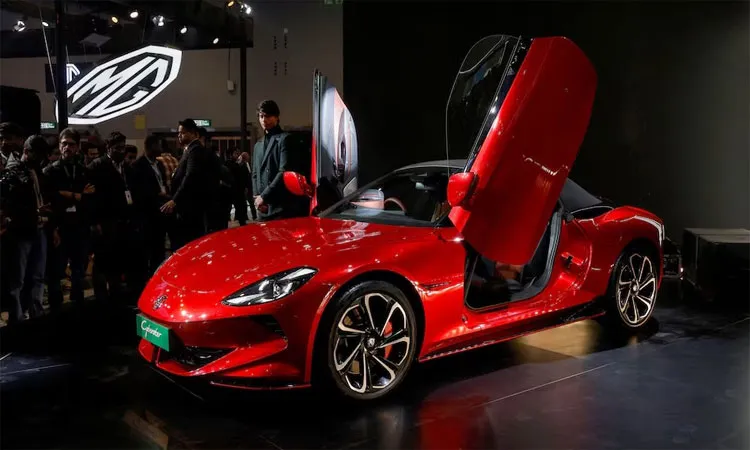
JSW MG Motor, a joint venture between China’s SAIC Motor and India’s JSW Group, plans to invest up to $440 million to expand its factory in India and launch new vehicles focused on hybrid and electric technology, its managing director said.
The carmaker has struggled to scale up in India since New Delhi tightened curbs on Chinese investment in 2020. To raise funds, SAIC sold a minority stake in its Indian unit to JSW in 2024. Sales have since increased, but the company remains loss-making.
Managing Director Anurag Mehrotra said the company would invest between 30 billion and 40 billion rupees ($330 million to $440 million) over the next few years. The plan includes launching three to four new models this year and expanding annual production capacity to 300,000 units from about 120,000.
Funding will come from multiple sources. “At least for this year, internal accruals are sufficient,” Mehrotra said, adding that debt and equity options remain under consideration.
India, the world’s third-largest car market, is emerging as a manufacturing hub as Japanese automakers such as Toyota and Suzuki commit billions of dollars, while European brands like Renault revive their presence. Chinese automakers, however, face restrictions that have limited growth.
SAIC and BYD currently sell vehicles in India, but expansion has been modest. Last year, SAIC explored reducing its 49% stake in the venture. JSW, which holds 35%, offered to buy most of that stake, but talks stalled over valuation.
Mehrotra said political ties between New Delhi and Beijing appear to be easing. “Whether it is visas or flights, there is more receptivity than earlier. It is better than a couple of years ago, though risks remain,” he said.
Carmaker bets on new energy vehicles JSW MG Motor’s losses doubled to $121 million in the financial year ended March 31, 2025, according to regulatory filings. At that time, it held about $60 million in cash and had borrowings of $344 million.
Sales continue to rise. The company sold 70,500 vehicles in 2025, up from 61,000 in 2024, driven mainly by its Windsor electric model.
Mehrotra said the focus is now on balancing growth with profitability. The company aims to build an advantage through its range of hybrid and electric vehicles, which it classifies as new energy vehicles (NEVs).
“NEVs will account for at least 75% of our total volumes,” he said, adding that such vehicles could make up 30% of India’s annual car sales—estimated at up to 6 million units—by 2030, compared with about 5% today.
The company also plans to cut costs by sourcing more components locally. “Deeper localisation will be one of our biggest levers for profitability. It reduces foreign exchange risk and dependence on sea freight,” Mehrotra said.