


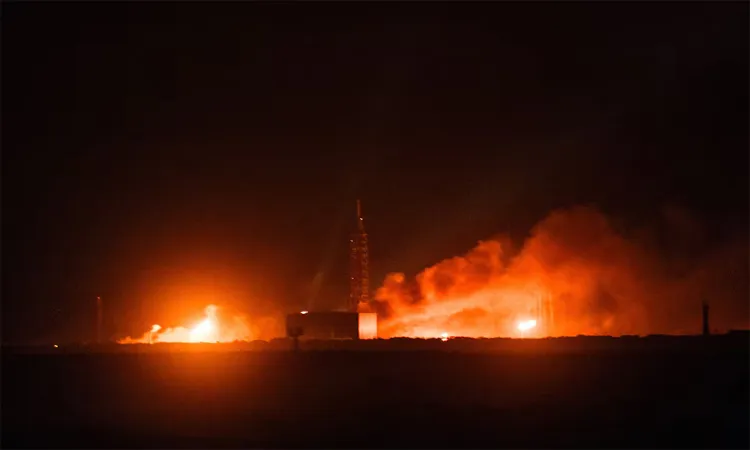
An uncrewed New Glenn rocket belonging to Jeff Bezos’ space venture, Blue Origin, exploded on a Florida launchpad during a ground test on Thursday. The incident deals a significant blow to the company’s efforts to challenge Elon Musk’s dominant SpaceX.
Video footage captured by independent space flight trackers showed the 29-story heavy-lift rocket igniting at Cape Canaveral at approximately 9:00 PM Eastern Time (1:00 AM GMT Friday) before rapidly exploding into a massive fireball.
The vehicle was being prepared for its fourth developmental launch, which was scheduled to deploy 48 of Amazon’s low-Earth orbit broadband satellites—part of a project designed to compete directly with SpaceX's Starlink network. An industry source confirmed that the satellites had not yet been integrated onto the rocket at the time of the explosion.
Blue Origin confirmed the platform loss, stating that engineers experienced a major "anomaly" during a hot-fire test—a routine procedure where rocket engines are ignited at full thrust while the vehicle remains anchored to the launchpad structure.
"Very rough day, but we'll rebuild whatever needs rebuilding and get back to flying. It’s worth it," Blue Origin founder Jeff Bezos posted on social media platform X, adding that it was too early to determine the root cause of the failure.
The Federal Aviation Administration (FAA) stated it was aware of the pad explosion but noted that because the incident occurred during a static ground test rather than an active flight, it fell outside its formal flight accident scope and did not disrupt local commercial air traffic.
The failure marks a critical timeline challenge for Blue Origin’s flagship heavy-lift vehicle, which has faced years of engineering delays. New Glenn is contracted to play a central role in delivering cargo, infrastructure, and lunar landers for NASA’s Artemis lunar exploration program.
The explosion occurred just two days after NASA awarded Blue Origin a new $188 million contract to land automated rovers on the moon, highlighting the agency’s reliance on the company to provide a competitive alternative to SpaceX.
NASA leadership stated the agency would work closely with Blue Origin to investigate the root failure mechanism. Officials noted that engineering heavy-lift infrastructure is extraordinarily difficult and that the agency will evaluate potential ripple effects on its broader Moon Base timelines.
The accident underscores the fierce rivalry between Bezos and Musk as both companies race to build the hardware necessary to land humans on the moon before China’s targeted 2030 crewed lunar mission.
While SpaceX remains years ahead in active launch iterations, it has suffered its own share of high-profile spectacular failures during its iterative development cycle. SpaceX’s massive Starship vehicle exploded during a similar ground-testing phase in Texas last year.
Elon Musk responded to the footage of the Blue Origin explosion on X, writing: “Most unfortunate. Rockets are hard.”

