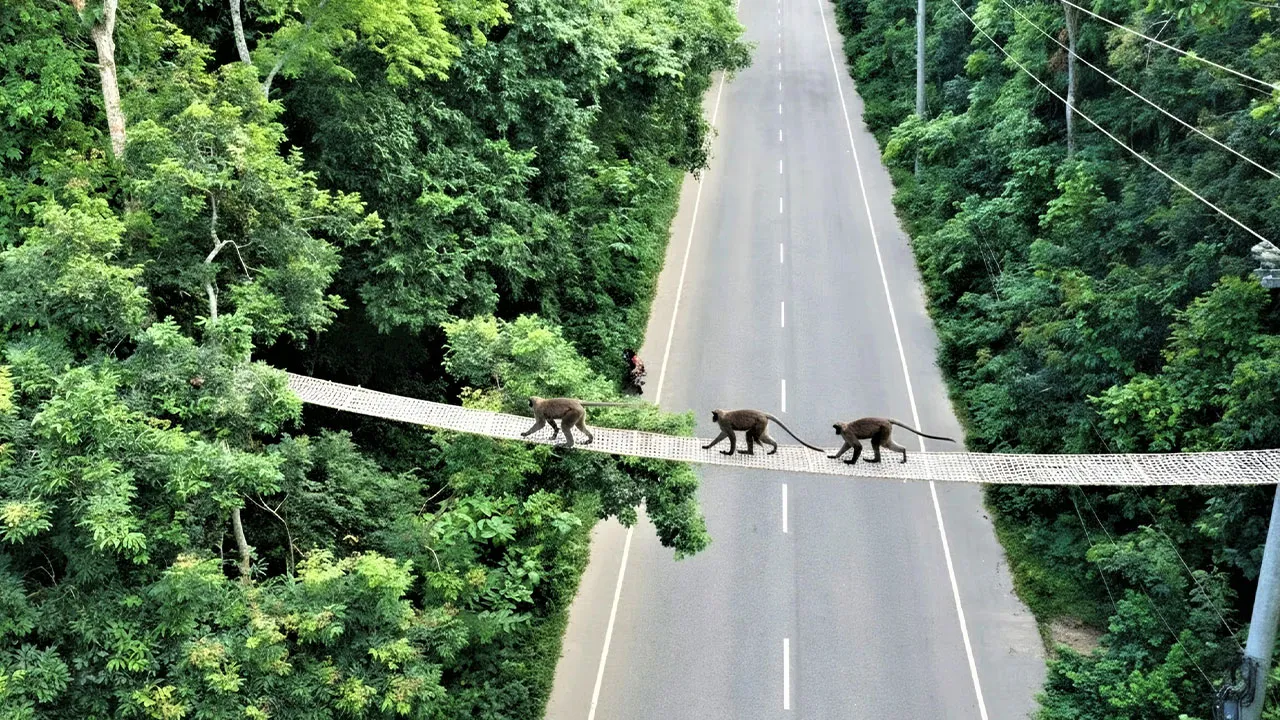
The Forest Department has constructed five ropeway corridors across the Tangail-Mymensingh regional highway to ensure safe passage for wildlife in the Madhupur Garchanal area. This initiative aims to prevent wild animals from being killed by speeding vehicles.
According to Tangail Forest Department sources, the ropeways connect tall trees on both sides of the highway within the Madhupur National Park Sadar Range. Tree-dwelling animals—including monkeys, langurs, and squirrels—can now cross the highway safely without descending to the ground.
Madhupur National Park hosts around 190 wildlife species, including 21 mammals, 140 birds, and 29 reptiles. Notably, the endangered Bengal slow loris (locally known as Lajjoboti Banor), a nocturnal and shy primate, was recently spotted here. The highway had previously fragmented their habitat, forcing animals to cross the road for food and mating, often resulting in fatal accidents.
"This infrastructure will significantly reduce wildlife road kills and help preserve biodiversity," said Professor Dr. ASM Saifullah, Chairman of the Environmental Science Department at Maulana Bhashani University of Science and Technology.
Md. Mosharraf Hossain, Deputy Ranger of the Sadar Range, noted that the experimental project was built between the 25-Mile area and Rasulpur Bazar with local community participation.
Tangail Divisional Forest Officer Dr. Abu Naser Mohsin Hossain stated that the initiative is part of the Madhupur Shalban Establishment Project. Launched in April 2025 and set for full implementation by March 2028, the project's expansion to other risky zones depends on the success of these initial five corridors.