- National
- Bangladesh
- Business
- International
- Sports
- Entertainment
- Politics
- Technology
- Life Style
- Religion
- Opinion
- FIFA World Cup 2026
Thursday, 25 June 2026

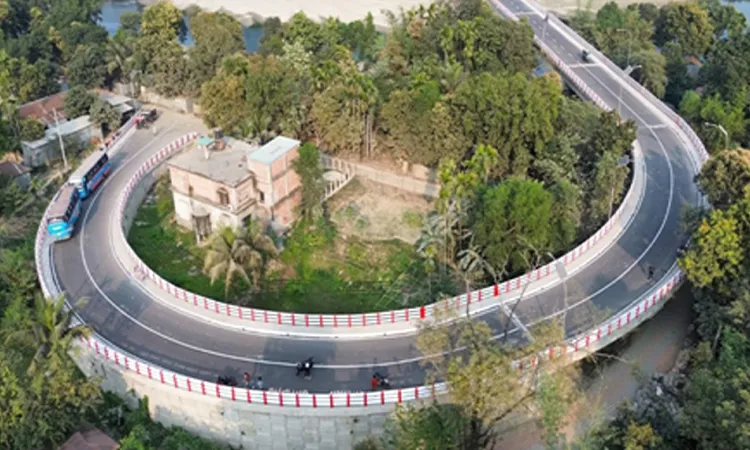
The Local Government Engineering Department (LGED) is driving a rural revolution in Tangail. Extensive infrastructure projects—including paved roads, new bridges, modernized schools, and upgraded water management systems—are rapidly transforming the district's local economy and improving daily life for marginalized communities.
As of May 2026, Tangail district boasts a road network of 9,826.7 kilometers. To boost the rural economy, LGED has already paved 2,946.5 kilometers with bituminous carpeting. The department is now executing a mega-plan to systematically pave the remaining 6,881.2 kilometers of dirt roads.
This vast network includes upazila (814.5 km), union (1,075.4 km), and rural roads (7,936.8 km). Currently, 286.7 kilometers are under regular maintenance to ensure uninterrupted transport. To bridge connectivity gaps, LGED has also constructed approximately 2,500 meters of bridges and culverts. In the current fiscal year, development is accelerating on an additional 205 kilometers of local roads.
Beyond roads, LGED has built 16 modern rural markets and river ghats (steps). These facilities allow farmers in remote areas to bring their agricultural products directly to consumers.
To ensure equal educational opportunities, the department’s Primary Education Infrastructure Management Unit has constructed several visually appealing, modern government primary schools. These upgraded facilities are significantly improving the learning environment for local children.
Furthermore, LGED is actively supporting agricultural and fisheries production through better water management. The department recently excavated 12 kilometers of canals and five government ponds. Two major irrigation projects, including a crucial sluice gate, are complete, with another progressing rapidly.
Local residents are already reaping the benefits of these initiatives. In Tangail city, citizens and professionals report that the previously impassable road between the DC Office and LGED intersection (Bailla) has been successfully rebuilt, ending years of public suffering caused by jurisdictional disputes.
In Dhanbari upazila, farmers and business owners note that a new bridge on the Mushuddi-Jhopna road saves them a 3-to-4-kilometer detour, dramatically easing the transport of poultry, feed, and daily necessities. Similarly, in Basail upazila, a new bridge over the Jhenai River has smoothed daily commutes for students and workers while boosting local trade and access to the Dapnajor area.
"This sustainable infrastructure development is directly improving the quality of life for marginalized communities," said Mohammad Kamruzzaman, Executive Engineer of LGED, Tangail. "Once ongoing projects are complete, the district's economic growth will accelerate further. Farmers and producers can now quickly and cheaply transport their goods to Dhaka and other districts, ensuring they get a fair price."