More than 1,500 marginalized litigants in Pabna have received free government legal assistance over the past 18 months resulting in the recovery of nearly Tk 75 lakh for vulnerable individuals.
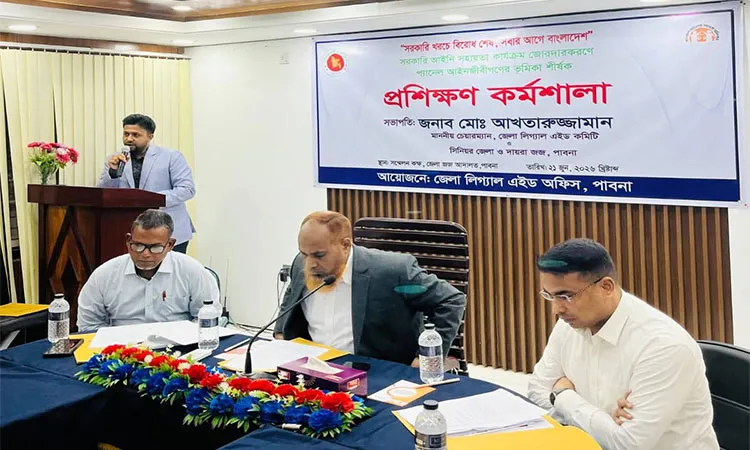
The figures were revealed on Wednesday during a special training workshop for panel lawyers organized by the Pabna District Legal Aid Committee to strengthen government-funded legal initiatives.
Presenting the progress report, District Legal Aid Officer and Senior Civil Judge Md. Azharul Islam stated that between January 1, 2025, and June 21, 2026 the office provided direct legal services to 1,587 people including women and children.

During this period, the office received 858 applications for Alternative Dispute Resolution (ADR) and successfully resolved a record 770 of them without the need for prolonged trials. Additionally, panel lawyers were appointed in 550 formal cases, and 238 individuals received free legal counsel. Through these combined efforts, Tk 7,464,660 was recovered for the beneficiaries.
Speaking as the chief guest, Senior District and Sessions Judge Md. Akhtaruzzaman reminded lawyers of their constitutional duties.
"In light of Articles 27 and 33 of the Constitution, the National Legal Aid Services Organization is working tirelessly to ensure justice for the poor," he said. "'Ending disputes at government expense' is not just a slogan; it is our commitment. This initiative can only succeed through the strong representation of our panel lawyers."
Md. Noor Alam, Senior District and Sessions Judge of the Women and Children Repression Prevention Tribunal, urged panel lawyers to treat victims with deep compassion. He also stressed the need to reform the Dispute Resolution (Municipal Areas) Board Act, 2000 to better serve justice seekers.
Addressing the rights of the incarcerated, Chief Judicial Magistrate Md. Jahangir Hossain directed the magistrate courts to take urgent steps to protect detained defendants ensuring they receive legal advice through regular jail visits.
The workshop also outlined strategic priorities for the remainder of 2026. Key initiatives include prioritizing compulsory ADR to reduce case backlogs, implementing rapid legal interventions for vulnerable women and children and introducing a 'Digital Tracking and Online Reporting' system to modernize operations.
Panel lawyers were instructed to follow a strict four-step workflow moving forward prompt case acceptance, pushing for speedy hearings, attempting ADR and submitting mandatory monthly progress reports.