


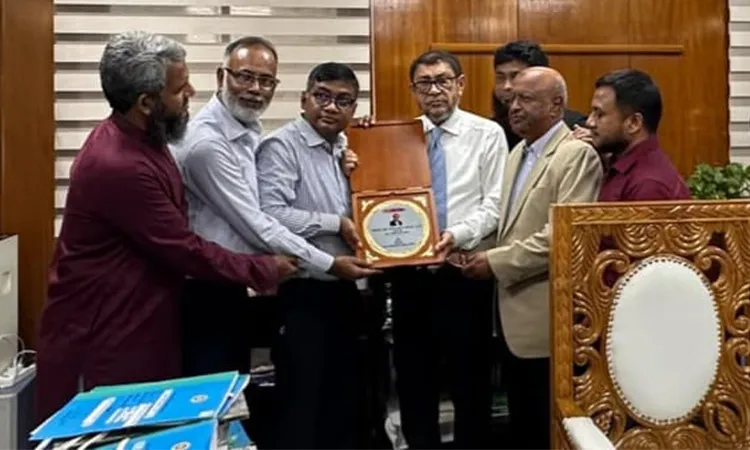
Leaders of the Bangladesh Physiotherapy Association (BPA) met Health and Family Welfare Minister Sarkar Sakhawat Hossain Bakul to discuss the development of physiotherapy professionals and the expansion of rehabilitation services across Bangladesh.
The meeting was attended by BPA Central President Prof. Dr. Anwar Hossain, General Secretary Dr. Shahadat Hossain, BPA Chittagong Division President Dr. Mohammad Kamruzzaman, Gonoshasthaya Physiotherapy College of Health Sciences Principal Dr. Mohiuddin Mamun, Bangladesh Physical Therapy Association General Secretary Dr. Mohammad Mizanur Rahman, and senior physiotherapy educator Prof. Dr. Altaf Hossain Sarkar.
During the meeting, BPA leaders highlighted the importance of physiotherapy and rehabilitation services in treating arthritis, paralysis, post-stroke complications, and other physical disabilities. They emphasized the need to expand physiotherapy services to the upazila level to improve access to care for people in rural areas.
The Health Minister said the government would take steps to appoint one male and one female physiotherapist at every upazila health complex to strengthen rehabilitation services for the public.
At the end of the meeting, BPA presented a commemorative crest to the minister.
The association also noted recent developments in the profession, including the establishment of a physiotherapy unit at the University of Chittagong and ongoing implementation of the Bangladesh Rehabilitation Council Act, 2018.
Under the Bangladesh Rehabilitation Council Act, 2018, physiotherapists are recognized as licensed rehabilitation practitioners. The law specifies that a Bachelor of Science in Physiotherapy is the required qualification for professional registration and licensing.
According to the Bangladesh Rehabilitation Professional Registration and Practitioner License Regulations, 2026, physiotherapy is defined as a science-based healthcare discipline that assesses, diagnoses, plans treatment, provides therapy, and supports rehabilitation for individuals with disabilities, injuries, paralysis, arthritis, and other conditions affecting physical function and quality of life.
The regulations also authorize licensed rehabilitation practitioners to conduct patient assessments, prepare treatment plans, provide therapy, issue professional documents within their scope of practice, and use professional titles consistent with recognized national and international standards.

