
- National
- Bangladesh
- Business
- International
- Sports
- Entertainment
- Politics
- Technology
- Life Style
- Religion
- Opinion
- FIFA World Cup 2026
Thursday, 11 June 2026

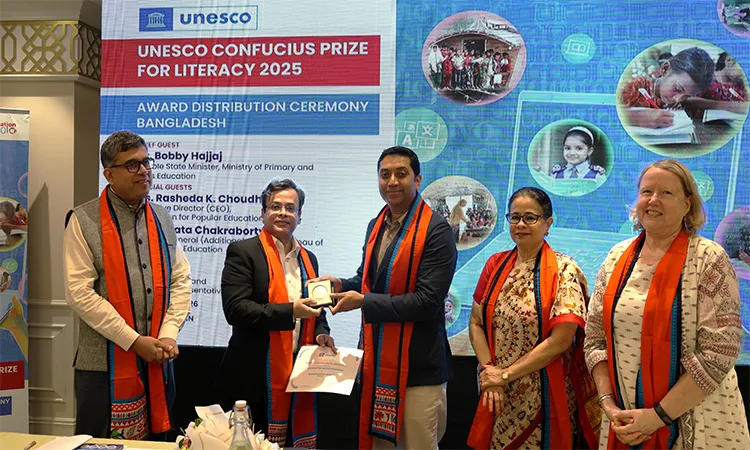
Bangladesh's pioneering 'Sidhulai Self-Help Organization' has officially received the prestigious UNESCO Confucius Literacy Prize for its innovative solar-powered floating school initiative.
The award ceremony was hosted by UNESCO Dhaka on Wednesday afternoon at the Holiday Inn Dhaka City Centre. State Minister for Primary and Mass Education, Bobby Hajjaj, attended as the chief guest alongside special guests Debabrata Chakraborty, Director General of the Bureau of Non-Formal Education, and Rasheda K. Chowdhury, Executive Director of CAMPE.
Presided over by Dr. Susan Vaiz, UNESCO Representative to Bangladesh, the ceremony highlighted this year's theme: 'Spreading Literacy in the Digital Age'. Sidhulai won the award alongside the National Adult Literacy Agency of Ireland and Morocco’s Ministry of Education for successfully extending literacy to remote, climate-vulnerable rural communities.

Sidhulai's floating school project operates in the Chalanbil wetland region, where annual monsoon flooding completely cuts off rural children from traditional land-based schools. Built using local craftsmanship, each boat is equipped with solar panels to power a modern classroom.
The organization currently operates a fleet of 56 customized boats: 26 serve as floating primary schools, 10 function as mobile libraries and computer labs, eight act as vocational training centers, and the remaining vessels provide emergency healthcare, sports facilities, and safe community transport.
"Sustainable solutions must be built on the indigenous knowledge, experience, and participation of the local community," said Architect Mohammad Rezwan, the founder and Executive Director of Sidhulai. "This global award recognizes the resilience of our remote communities."
Established in 1967 and supported by the Chinese government, the UNESCO Confucius Literacy Prize carries a cash reward of USD 30,000. Sidhulai is the third Bangladeshi organization to receive this honor, following Dhaka Ahsania Mission in 2013 and Friendship in 2023.
