
- National
- Bangladesh
- Business
- International
- Sports
- Entertainment
- Politics
- Technology
- Life Style
- Religion
- Opinion
Sunday, 17 May 2026

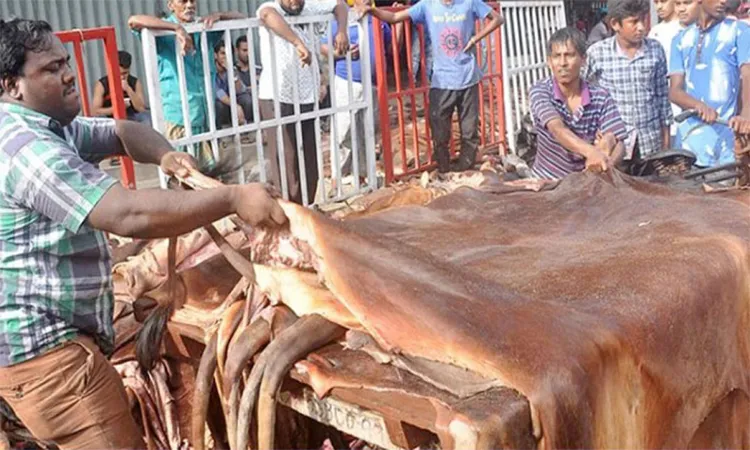
Muslim Uddin joined the leather business in 1988, following the footsteps of his father and elder brother. For years, he has led the Chittagong Raw Leather Traders' Association, witnessing a historic industry crumble.
"Most traders here inherited their businesses from their ancestors, dating back to the Pakistan period," Muslim Uddin said. "Even after Bangladesh's independence, Chittagong boasted 22 active tanneries. Today, the local industry is in a deep crisis driven by financial distress, environmental challenges, and the flawed policies of the previous government."
The decline has left a trail of financial devastation. Samshul Alam, a trader from Boalkhali who also inherited his business, is on the brink of ruin. He has massive unpaid dues stuck with tannery owners in Dhaka. Burdened by loans, he was forced to sell his land and personal assets just to keep his ancestral business afloat. Alam estimates that at least 200 local traders have gone bankrupt under similar circumstances.
According to the Leather Traders Association, as Chittagong's tanneries closed down one by one, the regional market became entirely dependent on Dhaka. Traders allege that Dhaka-based tannery owners now hold a monopoly, dictating terms and leaving Chittagong traders vulnerable.
In a recent press conference, association leaders claimed local traders are being held hostage. They alleged that during Eid-ul-Adha, a Dhaka-based syndicate bypasses government-fixed rates to buy raw hides at arbitrarily low prices.
Samrat Muhammad Shahjahan, vice-president of the Chittagong Raw Leather Wholesalers Association (Aarotdar Samity), revealed that around ৳200 million in arrears from the 2016–2020 period remain unpaid by Dhaka tanners.
"Tanneries and wholesalers are interdependent; one cannot survive without the other," Shahjahan said, urging the Ministry of Commerce to form a dedicated monitoring cell featuring representation from local traders.
Chittagong remains one of Bangladesh's largest hubs for raw hides, collecting between 350,000 to 400,000 pieces of leather during Eid-ul-Adha annually. However, the industry suffered a catastrophic blow during the pandemic era. In 2019 and 2020, unable to sell the hides of sacrificial animals due to market stagnation, traders dumped them on the streets. The Chittagong City Corporation alone had to collect and discard over 150,000 ruined skins in a single year. The market has struggled to recover since.
Despite being Bangladesh’s second-largest export sector, the leather industry faces severe hurdles on the global stage due to environmental non-compliance.
Traders point out that the country has fallen behind due to operational defects at the Central Effluent Treatment Plant (CETP) in the Savar Tannery Estate, Dhaka. The lack of certification from the international Leather Working Group (LWG) prevents major European and American footwear and fashion brands from sourcing leather from Bangladesh.
Madina Tannery, once Chittagong’s largest and most famous processing plant, has long been closed due to environmental complications.
Its owner, Haji Abu Mohammad, previously lamented the situation: "We used to export leather to the US, Spain, Italy, Japan, and Korea. Ill-planned government enforcement in the name of pollution control pushed the local industry to the brink of destruction. If the errors of the past administration are identified and solved, the lost heritage of this sector can still be restored."
Today, only Reef Leather Tannery survives in Chittagong. Established in 1991 in the Kalurghat Industrial Area as an associate of TK Group, it remains viable by maintaining strict international standards. It successfully exports processed leather and footwear globally.
"European companies strictly reject leather products without an LWG certificate," explained Mokhlesur Rahman, Director of Reef Leather. "Because we hold this certification, top global brands buy from us at competitive prices. Those without it are forced to sell at a loss."
Greater Chittagong Raw Leather Traders-Wholesalers Cooperative Association President, Md. Muslim Uddin, emphasized that the government must intervene. "Immediate initiatives must be taken to revive Chittagong’s closed tanneries," he warned. "Otherwise, this historic regional industry will face total extinction."
