"Jinnah’s father used to sell fish. He was a Hindu—I am not disrespecting him.” Kishoreganj-4 MP and freedom fighter Advocate Fazlur Rahman made the remarks while discussing Muhammad Ali Jinnah’s family background and the political history surrounding the establishment of Pakistan.
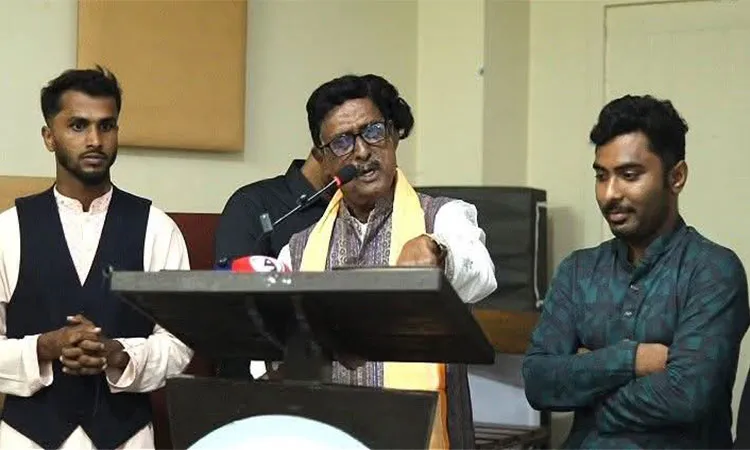
He made the remarks on Thursday (September 17) while speaking as the chief guest at a fresher reception and cultural programme organised by the Kishoreganj District Students’ Forum at Jatiya Kabi Kazi Nazrul Islam University.
Speaking about Muhammad Ali Jinnah, Fazlur Rahman said, “I do not hate Pakistan. Now a debate has emerged—did Jinnah create our country? No! I do not consider Muhammad Ali Jinnah insignificant.”
Referring to the beginning of Jinnah’s political career, he said, “Muhammad Ali Jinnah was born in 1876. In 1909, he became a member of parliament from Bombay.”
Speaking about Jinnah’s family background, Fazlur Rahman said, “His home was in Bombay. He was from a Khoja family in Gujarat, who used to sell fish... Jinnah’s father used to sell fish. He was a Hindu—I am not disrespecting anyone.”
However, historical sources describe Jinnah’s father, Jinnahbhai Poonja, as a businessman. Official Pakistani sources also describe his family as a Muslim business family from Paneli village in Gujarat.
Referring to changes in Jinnah’s political position, Fazlur Rahman said that "he had been associated with the Congress and later joined the Muslim League and led the movement for the creation of Pakistan." “He presented the 14 Points, made Hindus and Muslims two nations, and created Pakistan,” he said.
Historically, Jinnah joined the Muslim League in 1913. He also played an important role in the 1916 Lucknow Pact between the Congress and the Muslim League. His 14 Points, announced in 1929, included various constitutional demands, including Muslim political representation, separate electorates and provincial autonomy.
Speaking about the role of Bengali leaders in the creation of Pakistan, Fazlur Rahman said, “We all created Pakistan together, we do not deny that. But after creating it, when we saw that Pakistan was not good, we started the fight against it in 1952.”
Tracing the political developments from the Language Movement to the Liberation War, he said, “We do not want to build a country based on a religious national identity, we want to build a country based on an ethnic and linguistic national identity.”
He said, “In 1952. And following that came the 1954 election and Ayub Khan’s rule in 1958.” He added that the movement for independence subsequently advanced through the Six-Point movement and the Eleven-Point movements and the 1970 election.
Referring to the 1970 election, Fazlur Rahman said, “Sheikh Mujibur Rahman had the majority in all of Pakistan.” He said the war began after Yahya Khan refused to transfer power, and Bangladesh became independent through the Liberation War.
Recalling his participation in the Liberation War, he said, “I was 23 years old then. I went to war. I did not just go to war, I organised the war.”
Highlighting the importance of the ideals of the Liberation War, he said, “This is not the arms that fights, but the man behind the arms, and ideology behind the man that fights.”
He also recalled the selection of the national flag and the song “Amar Sonar Bangla”. Criticising attempts to question the Liberation War, he said, “The Liberation War is the truth. When someone says, ‘The Liberation War did not happen’—it hurts me here” pointing to his chest.
Addressing the younger generation, he said, “Follow the path of truth. Speak the truth. To illuminate the darkness, hold at least a candle in your hand.”
Jatiya Kabi Kazi Nazrul Islam University Vice-Chancellor Prof Dr Mohammad Mosharraf Hossain was the chief discussant at the programme. Kishoreganj District Council administrator Khaled Saifullah Sohel Khan was the inaugural speaker.
University Treasurer Prof Dr Mohammad Imdadul Huda, Acting Registrar Khandaker Nazmul Hasan, Supreme Court lawyer Umme Kulsum Begum, Kishoreganj District Public College founder and principal Rafiqul Islam, JKKNIU unit Chhatra Dal convener Habibur Rahman Habib and member secretary Mamun Sarkar were present as special guests.
Associate Professor of Economics Alfarun Nahar Ruma chaired the programme. while Rabindra Srijon Kala University's lecturer Md Nizam Uddin moderated it.
The fresher reception and cultural programme was organised by the Kishoreganj District Students’ Forum at Jatiya Kabi Kazi Nazrul Islam University. Students from Kishoreganj studying at the university, teachers and guests from different levels attended the programme.