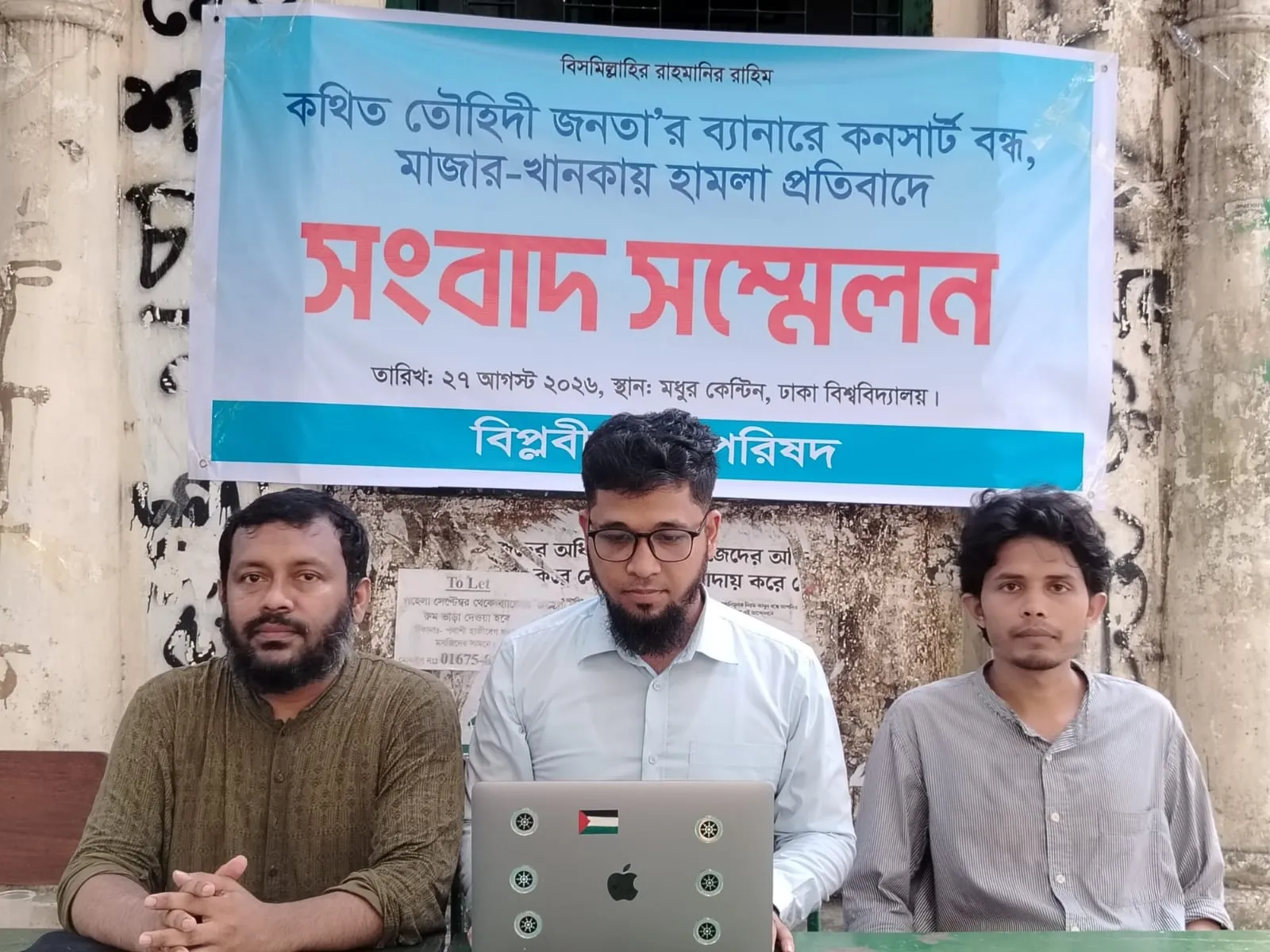
The Biplobi Chhatra Parishad (Revolutionary Students' Council) has demanded immediate legal action against those involved in the widespread attacks on Sufi shrines (mazars and khanqahs), as well as the forced disruption of concerts and traditional cultural events across Bangladesh.
The student organization voiced these demands during a press conference held at Madhur Canteen in Dhaka University on Thursday.
Reading out a written statement, Biplobi Chhatra Parishad Convener Abdul Wahed alleged that since the July 2024 mass uprising, a wave of systematic attacks on shrines and cultural heritage has unfolded under banners such as "Tawhidi Janata" and the "Imam-Ulama Council." He claimed that local leaders and activists from Qawmi-based Islamic groups, Bangladesh Jamaat-e-Islami, and the ruling Bangladesh Nationalist Party (BNP) were directly linked to these incidents.
Citing data from "Maqam: Center for Sufi Heritage," the organization highlighted that 97 shrines were attacked between August 5, 2024, and December 31, 2025. At least six more attacks were documented in the first six months of 2026.
Representatives noted a fresh spike in anti-cultural activity since August, following the emergence of extremist flag displays modeled after Middle Eastern and Afghan militant groups during the FIFA World Cup period in June and July.
Recent Incidents Highlighted The press conference detailed several recent disruptions across the country:
Brahmanbaria (August 18): Students from a local madrasa allegedly attacked and halted a musical event at the police lines.
Kishoreganj (August 19): A scheduled band concert at Kishoreganj Stadium was cancelled by local authorities following an application by the "Imam-Ulama Council."
Savar: Demands were raised to cancel the annual urs at the shrine of Shah Sufi Syed Maulana Kazi Afsar Uddin Al-Jahangiri in Charelalia village, though it eventually took place under strict security.
Boat Races: Calls have been issued by religious groups to halt upcoming traditional boat races (Nouka Baich) on the Titas River in Brahmanbaria (scheduled for September 12) and on the Sonai River in Beani Bazar, Sylhet. Abdul Wahed emphasized that the violence carried out under the guise of "Tawhidi Janata" has nothing to do with genuine Islamic teachings or Tawhid.
He characterized the situation as a society held hostage by extremist elements, pointing out that Islam in Bengal historically spread through the peaceful message of Sufis and saints. The student leaders criticized mainstream Islamic political parties for their silence, calling it a moral and political failure, while also taking the government and law enforcement to task for failing to prevent attacks or prosecute perpetrators.
Five-Point Demand The student body placed a five-point demand to the government and political leadership: Immediate Prosecution: Identify and prosecute all individuals responsible for attacks on shrines, concerts, and boat races.
Zero Tolerance Policy: Issue an explicit government directive declaring zero tolerance for violence in the name of religion, backed by proactive policing. Public Condemnation: Require major Islamic political parties to publicly condemn these violent acts.
State Protection for Heritage: Ensure state security and sponsorship to safeguard folk music, boat races, and Sufi shrine traditions.
Long-Term Counter-Extremism: Drive sustained state and social initiatives to foster religious tolerance and communal harmony over extremism.
Biplobi Chhatra Parishad Central Coordinator Md. Ariful Islam and Jatiya Biplobi Parishad Convener Khomeni Ihsan were also present at the press conference.