


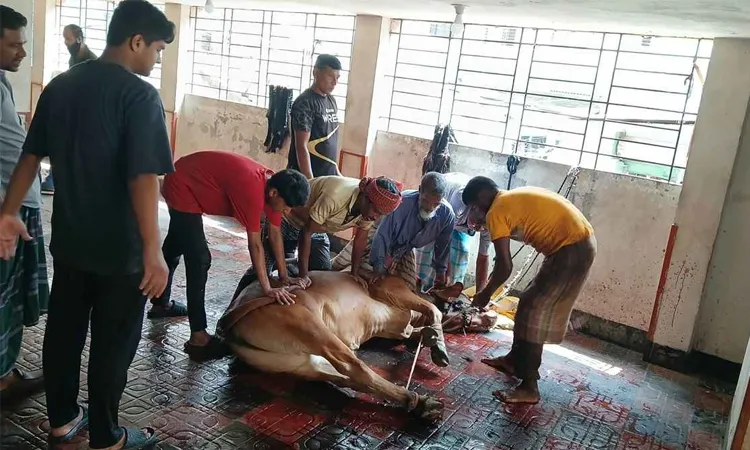
Ritual animal sacrifices continued across various neighborhoods in the capital on Friday, the second day of Eid-ul-Azha, as residents took advantage of religious provisions allowing slaughters for up to three days.
While the volume of sacrifices was significantly lower than on Eid day, substantial activity was visible since Friday morning. Residents in Shahjadpur, Uttara, Dhanmondi, Mirpur, Gulshan, Mouchak, and Badda were seen preparing cows and goats following dawn prayers.
Many of those slaughtering animals on the second day cited space constraints, logistical issues, and the severe shortage of professional butchers on Eid day as their primary reasons for waiting.
"We chose the second day to process the meat with relative ease," said a resident in Mirpur. "On Eid day, the pressure on butchers is immense, leading to long delays and rushed work."
For others, the timing is a deliberate choice. "It has been a long-standing tradition in our family to sacrifice on the second day of Eid," said Rafe Islam, a resident of Shahjadpur.
"Beyond tradition, it makes practical sense. Professional butchers are readily available, which allows us to manage the distribution and processing much more efficiently."
The extended timeline has also extended the peak earning window for seasonal and professional butchers.
"I slaughtered several cows on Eid day, but my schedule is completely packed today as well," said Matin Mia, a butcher working in the Badda area. "We are moving from building to building to keep up with the second-day bookings."
Meanwhile, cleaning crews from the Dhaka North and South City Corporations remained deployed on the streets.
Waste management workers were observed flushing away blood and removing animal refuse rapidly in different zones to keep the city clean and prevent odor build-up amid ambient humidity.

