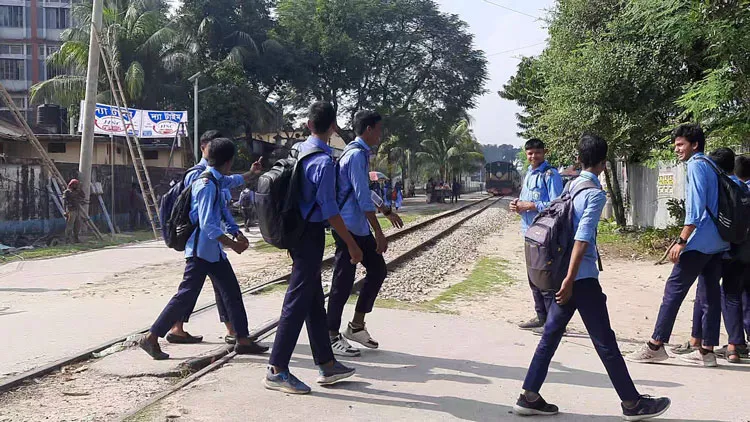
Whenever a train disaster strikes, railway authorities temporarily snap into action. Officials show urgency, probe committees are formed, and investigation reports are submitted complete with various recommendations. Yet, as time passes, these reports are routinely shelved and forgotten until the next tragic accident occurs.
Once again, a flurry of activities begins: a few officials are temporarily suspended, another inquiry committee is set up, and a fresh multi-page report is submitted, while those responsible remain comfortably in their positions. This cycle continues as the railway administration repeatedly fails to implement effective measures, resulting in annual train accidents that destroy state property and cost innocent lives.
According to data from two years ago, Bangladesh’s 2,835-kilometer railway network has 2,541 level crossings. Of these, only 1,413 are authorized by Bangladesh Railway, while 1,128 remain unauthorized. Alarmingly, 2,170 level crossings both authorized and unauthorized lack gates, traffic control personnel, or warning signals. This means nearly 85 percent of these highly vulnerable spots are left completely unprotected. Despite causing numerous fatalities, including at least 12 deaths recorded in recent reports, the railway administration has failed to wake up to the gravity of the situation.
In Lalmonirhat, over the past five years (2021–2026), the majority of level crossing accidents and train tragedies have stemmed from unmanned gates and signal failures. In the Kaliganj Votmari area alone, 10 unprotected railway crossings have turned extremely hazardous due to the absence of gatemen and barrier arms, leading to frequent accidents.
Furthermore, warning notice boards put up by railway authorities have either faded over time or been overgrown by weeds. Local residents have urgently demanded the immediate appointment of gatemen, installation of barrier arms, and restoration of the cautionary signage.
Residents from various areas across Lalmonirhat, including Kaliganj, Hatibandha, Patgram, and Aditmari, have repeatedly submitted written applications to higher authorities requesting gatemen for their local crossings. However, these appeals have fallen on deaf ears.
The consequences of this negligence are devastating. In Uttor Gopal Roy village under Kakina Union in Kaliganj, a 15-year-old boy, Abdul Qayyum, was struck and killed by a running train while trying to save a calf. Near the Sukhandighi level crossing in the same upazila, a 60-year-old man lost his life under the wheels of a train.
In another tragic incident at the unprotected Ghontibazar crossing on the Lalmonirhat-Burimari route, a mother and her 7-year-old daughter were killed after being hit by a train, leaving her 2-year-old child critically injured.
Beyond railway crossings, road safety in the region remains precarious; in June 2023, a head-on collision between a truck and a CNG auto-rickshaw on the Burimari highway in Kaliganj's Kakina area left 2 passengers dead and 5 severely injured.
Experts attribute these recurring accidents to management failures across relevant departments, alongside unauthorized road connections and a lack of public awareness. Railway experts point out three primary causes for train accidents: unsafe level crossings, signaling system flaws, and trains being misrouted onto loop lines or side tracks during maintenance work.
Outside Lalmonirhat district town, numerous busy level crossings sit beside highways, regional roads, markets, and educational institutions, yet only a handful feature gatemen and barriers. At many points, local citizens take it upon themselves to direct traffic when trains approach.
Conscious citizens demand that the railway administration take accountability, secure all level crossings, and launch public awareness campaigns to prevent further loss of life.