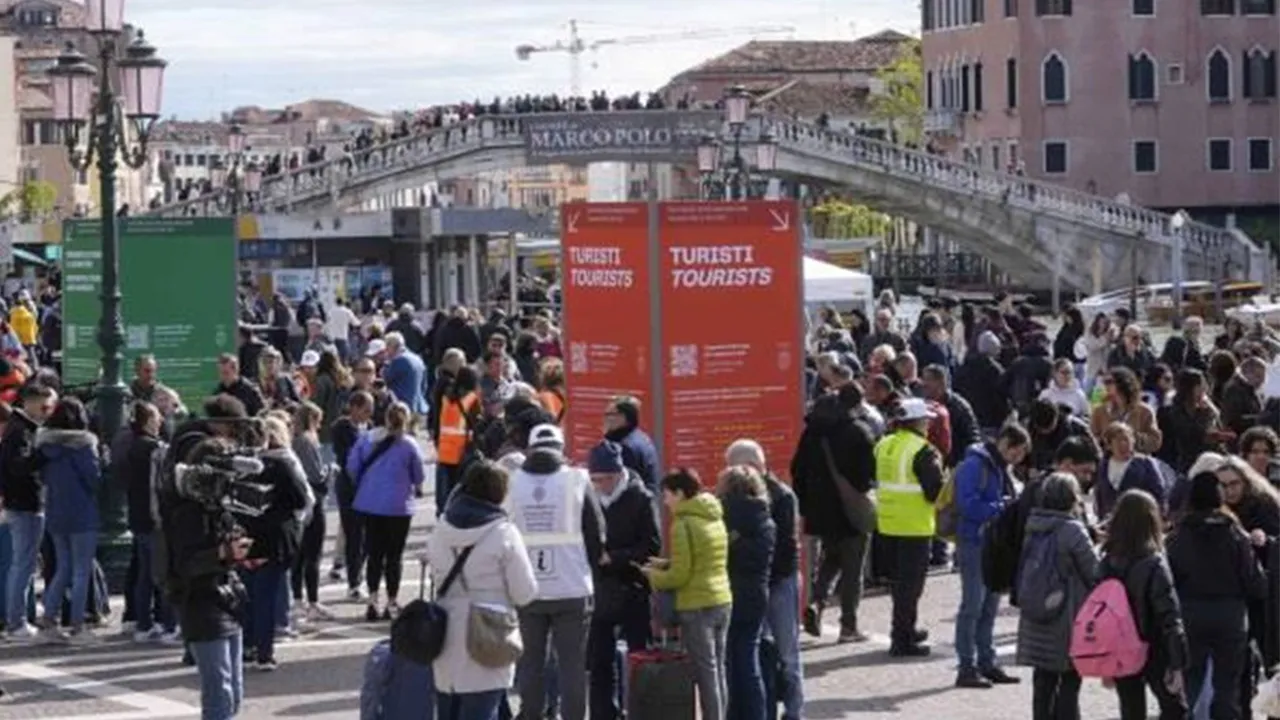
Venice's newly elected mayor, Simone Venturini (who previously served as the city's tourism councillor), has proposed introducing a new entry fee system to manage the influx of tourists and cover maintenance costs. A proposal has been made to introduce a ‘Dynamic Pricing’ system—or variable entry fees—aimed at controlling overcrowding and preserving the city's environment. Last week, mainstream Italian newspapers and television channels gave significant coverage to this news.
What is the 'dynamic pricing' ? The Venice city authorities are planning to set entry fees based on the principle of "higher fees on days with heavier crowds"— • Maximum fee: Under the new proposal, a tourist could be charged up to 55 euros to enter Venice on days with peak tourist traffic (such as special festival days or summer holiday weekends). • Current fee: Currently, the entry fee for Venice is 5 euros for advance bookings and 10 euros for last-minute bookings.
Citing Venice's Councillor for Tourism, Simone Venturini, Italian media report— • €5 fee ineffective: The current fixed entry fee of €5 is having little impact on reducing tourist crowds. Tourists are paying this nominal amount and flocking to the city just as before. • Maintaining the city's capacity: Venice is a historic and fragile city. Its infrastructure is suffering under the strain of overcrowding. Therefore, the primary objective of significantly raising the entry fee is to discourage tourists from visiting on 'peak days'—days characterized by excessive crowds. Italy's leading newspapers and TV channels have described this decision as a "major shift in Venice's tourism policy":
Television media: • Rai News 24: Italy's state television channel highlighted in its report the extent to which local residents of Venice are suffering due to excessive tourism. It stated that if this dynamic pricing system is implemented, visiting Venice will become nearly impossible for ordinary and budget-conscious tourists.
• Sky TG24: This 24-hour news channel hosted a special talk show to discuss whether the fee would actually reduce overcrowding or simply turn Venice into an "amusement park for the wealthy." Print Media – • Il Corriere della Sera: This major Italian national daily reported that the dynamic pricing model would function much like airline or hotel ticketing; as demand rises, so will the price of entry. The paper described it as the "most expensive entry fee" in the history of Venice. • La Repubblica: This newspaper has published the reactions of local business owners and hoteliers. The Venice Hotel Association (AVA) is strongly opposing this decision, fearing that it could severely damage Venice's tourism industry. • Il Gazzettino: This influential local newspaper from the Venice region has reported that city councilors are working to fast-track the legislation, and it could be implemented on a trial basis starting from the upcoming tourist season.
Reactions from local residents and environmentalists – According to Italian media reports, mixed reactions have emerged in Venice regarding this proposal: • Support: Some believe there is no alternative to strict measures to save the city and avoid excessive waste and overcrowding. • Opposition: On the other hand, left-wing political parties and local activists have strongly condemned the proposal. In their view, Venice is neither a museum nor a park that requires an entry fee. They have also staged protests at the city's entry points, displaying banners that read "Venice is not Disneyland."
Statement by Mayor Venturini – In interviews with the international news agency The Associated Press (AP) and the Italian television channel Sky TG24, Mayor Simone Venturini explained two main reasons behind his decision: • The €5–€10 fee has failed: Venturini has openly admitted that the €5–€10 ticketing system, introduced on a trial basis for 2024 and 2025, has completely failed to curb tourist crowds. Tourists are easily paying this nominal amount, and there are no signs of reduced congestion on "peak days" or holidays. Consequently, the fee is being raised significantly in one step to serve as an effective deterrent, discouraging tourists from visiting Venice on days of peak overcrowding.
• Enormous cost of city maintenance: The mayor emphatically states, "We have to spend over 100 million euros annually just to physically or structurally sustain and maintain the city of Venice. Neither the European Union nor the Italian central government contributes a single euro of this amount. International critics do not provide these funds either. This massive expense is borne by Venice's local residents and, in part, by tourism taxes."
• Cleanliness and Waste Management: The mayor further noted that day-trippers—those who visit Venice without staying overnight—generate vast amounts of waste in the city. Since Venice is built on water, modern vehicles cannot operate there; consequently, sanitation workers must collect all refuse on foot using brooms and pushcarts to load it onto boats—a process that is both extremely costly and laborious. This new €50 fee will help cover the burden of these additional expenses.
Who is subject to this fee and who is exempt – . According to the Italian newspaper Il Fatto Quotidiano and The Guardian, this entry fee is primarily mandatory for "day-trippers"—those who visit Venice for just a few hours during the day without booking a hotel. However, there will be exemptions or waivers in certain cases:
• Hotel Guests: Those who have booked a stay of at least one night at a hotel or B&B in Venice's historic center are completely exempt from this fee (as they already pay the tourist tax through their accommodation). However, they must still register on the official website to obtain a free QR code. • Local residents: Permanent residents of Venice and the surrounding Veneto region are exempt from this fee. • Others: Children under the age of 14, individuals working in Venice, students, and relatives or friends of Venice residents are exempt from this fee.
In conclusion, the introduction of 'dynamic pricing' or an entry fee system in a world-renowned tourist city like Venice has ushered in a new era in tourism management. While authorities face the significant challenge of preserving the city's heritage and maintaining environmental balance by alleviating the pressure of excessive tourist numbers, the imposition of additional fees on tourists has elicited mixed reactions. Nevertheless, such a technology-driven and dynamic pricing mechanism could serve as an effective model for ensuring the long-term sustainability of the tourism industry and managing tourist crowds in an orderly manner.
It remains to be seen how successful this measure proves to be in controlling the number of tourists and what kind of changes its impact brings to the local economy.