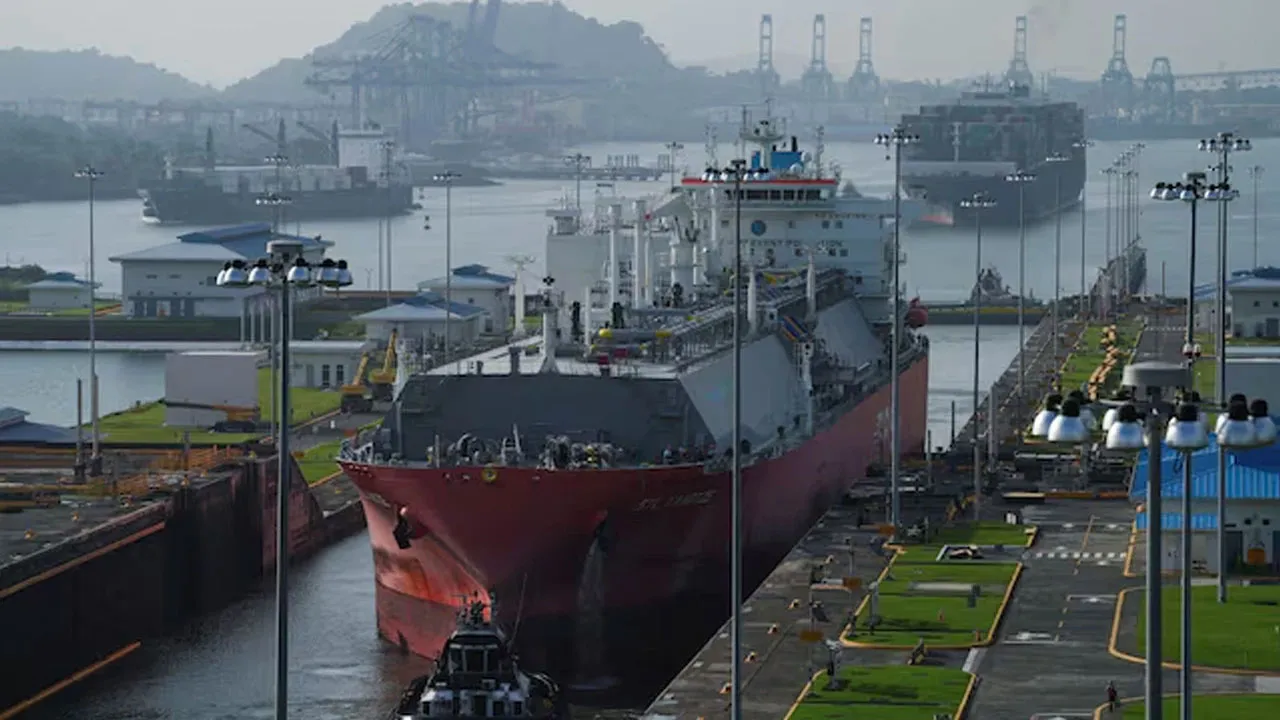
The cost of securing a transit slot through the Panama Canal has recently climbed to more than $5 million for a single vessel, highlighting growing pressure on global shipping routes.
The amount is not the canal’s regular toll. It is an additional premium paid through an auction to secure passage at a specific time. The record-level payment has been driven by rerouted vessels amid conflict in the Middle East, increased demand for canal capacity and restrictions caused by water shortages.
The Panama Canal is about 50 miles long and connects the Atlantic and Pacific oceans. Around 6% of global trade passes through the waterway, meaning disruptions at other major shipping routes can quickly increase pressure on the canal.
Recently, an LPG carrier operated by South Korea’s SK Gas reportedly paid more than $5 million for a Panama Canal transit slot, according to Reuters. The payment was an auction premium to secure passage at a particular time rather than the standard canal toll.
Auction bids had previously reached around $4 million. In April and May, average auction premiums rose to roughly $385,000–$425,000. Some vessels paid more than $1 million, while several transactions exceeded $3 million. Before the Middle East disruptions intensified, auction slots typically attracted bids of around $135,000–$140,000.
Demand rises as capacity falls
Two main factors are putting pressure on the Panama Canal.
First, conflict and disruption in the Middle East have forced vessels carrying oil, LPG and LNG to consider alternative routes. This has increased demand for Panama Canal transits.
Second, water shortages associated with El Niño have reduced the canal’s operating capacity. According to Reuters, average daily traffic through the canal rose to around 44 vessels from March to May, compared with about 37 a day in 2025—an increase of roughly 17%. At the same time, the Panama Canal Authority planned to limit daily transits to 32–34 vessels in September because of water constraints.
The result is a squeeze in which demand is rising while available capacity is being restricted.
LNG carriers add to the pressure
Disruptions to energy supplies from the Middle East to Asia have increased the need to move LNG from the US Gulf Coast to Asian markets.
LNG carriers generally do not reserve Panama Canal slots far in advance in the same way as some scheduled cargo services. When urgent shipments arise, operators may have to compete in auctions for available slots, pushing up the premiums they pay.
After the Russia-Ukraine war began in 2022 and European demand for LNG increased, some LNG vessels using the Panama Canal shifted toward Europe. With disruptions now affecting energy supplies from the Middle East to Asia, more vessels are again looking toward the Panama Canal as an alternative route.
Drought puts pressure on water levels
The Panama Canal’s lock system depends on freshwater. Water stored in reservoirs is used to operate the locks, which raise vessels about 90 feet above sea level before moving them through the canal and then lower them on the other side.
When water levels fall during droughts, large vessels cannot always transit while fully loaded. Operators may have to reduce cargo to lower a ship’s weight and draft. The number of vessels allowed to transit can also be reduced.
The situation becomes more difficult when water levels in Gatun Lake, one of the canal’s key reservoirs, decline. Vessels travel roughly 20 miles through the artificial lake. Lower water levels can restrict the movement of larger ships.
Gatun Lake is also an important source of drinking water for Panama’s population, adding another dimension to the pressure on available freshwater.
The canal continues to face water-related risks. Its administrator has said additional restrictions could be necessary if rainfall remains insufficient to replenish reservoir levels, while a longer-term water infrastructure project is expected to address the problem.
Container shipping could face greater pressure
So far, much of the additional demand has come from energy carriers. But container shipping could add another layer of pressure.
August through October is traditionally a busy period for container transport in the Northern Hemisphere, as retailers build inventories ahead of Black Friday and Christmas.
Fully loaded container arrivals at the Port of Long Beach in California are typically around 15% higher from August to October than during an average month. With Panama Canal capacity limited, fuel and container vessels could increasingly compete for the same transit capacity.
Reuters reported that the cost of shipping a 40-foot-equivalent container from the Far East to the US West Coast has risen to around $7,848, nearly four times the level of a year earlier. Shipping to the US Gulf and East coasts costs closer to $10,000 per container.
How much could Bangladesh be affected?
The increase in Panama Canal auction premiums may have a relatively limited direct impact on Bangladesh’s trade because the country’s main export market is Europe and there are multiple maritime routes for shipments to the United States.
However, if global shipping costs remain elevated for an extended period, the effects could reach Bangladesh indirectly through higher import costs and increased prices for various goods.
Bangladesh is already facing higher energy and shipping-related costs amid disruptions to global trade routes. Reuters recently reported that the country raised fuel prices in September as global oil prices and shipping costs increased because of the Middle East conflict.
Importance to Panama’s economy
The Panama Canal is also crucial to Panama’s own economy. Canal-related activity accounts for a significant share of the country’s economy and government revenue.
The Panama Canal Authority expects to generate $5.56 billion in revenue in fiscal 2027 and contribute $3.61 billion directly to the national treasury. The authority is also projecting 10,750 high-draft vessel transits during the fiscal year beginning in October, despite potential challenges from water shortages and El Niño conditions.
The record auction payment therefore reflects more than the cost of one vessel’s passage. It illustrates how disruptions at one global shipping chokepoint can shift traffic to another, where limited capacity can translate into sharply higher transportation costs.