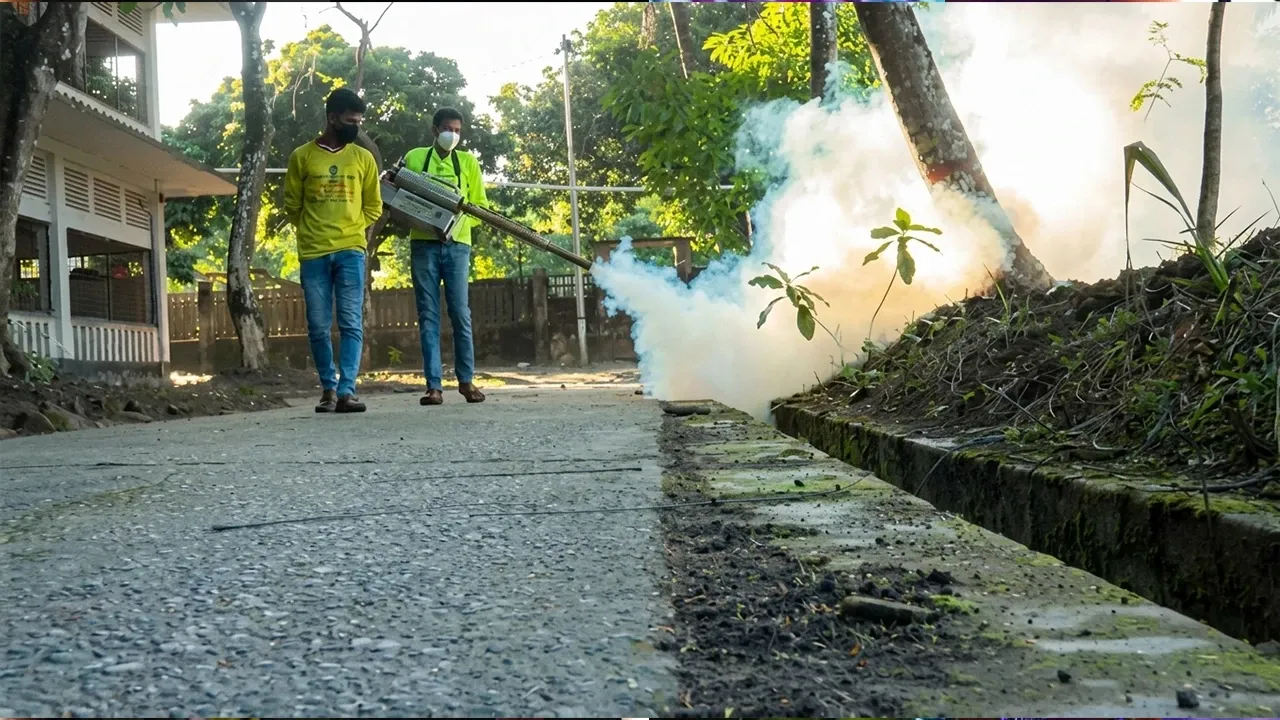
The Dhaka North City Corporation (DNCC) has launched a three-month special campaign to control the spread of dengue in the capital, with greater emphasis on destroying mosquito larvae rather than targeting adult mosquitoes.
The campaign will run throughout September, October and November. According to the city corporation, eliminating mosquito breeding grounds is one of the most effective ways to control dengue.
However, lack of access to residential buildings has emerged as a major obstacle to destroying larvae. Mosquito-control workers are being denied entry to many homes, including high-rise buildings. Even a brigadier general in uniform reportedly faced resistance while attempting to enter a residence.
DNCC Chief Health Officer Brigadier General Imrul Kayes Chowdhury said some houses in the area had refused to allow city corporation personnel to enter.
“They do not respond. People do not come out from inside the houses. There is always a tendency to blame someone else, saying it is coming from the neighbouring house or flat, or saying, ‘It is not my responsibility’ or ‘It is not within my area of responsibility,’” he said.
The city corporation said it cannot achieve complete success in destroying larvae when its workers are unable to enter homes. It also said the two insecticides being used in the campaign are standard and effective.
Explaining the three-month plan, Imrul Kayes Chowdhury said the programme has been named the ‘100 to 100’ campaign.
“We are deploying 100 volunteers every day. It will continue for 100 days. The 100-day programme is aligned with the government’s 90-day, or three-month, national programme. One hundred volunteers will work at 100 hotspots with the aim of making them 100 percent clear,” he said.
Alongside the field campaign, the DNCC is also increasing public awareness. Awareness letters are being delivered to residents across the city corporation’s jurisdiction.
DNCC Administrator Md Shafiqul Islam Khan said letters signed by him had been prepared for every home and housing society, as well as educational institutions, government buildings, offices and courts.
“We will deliver these letters to every house and society, every educational institution, government building, office and court,” he said.
Experts said dengue control would remain difficult unless mosquito larvae inside residential premises are destroyed, regardless of how much insecticide is sprayed outdoors.
Entomologist Kabirul Bashar said extensive efforts must be undertaken to destroy Aedes mosquito breeding grounds. He also stressed the need to involve communities and residents in the effort.
“The residents of every home and its surroundings must ensure that Aedes mosquitoes cannot breed there under any circumstances,” he said.
Officials and experts said keeping residential premises clean and cooperating with mosquito-control workers could be among the most effective ways to control dengue.