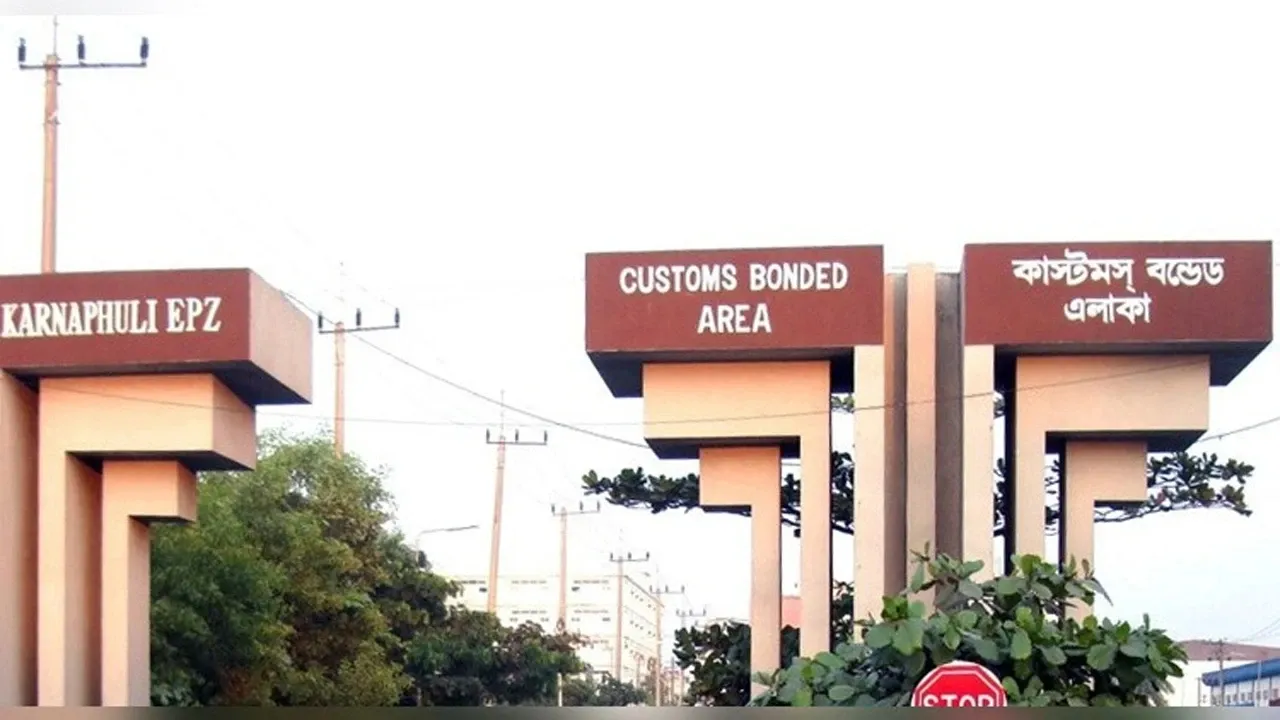
Investment in Chattogram’s Karnaphuli Export Processing Zone (Karnaphuli EPZ) has increased 412-fold over the past two decades, according to Bangladesh Export Processing Zones Authority (BEPZA) Executive Director Anwar Parvez.
Karnaphuli EPZ began operations with an investment of just $1.91 million in the 2006-07 fiscal year. By August this year, total investment had risen to $787.33 million, marking significant growth over the period.
The EPZ has 258 industrial plots, each measuring 2,000 square metres. A total of 40 large, medium and small industrial enterprises are currently operating there. Of these, 29 are fully foreign-owned, three are joint ventures and eight are owned by local entrepreneurs.
In addition, five more industrial enterprises are under implementation across 49,798 square metres of floor space.
Entrepreneurs from 14 countries—including Bangladesh, China, Taiwan, Hong Kong, South Korea, India, Sri Lanka, Japan, the United Kingdom, the United States, the Netherlands and Malaysia—have invested in the EPZ.
Anwar Parvez said Karnaphuli EPZ started operations in 2006 and began exporting goods in November 2007. In its first year of exports, the 2007-08 fiscal year, the EPZ shipped products worth $9.86 million.
According to sources, total exports from Karnaphuli EPZ reached $14,156.46 million between its establishment and August this year.
BEPZA data shows that export earnings over the past five fiscal years stood at $1,448.69 million in 2021-22, $1,885.55 million in 2022-23, $1,018.87 million in 2023-24, $1,259.42 million in 2024-25 and $1,230.44 million in 2025-26.
Alongside large-scale garment production, factories at Karnaphuli EPZ manufacture tents and camping equipment, bicycles, leather goods, furniture, bags, fashion apparel and safety suits. Many of these products are made for internationally recognised brands.
Products manufactured at the EPZ are exported to around 80 countries worldwide, including European Union member states, other countries outside the EU and the United States.
Speaking at an event marking the 20th anniversary of Karnaphuli EPZ, BEPZA Executive Director Mahbub Ahmed Siddiqui said product diversification was one of the key factors behind the zone’s significant growth.
He said most of the EPZ’s substantial export earnings had come from diversification into globally competitive products. Karnaphuli EPZ has now emerged as a major hub for high-value and specialised manufacturing.
Technology-driven sportswear, camping tents, high-tech equipment, bicycles, safety shoes and leather products for leading premium brands are among the products currently manufactured there.
BEPZA developed the specialised industrial zone on land previously occupied by Chattogram Steel Mills Ltd. The state-owned major steel producer suffered extensive damage during the devastating cyclone of 1991 and subsequently remained loss-making for years due to mismanagement. The company was eventually declared closed in 1998.
During its peak production period, the steel mill employed around 10,000 workers. The vast industrial area in Patenga was once bustling with thousands of workers and played a major role in keeping the industrial zone vibrant. After the mill closed, however, the entire area became largely inactive.
The Patenga industrial area later regained economic activity with the development of Karnaphuli EPZ along the banks of the Karnaphuli River.
The specialised industrial zone was established following a decision by the then BNP government, led by then Prime Minister Khaleda Zia, to develop the site as a dedicated industrial area. The initiative brought renewed industrial activity to Patenga.
Then Prime Minister Khaleda Zia formally inaugurated Karnaphuli EPZ in the presence of the then Commerce Minister and current Finance and Planning Minister Amir Khosru Mahmud Chowdhury. The inauguration marked the beginning of a new phase of industrialisation in the Patenga area.