
Cox’s Bazar celebrated World Tourism Day 2026 with a colourful rally, discussion meeting and tourism fair, highlighting the need for digital transformation and artificial intelligence to shape the future of tourism.
Held under the theme “Tourism of the Future with Digital Transformation and the Support of Artificial Intelligence,” the programme focused on modern tourism services, visitor safety, environmental protection and improved management.
With its blue sea, long sandy beach, hills and natural beauty, Cox’s Bazar remains one of Bangladesh’s most prominent tourist destinations. The town attracts visitors from home and abroad with its sunrises and sunsets, waves and scenic surroundings.
However, tourism stakeholders said the sector is changing with time and that natural beauty alone is no longer enough. Technology-driven services, safety, environmental conservation and modern management are increasingly important.
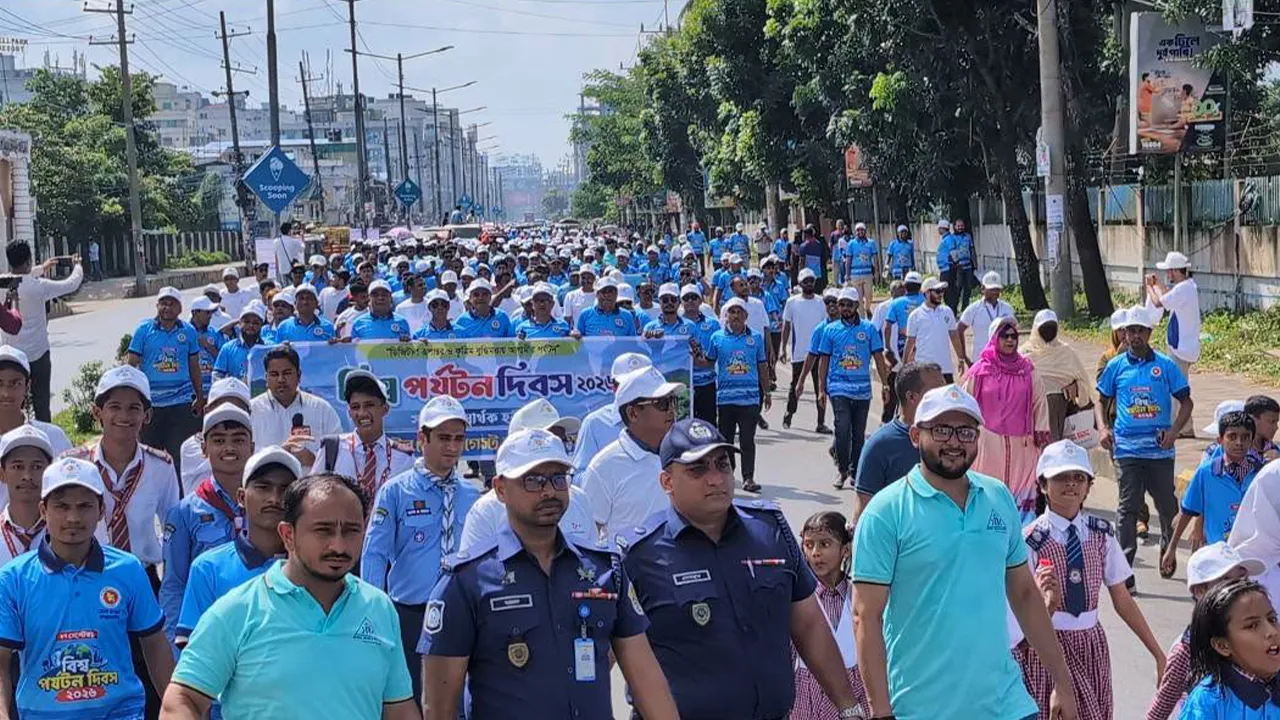
To mark the day, the district administration organised a colourful rally from Sugandha Point on Sunday morning, September 27. The procession passed through the city’s main roads before ending at the open stage at Laboni Beach.
Elected representatives, government and private-sector officials, students, tourism-related businesses, social organisations and people from different professions joined the rally.
A discussion meeting was later held at the open stage at Laboni Beach. Cox’s Bazar Deputy Commissioner Md Abdul Mannan presided over the event, while Cox’s Bazar-3 MP Lutfur Rahman Kajal attended as the chief guest.
Reserved women’s seat MP Shamim Ara Begum Swapna and tourism stakeholders also spoke as special guests.
Planned development needed to strengthen tourism
In his speech, MP Lutfur Rahman Kajal said the government has undertaken a master plan to make Cox’s Bazar’s tourism industry more developed, modern and attractive.
He said work was underway to improve tourism infrastructure and service quality through planned development.
“Tourism in Cox’s Bazar is not only about recreation; it is directly connected with the national economy, employment and the livelihoods of local people,” he said.
He added that, alongside ensuring a safe and quality environment for tourists, local communities should be more closely integrated into the tourism economy.
Reserved women’s seat MP Shamim Ara Begum Swapna said all stakeholders must work sincerely to develop tourism in Cox’s Bazar.
She said the desired development of the tourism industry could not be achieved through government initiatives alone. According to her, improving tourist confidence would require good behaviour toward visitors, better services, cleanliness and safety.
Focus on digital technology and AI
In his address as chair, Deputy Commissioner Md Abdul Mannan said tourism around the world is rapidly becoming technology-driven.
He said Cox’s Bazar’s tourism management must also keep pace with these changes.
According to him, greater use of digital technology and artificial intelligence could make information, communication, security and tourism services easier and more effective for visitors.
He said the administration and all tourism-related stakeholders must work together to establish Cox’s Bazar as a modern, safe, clean and tourist-friendly destination.
Speakers at the meeting said Cox’s Bazar has enormous tourism potential, but several fundamental issues need attention to fully realise it.
These include tourist safety, beach cleanliness, environmental conservation, traffic management, modern transport and communication systems, tourism infrastructure and improved service quality.
They said arrangements should be made to ensure that the entire visitor experience is safe, comfortable and memorable.
Experts call for smart tourism
Experts said Cox’s Bazar cannot rely solely on its natural beauty if it wants to remain competitive in the global tourism market. They called for a “smart tourism” management system.
They said artificial intelligence could be used to analyse tourists’ needs, while digital information centres, online booking, smart navigation, multilingual tourism information, crowd management and emergency services could make the overall tourism experience more efficient.
The discussions highlighted technology not simply as an additional tourism service, but as a tool for improving visitor safety, service delivery, environmental management and the overall competitiveness of Cox’s Bazar as a tourism destination.