- National
- Bangladesh
- Business
- International
- Sports
- Entertainment
- Politics
- Technology
- Life Style
- Religion
- Opinion
- FIFA World Cup 2026
Sunday, 02 August 2026

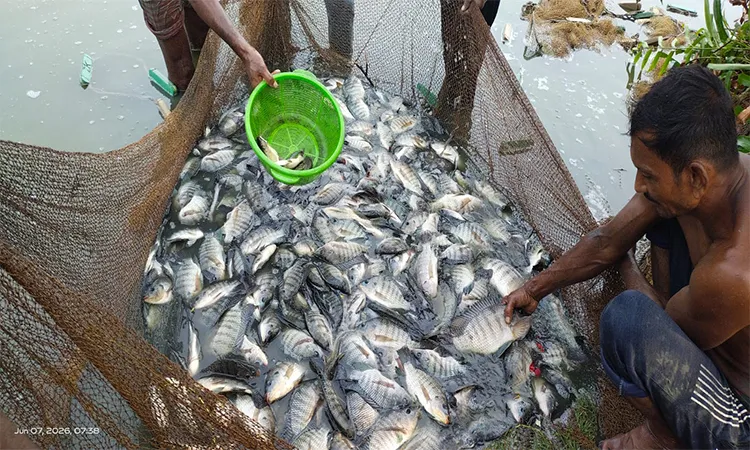
A massive quantity of fish was harvested and sold from a government-owned lake at the Bangladesh Water Development Board (BWDB) colony in Paikgachha, Khulna, raising allegations of corruption against a local official.
On the morning of June 7, locals reported that a 300-foot net was used to clear the lake of various species, including Rui, Katla, Tilapia, and Bhetki. The catch was allegedly sold to a local fish trader. Residents claim the operation was conducted under the direct supervision of Motaleb Hossain, a BWDB Section Officer (SO) for Polder No. 16, without any open tender, lease agreement, or formal public notice.
The incident has sparked questions regarding the legality of the harvest and the destination of the funds, with locals pointing out that utilizing government property for personal gain violates state asset management rules.
When confronted, Md. Motaleb Hossain denied misappropriating state resources. "The fish were not farmed with government funds," he stated. "Some of our previous colleagues pooled 5,000 to 10,000 taka to release them. Because this is not government revenue, the proceeds were not submitted to the revenue department."
Hossain claimed that "influential local figures" also participated in the harvest. Furthermore, he admitted that he did not inform the BWDB Executive Engineer about the fishing activities.
Attempts to reach higher authorities yielded little clarification. Mohammad Zahir Mazhar, Executive Engineer of BWDB Khulna Division-2, abruptly disconnected the phone when asked about the incident, stating only that he would speak later.
Paikgachha Upazila Nirbahi Officer (UNO) Wasiuzzaman Chowdhury clarified that the lake falls under the BWDB's administrative jurisdiction. "The decision and management of these matters are the responsibility of the concerned department," Chowdhury said, adding that the local administration is ready to provide necessary measures if the BWDB submits a formal written request for cooperation.
The situation sparked further controversy when Hossain allegedly asked a reporter for their bKash account number during an inquiry—a move widely interpreted as an attempted bribe.
Locals are now demanding an impartial investigation. They argue that if government resources were exploited, strict legal action must follow. Conversely, if the official's claim of private funding is true, the BWDB must produce documentation proving that employees are authorized to operate private fish farms inside government establishments.