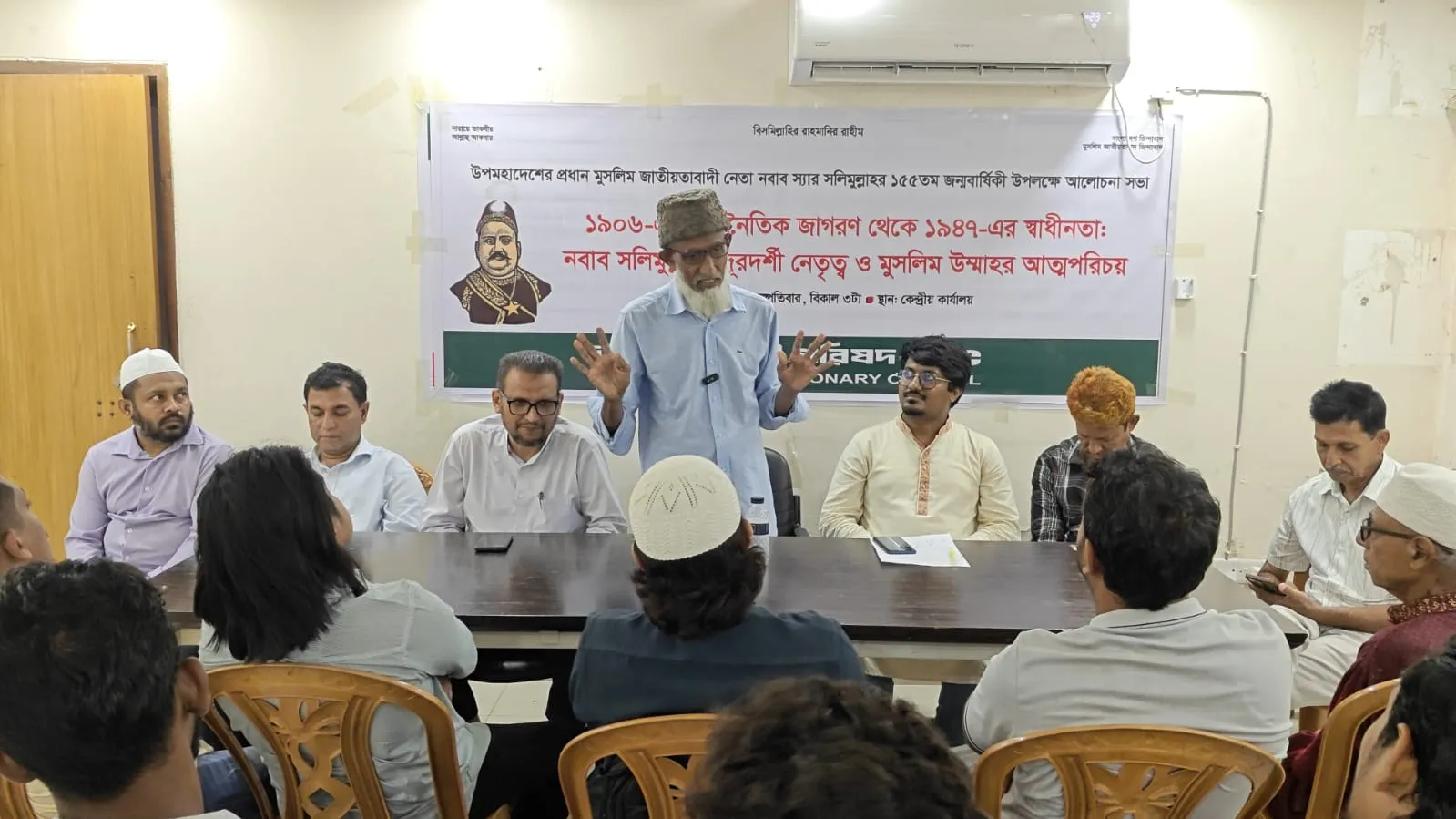
A discussion meeting marking the 155th birth anniversary of Nawab Khwaja Salimullah, widely regarded in the subcontinent’s political history as a key figure in early Muslim political mobilisation and the founder of the All-India Muslim League, was held in the capital on Thursday.
The event was organised by the National Revolutionary Council at its central office in Paltan, Dhaka. The discussion was titled: *“From the political awakening of 1906 to the independence of 1947: Nawab Salimullah’s visionary leadership and the identity of the Muslim Ummah.”*
Speakers at the programme described Nawab Salimullah as a visionary statesman and political organiser whose patronage played a decisive role in the establishment of the Muslim League in Dhaka in 1906. They said the formation of the party marked a “turning point” in the political awakening of Muslims in the subcontinent.
They further argued that the political developments initiated through the Muslim League eventually contributed to the creation of Pakistan in 1947, which later became the historical backdrop for the emergence of Bangladesh.
Some speakers also claimed that the creation of Pakistan was not only significant for the subcontinent but also served as a broader milestone in the political liberation movements of Muslims globally in the 20th century.
The discussion was presided over by Khomeni Ehsan, convener of the National Revolutionary Council, while Dr Nabil Ahmed, member secretary of the organisation, moderated the session.
Among others, Abdul Jabbar, chairman of the Nawab Salimullah Academy, Advocate Mostafa Jamal Bhuiyan, Engineer A.K.M. Rezaul Karim, Afzal Warsi, a Muhajir leader, Mohammad Shamsuddin, Mohammad Azim, Abdus Salam, and Ghalib Ehsan spoke at the event.
Speakers called for greater research and public awareness about Nawab Salimullah’s life, political philosophy and contributions, particularly among younger generations.
In his remarks, Khomeni Ehsan said Nawab Salimullah was a “founding architect of modern Muslim politics in the subcontinent” and played a pioneering role in shaping Muslim political identity through the establishment of the Muslim League.
The organisers said the event aimed to highlight the historical legacy of Nawab Salimullah and encourage academic and public discourse on his role in regional political history.