- National
- Bangladesh
- Business
- International
- Sports
- Entertainment
- Politics
- Technology
- Life Style
- Religion
- Opinion
- FIFA World Cup 2026
Tuesday, 18 August 2026


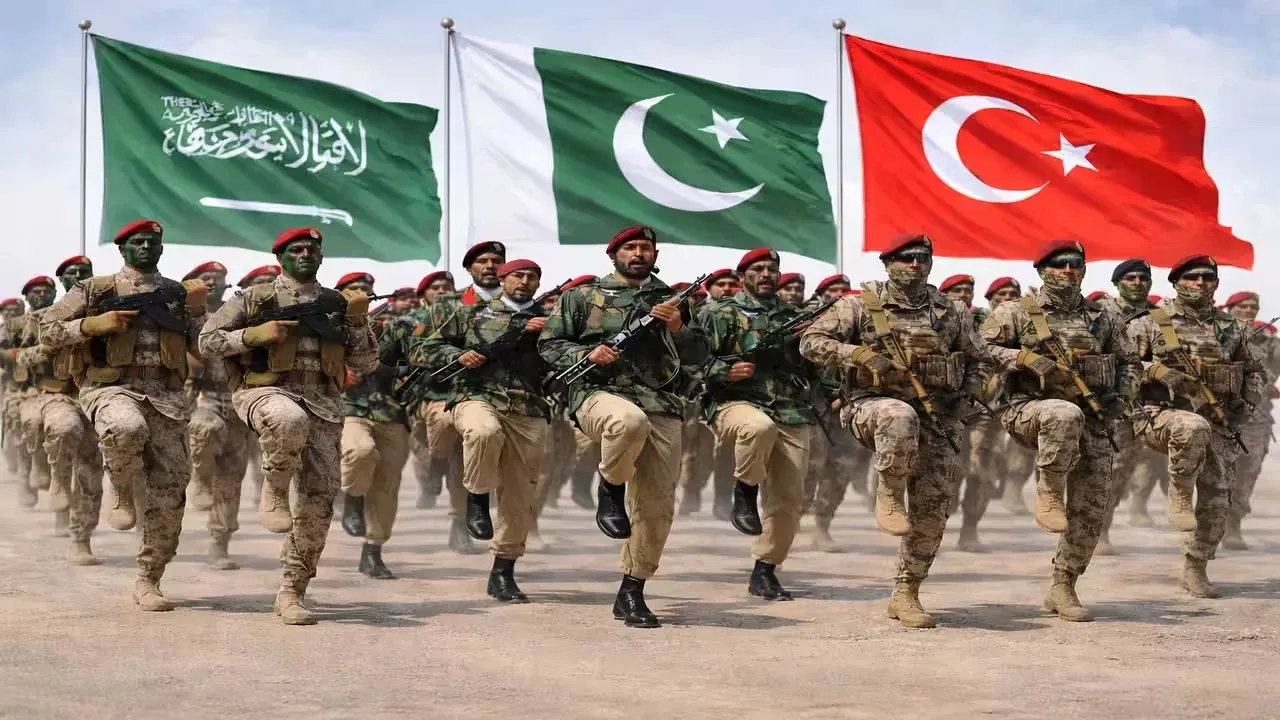
A new defence agreement between Pakistan, Türkiye and Saudi Arabia has sparked fresh debate over the changing security landscape in the Middle East and South Asia. The three countries have signed the Mecca Joint Defence Agreement, under which an armed attack on any one of the three countries would be considered an attack on all three.
The arrangement has drawn comparisons with NATO’s collective-defence principle. However, it is important to note that the agreement does not yet constitute a full-fledged military alliance comparable to the US-led NATO.
In terms of conventional military strength, the three countries together form a significant regional bloc.
According to 2026 Global Firepower figures cited in the report, Pakistan has around 660,000 active military personnel, Türkiye around 481,000, and Saudi Arabia around 247,000. Combined, their active military strength stands at approximately 1.29 million personnel.
But troop numbers alone do not determine the strength of a military alliance. Air power, naval capabilities, missiles, defence technology, intelligence, military spending, logistics and battlefield experience are equally important.
Pakistan brings nuclear power and a large military
Pakistan is arguably the most strategically significant member of the proposed alliance because of its nuclear weapons capability.
The country has an estimated 170 nuclear warheads, according to estimates cited from the Stockholm International Peace Research Institute (SIPRI).
Pakistan also possesses a sizeable conventional military and a substantial air force. Its combat aircraft include the F-16, J-10C and JF-17, giving the country a diverse air-power capability.
Pakistan's large standing army, nuclear deterrent and experience in military operations give it a unique position within the three-country arrangement.
Türkiye's biggest strength: its defence industry
Türkiye brings a different kind of military advantage.
While its armed forces number around 481,000 active personnel, one of Ankara's biggest strengths is its rapidly developing domestic defence industry.
Türkiye has become particularly well known for its unmanned aerial systems and has expanded its capabilities in drones, armoured vehicles, electronic warfare and other defence technologies.
Under the new cooperation framework, the three countries are expected to explore greater collaboration in defence production, technology development, maintenance and logistics.
Artificial intelligence, electronic warfare and unmanned and autonomous systems are also expected to receive greater attention.
Saudi Arabia: Deep pockets and advanced weapons
Saudi Arabia has a smaller active military compared with Pakistan and Türkiye, but it possesses another major advantage: enormous defence spending.
According to the SIPRI figures cited in the report, Saudi Arabia spent approximately $83.2 billion on defence in 2025. Türkiye's spending was around $30 billion, while Pakistan spent approximately $11.9 billion.
Saudi Arabia is also a major purchaser and operator of advanced Western military equipment, particularly US-made fighter aircraft and air-defence systems.
This means Saudi Arabia can contribute substantial financial resources and access to sophisticated military technology to any future joint defence structure.
The three countries collectively operate a large fleet of military aircraft.
Pakistan has around 1,397 military aircraft, including approximately 331 fighter aircraft. Türkiye operates roughly 1,101 military aircraft, including around 201 fighters, while Saudi Arabia has about 917 aircraft, including approximately 283 fighter aircraft.
The three air forces, however, have very different strengths.
Pakistan relies on a combination of American, Chinese and domestically developed platforms. Türkiye is rapidly expanding its indigenous aerospace and unmanned-aircraft capabilities, while Saudi Arabia relies heavily on advanced Western aircraft and air-defence systems.
Thousands of tanks and significant ground forces
The bloc would also possess considerable land warfare capability.
Pakistan has approximately 2,677 tanks, while Türkiye has around 2,284 and Saudi Arabia approximately 1,085.
Together, the three countries would therefore have more than 6,000 tanks, alongside large numbers of armoured vehicles, artillery systems and other ground-force equipment.
However, having large numbers of weapons does not necessarily mean that the three militaries could immediately operate as a single force.
This is where the real test for the alliance lies.
Pakistan, Türkiye and Saudi Arabia have different military doctrines, weapons systems, command structures and strategic priorities. Their forces are also geographically separated.
For the alliance to develop genuine collective military power, the three countries would need effective mechanisms for joint command, intelligence sharing, communications, logistics, air-defence coordination and interoperability between their armed forces.
Regular joint exercises would also be essential.
The agreement's reported focus on joint military exercises, defence technology, drones, air defence and logistics could therefore be an important first step toward greater military integration.
There is little doubt that Pakistan, Türkiye and Saudi Arabia together represent a major military and economic force.
Pakistan contributes a large army and nuclear capability. Türkiye brings a powerful military and rapidly expanding defence industry. Saudi Arabia contributes enormous defence spending and access to advanced Western weapons.
But the combined numbers should not be mistaken for an already integrated military force.
The real strength of the new alliance will ultimately depend on political unity, military interoperability, intelligence cooperation and the willingness of the three countries to actually deploy their capabilities together in a crisis.
For now, the agreement represents an important strategic development and could significantly reshape defence cooperation between South Asia and the Middle East. Calling it an “Islamic NATO” may capture its political significance, but its actual military effectiveness will depend on what the three countries build from the agreement in the years ahead.