- National
- Bangladesh
- Business
- International
- Sports
- Entertainment
- Politics
- Technology
- Life Style
- Religion
- Opinion
- FIFA World Cup 2026
Monday, 17 August 2026


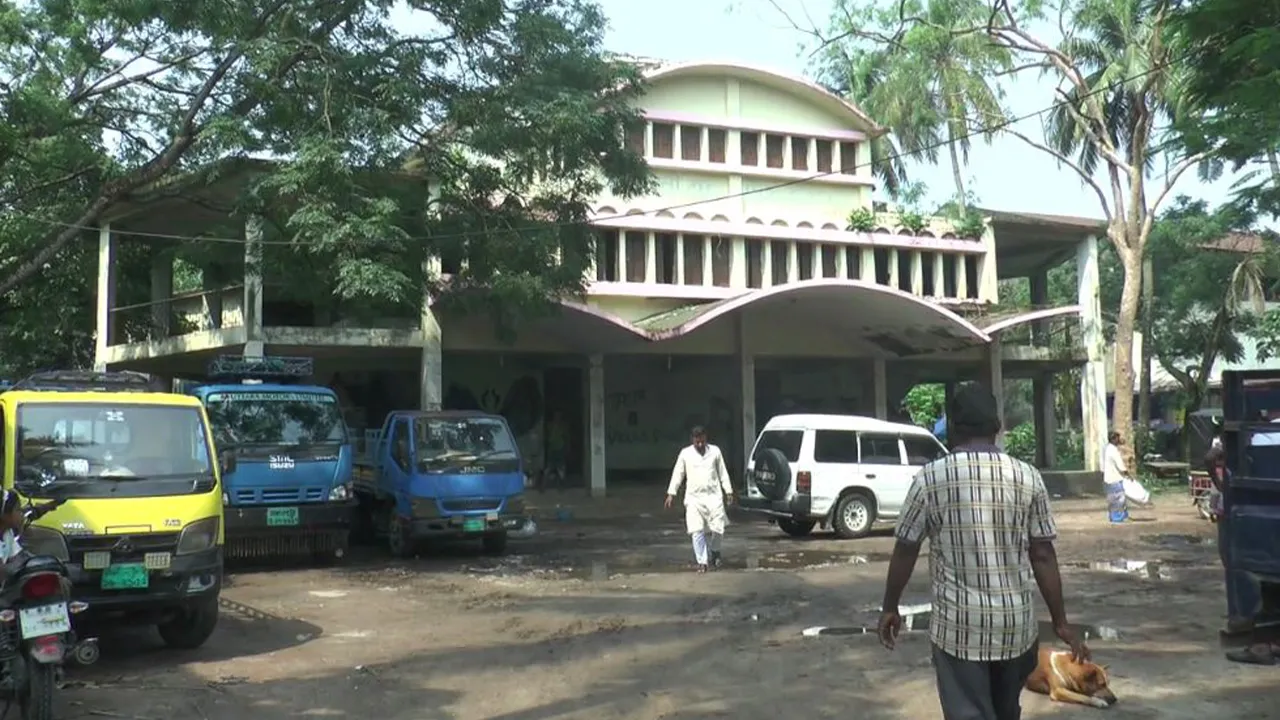
Once a vibrant cultural hub in Tangail city, the historic Bhasani Hall is now lying in a state of severe disrepair after years of neglect, inadequate maintenance and administrative inaction.
The nearly half-century-old auditorium, which once hosted theatre, music, dance, poetry recitals, book fairs and political and social programmes, now stands largely unused. Its corridors are reportedly occupied by a tea and betel-leaf stall during the day, while the surrounding premises are used as a truck stand. Locals allege that after dark, parts of the area become a gathering place for drug users and other antisocial activities.
The deteriorating condition has raised concerns among cultural activists and residents about both the loss of a significant part of Tangail’s cultural heritage and public safety.
The building was originally constructed on around 35 decimals of land in the heart of Tangail city as Tangail Town Hall.
The foundation stone was laid on August 16, 1976, by Professor Abul Fazal, then education adviser to the president. Under the efforts of then Deputy Commissioner Sheikh Habibullah, construction was completed in about two years.
The auditorium was inaugurated on April 2, 1978, by Khane Alam Khan, then commissioner of the Dhaka Division. It was later renamed Bhasani Hall following an initiative by then Tangail municipality chairman Shamsul Haque.
With a seating capacity of around 1,000, the hall became one of the city’s principal venues for cultural and public events.
For decades, theatre groups from Dhaka and other parts of Bangladesh performed there. The venue also hosted music programmes, recitations, book fairs, political meetings and cultural festivals.
Local residents and cultural figures say the hall gradually became unusable as regular maintenance stopped and many cultural organisations became inactive.
The administration eventually declared the building abandoned after it became structurally unsafe. An attempt was reportedly made to renovate it in 2015, but no significant work followed.
Today, large cracks are visible on parts of the walls, while plaster has reportedly fallen from the ceiling and walls. Many rooms have remained locked for years and are covered in dust.
Cultural activists say the closure has left Tangail without a suitable centrally located auditorium for large-scale cultural programmes.
Cultural figures argue that Bhasani Hall is more than an old building—it is closely connected to Tangail’s cultural history.
Composer, lyricist and singer Firoz Ahmed Bachchu, who attended the hall’s inauguration, recalled that major cultural and political programmes were once held there. Theatre practitioners and cultural activists also regularly gathered at the venue, while book fairs were organised on its premises in February.
He said cultural groups can no longer organise large events there and often have to rely on the Shilpakala Academy, which is located away from the city centre and is less convenient for audiences at night.
Poet Mahmud Kamal called for the historic venue to be renovated or rebuilt, saying the government should take steps to restore the facility.
Tangail Club General Secretary Kamruzzaman Khan said a modern auditorium is essential for sustaining cultural activities in a city with a long cultural tradition.
He also stressed the importance of keeping sports and cultural activities active to help protect young people from drug abuse and the influence of gangs.
On June 12 this year, Tangail MP and Fisheries and Livestock State Minister Sultan Salahuddin Tuku visited Bhasani Hall.
Following the visit, he reportedly instructed the relevant Public Works Department officials to begin comprehensive renovation work as soon as possible.
The minister later said Bhasani Hall is an important and historic landmark for Tangail and pledged to make every effort toward its reconstruction.
Local cultural activists and residents are now calling for the authorities to move beyond plans and ensure the full renovation and modernisation of Bhasani Hall, preserving its historic character while restoring it as a safe, functional cultural venue.