
- National
- Bangladesh
- Business
- International
- Sports
- Entertainment
- Politics
- Technology
- Life Style
- Religion
- Opinion
Sunday, 31 May 2026

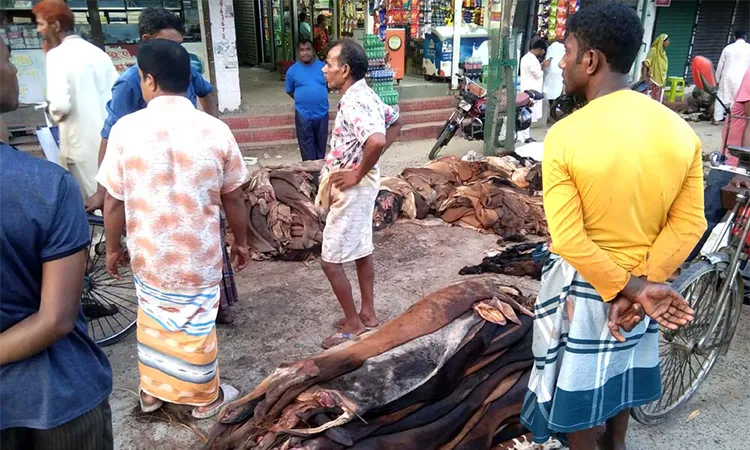
Despite government-fixed rates, the raw hide market has collapsed in Phulbari upazila of Dinajpur. Sacrificial animal skins are being sold at a fraction of their official value, leaving seasonal traders, madrasas, and orphanage authorities in deep disappointment.
During visits to the makeshift leather market at Nimtala More in Phulbari municipality on the second day of Eid (Thursday), field-level prices were found to be devastatingly low. Large and medium cowhides were trading for a mere Taka 200 to 500. Meanwhile, goat skins have become virtually worthless, selling for just Taka 20 to 30, forcing many to simply dump them in the trash.
For this year's Eid-ul-Adha, the Ministry of Commerce fixed the price of salted cowhide at Taka 57–62 per square foot outside Dhaka, and goat skins at Taka 22–27 per square foot nationwide. At these rates, a medium-sized cowhide should easily fetch Taka 1,300 to 1,850, and larger ones should exceed Taka 2,000.
"The government prices only exist on paper," said Sultan, a local resident who came to sell hides. "I managed to get a token amount for my cowhide, but I had to throw the goat skin away because no one would buy it."
This market crash directly hits the country's social safety net. Madrasas and orphanages collect the vast majority of hides during Eid-ul-Adha, relying heavily on these sales to fund orphan welfare and operating expenses. The consecutive years of low prices have pushed these charitable institutions into severe financial distress.
Local leather traders blame central syndicate issues and rising overhead costs for the crisis. Qurban Ali, a field-level trader, explained that the math simply doesn't add up for them anymore.
"Tanneries refuse to buy hides from us at the government rate, so we can't afford to pay those rates at the grassroots either," Ali said. "On top of that, skyrocketing salt prices, processing, and transport add an extra Taka 200 to 300 in costs per cowhide. I lost money last year trying to follow official pricing, so this year I capped my collection at just 200 hides."
Traders also point out a structural bottleneck: the processing capacity of local tanneries is far lower than the volume of animals slaughtered during Eid. Without adequate export options to clear the surplus, grassroots sellers are left holding the bag for an industry on the brink of collapse.
