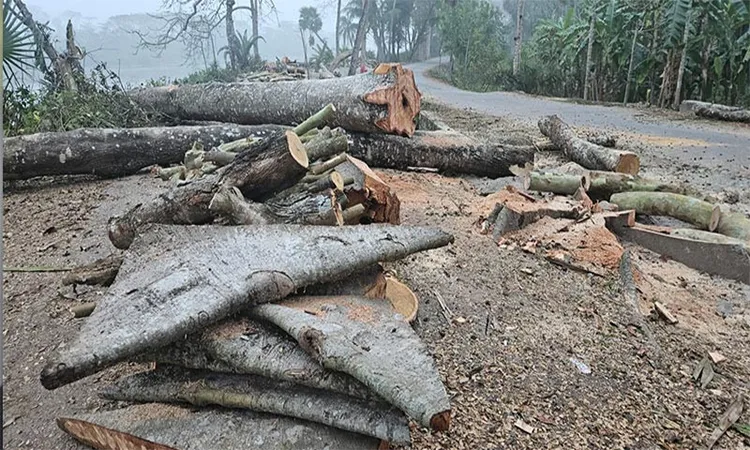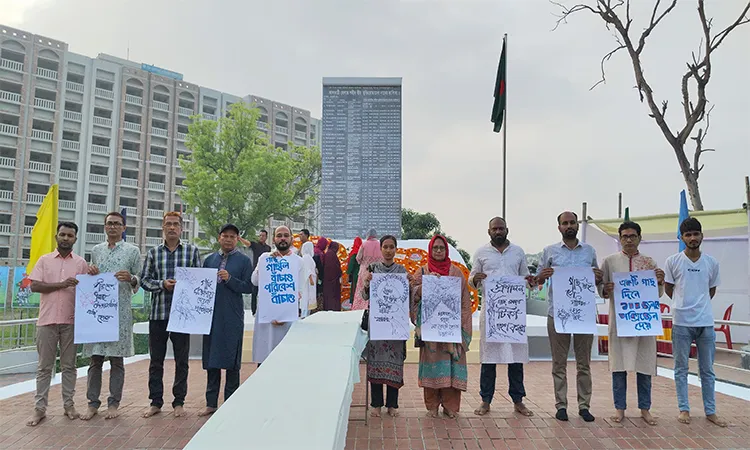
Environmental activists in Jhalakathi staged a placard protest on Independence Day, condemning the decision to fell over 2,000 trees along the Gabkhan River for a Water Development Board (WDB) project. The demonstration took place at the Freedom Fighters Memorial after activists paid their respects to the martyrs of 1971.
The controversy centers on a 4-kilometer stretch from Gabkhan Bazar to Baruhar. While the Forest Department officially listed 1,815 trees for felling across 47 lots, insiders suggest the actual number exceeds 2,350. The trees—including medicinal Arjuna, Neem, and endangered Raj Karai—were reportedly auctioned for a mere Tk 60 lakh, a figure senior lawyers and activists claim is a fraction of their true market value.
Following initial social media protests by activist Ismail Musafir, Deputy Commissioner (DC) Md. Momin Uddin briefly suspended the felling. However, a recently formed Environment and Forest Development Committee—mandated by a High Court guideline—reportedly cleared the project just before Eid.
Committee member and activist Elias Sikder Farhad alleged the meeting was a formality. "Instead of acting as experts to evaluate the environmental impact, members were pressured to sign off on a pre-decided move," Farhad said. He noted that while development is necessary, the massive scale of destruction was never fully disclosed.
Civil Surgeon Dr. Humayun Kabir, also a committee member, admitted he was unaware that 2,000 trees were slated for removal.
The Gabkhan River banks are a vital habitat for rare reptiles and hundreds of bird species. "In the name of development, we are destroying an ecosystem," said Advocate Akkas Sikder, President of the Jhalakathi Tree and River Protection Movement.
Locals are particularly incensed by the inclusion of fruit-bearing and lightning-resistant palm trees. Hanif, a local resident involved in the original planting 25 years ago, questioned the Forest Department's authority to cut trees they did not plant.
Observations on the ground reveal that the WDB’s embankment project may not require such extensive clearing. In many areas, the distance from the old road to the water line exceeds 50 feet. Despite this ample space, the plan insists on clearing both sides of the high road.
Advocate Manzil Morshed, Chairman of Human Rights and Peace for Bangladesh (HRPB), termed the decision "sad and suspicious," noting that the committee bypassed a physical inspection before authorizing the destruction of assets worth crores of taka.
While the Forest Department maintains that all tender procedures were followed, felling remains temporarily suspended following the public outcry.