


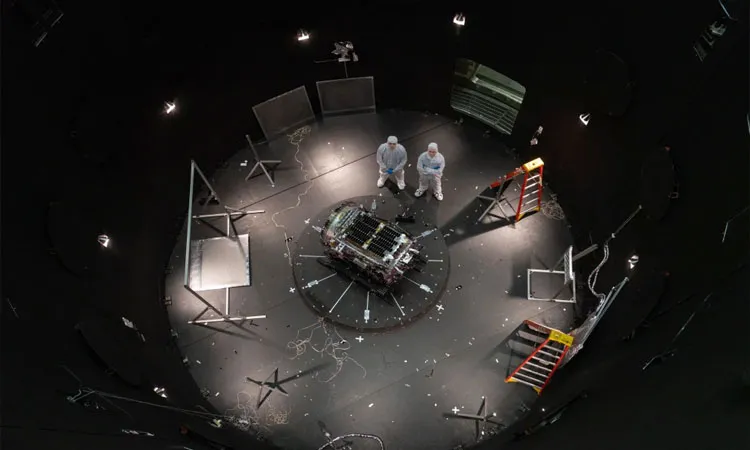
A three-armed rescue spacecraft launched from the Pacific on Friday to prevent a vital NASA telescope from crashing down to Earth.
The Link spacecraft, developed by Katalyst Space Technologies, was launched by Northrop Grumman using a Pegasus rocket deployed from a modified aircraft over the Marshall Islands. It is expected to intercept NASA's Swift Observatory in approximately one month.
Launched in 2004 to monitor gamma-ray bursts and exploding stars, Swift has been losing altitude rapidly due to intense atmospheric drag from recent solar storms. It currently orbits at an altitude of 224 miles. To prevent it from burning up in the atmosphere this October, NASA is paying Katalyst $30 million to lift the 1.6-ton telescope back to its original altitude by an additional 150 miles.
Katalyst engineered the high-stakes rescue mission in just nine months. If successful then the Link spacecraft's thrusters will gently raise the observatory's orbit without causing damage and allowing Swift to resume its cosmic observations by September.
NASA officials noted that if this mission succeeds, a similar salvage operation could be considered for the Hubble Space Telescope, which faces a similar threat from solar activity.

