

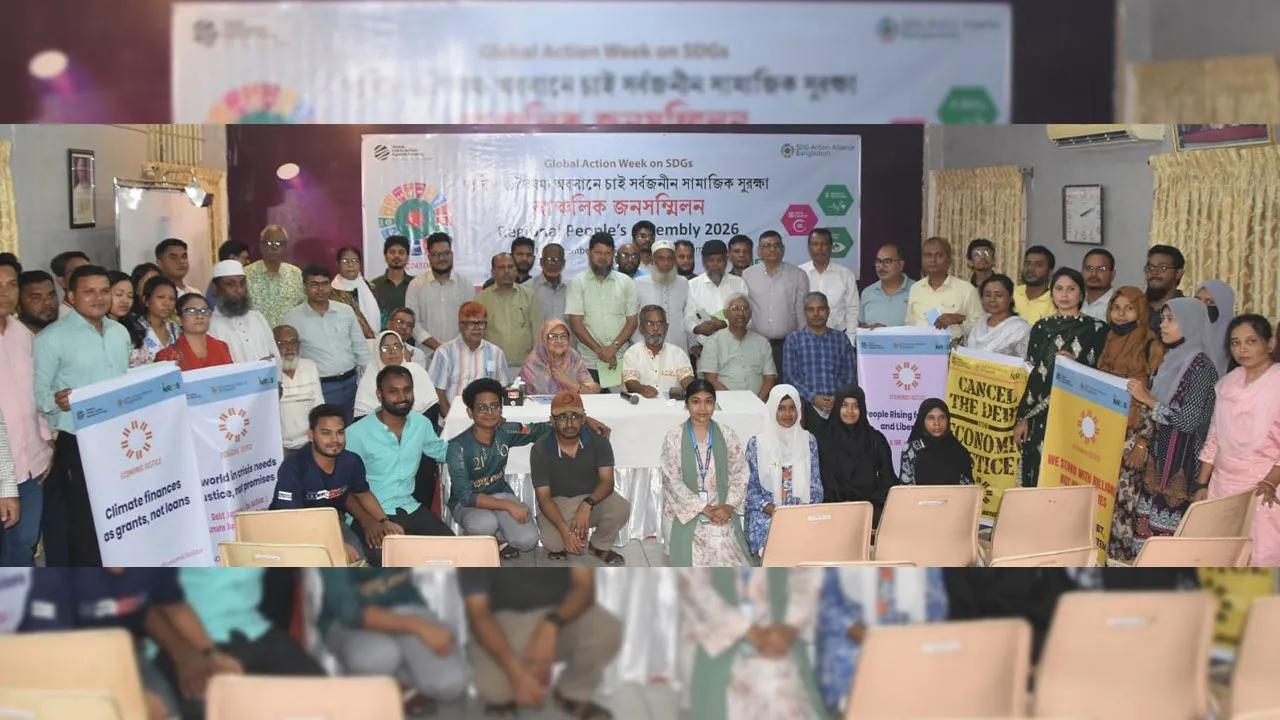
A regional peoples assembly in Chattogram has called for accelerated implementation of the Sustainable Development Goals (SDGs), adequate financing and the inclusion of marginalised communities in development planning, alongside effective and universal social protection to reduce poverty and inequality.
The call was made at the Regional Peoples Assembly 2026, held at the Caritas office in Chattogram on Saturday (September 19). The event was organised jointly by SDG Action Alliance Bangladesh, NRDS and ISDE Bangladesh as part of the Global Call to Action Against Poverty and People Rising to End Inequalities programmes and in observance of Global Action Week on SDGs.
The assembly also stressed the importance of economic justice and ensuring the rights of marginalised communities in implementing the SDGs.
The event was chaired by S M Nazer Hossain, Vice-President of the Consumers Association of Bangladesh (CAB) central committee and Executive Director of ISDE. CAB Chattogram divisional organiser Kazi Iqbal Bahar Chhaberi moderated the programme.
Abdul Awal, Coordinator of the SDG Action Alliance and Executive Director of NRDS, was the keynote speaker. Speakers included veteran academic Dr Professor Idris Ali, womens rights leader Jesmin Sultana Paru, columnist Musa Khan and BGC Trust University lecturer Sarwar Kamal.
Others who took part in the discussion included CAB Chattogram Metropolitan General Secretary Ajay Mitra Shanku, Joint Secretary Md Selim Jahangir, social worker Mitul Das Gupta, Proshika Deputy Director Shahadat Hossain, CAB Chandgaon Thana President Md Jane Alam, General Secretary Ismail Faruqi, CAB West Sholashahar Ward President ABM Humayun Kabir, Sabujer Jatra Executive Director Sayera Begum, Songsaptak Executive Director Liton Chowdhury, Swapnil Bangladeshs Mohammad Ali, Drishtys Helal Uddin Mahbub, SDSs Mousumi Akter, development worker Zubayer Faruk Liton, CAB Chattogram University President Rozain Al Rafi, journalists Manisha Chakraborty, Shahabuddin, Osman Jahangir and M A Hossain, ISDE Project Officer Raisul Islam, Asian University for Women student Lily Sain Marma, Saptarshi Chakma, BGC Trust Universitys Ammar Joyfullah, Premier Universitys Abid Hossain Rafi and Mousumi Akter, among others.
Speakers recalled that UN member states adopted 17 SDGs in 2015 with a target of achieving them by 2030. The goals cover issues including ending poverty and hunger, ensuring quality education and healthcare, gender equality, climate action, reducing inequality, and building sustainable cities and environments.
They said progress toward the goals has been affected by various global and national crises and is not advancing at the expected pace.
According to the UN Sustainable Development Goals Report 2026, of the 139 SDG targets with sufficient trend data, 36% are on track or making moderate progress, while overall progress remains slow and uneven. Financing shortfalls, climate change, debt pressures, conflicts and inequality are among the major challenges identified by the UN.
Participants said the next four years are crucial for achieving the 2030 targets. They called for greater emphasis on implementation alongside existing plans and commitments, with regular reviews of progress, gaps and measures taken to address those gaps.
They also said SDG implementation cannot be the responsibility of the government alone. Local governments, civil society, the private sector, development organisations, media, educational institutions and young people need to participate collectively, they said.
The speakers stressed the need to review SDG progress at the local level. They said, alongside national statistics, district- and upazila-level progress against SDG indicators should be published to identify where development benefits are reaching people and which groups remain underserved.
They further called for the participation of women, children, persons with disabilities, low-income communities, people vulnerable to climate change and other marginalised groups in development planning. They said the SDG principle of leaving no one behind should remain central to implementation.
Bangladeshs official SDG Tracker monitors progress across the 17 goals and their indicators, while also identifying areas where data are unavailable or incomplete.
The assembly said effective implementation of existing commitments is now more important than making new pledges. Participants called for greater transparency and accountability in development activities and stronger public-private partnerships.
They said addressing financing gaps, strengthening local capacity, collecting reliable data and ensuring public participation could help accelerate SDG implementation.
Global Goals Week 2026 is being observed from September 19 to 27 as a global initiative involving civil society, businesses, academia and parts of the UN system to promote faster action, awareness and accountability for achieving the SDGs.