- National
- Bangladesh
- Business
- International
- Sports
- Entertainment
- Politics
- Technology
- Life Style
- Religion
- Opinion
- FIFA World Cup 2026
Monday, 24 August 2026


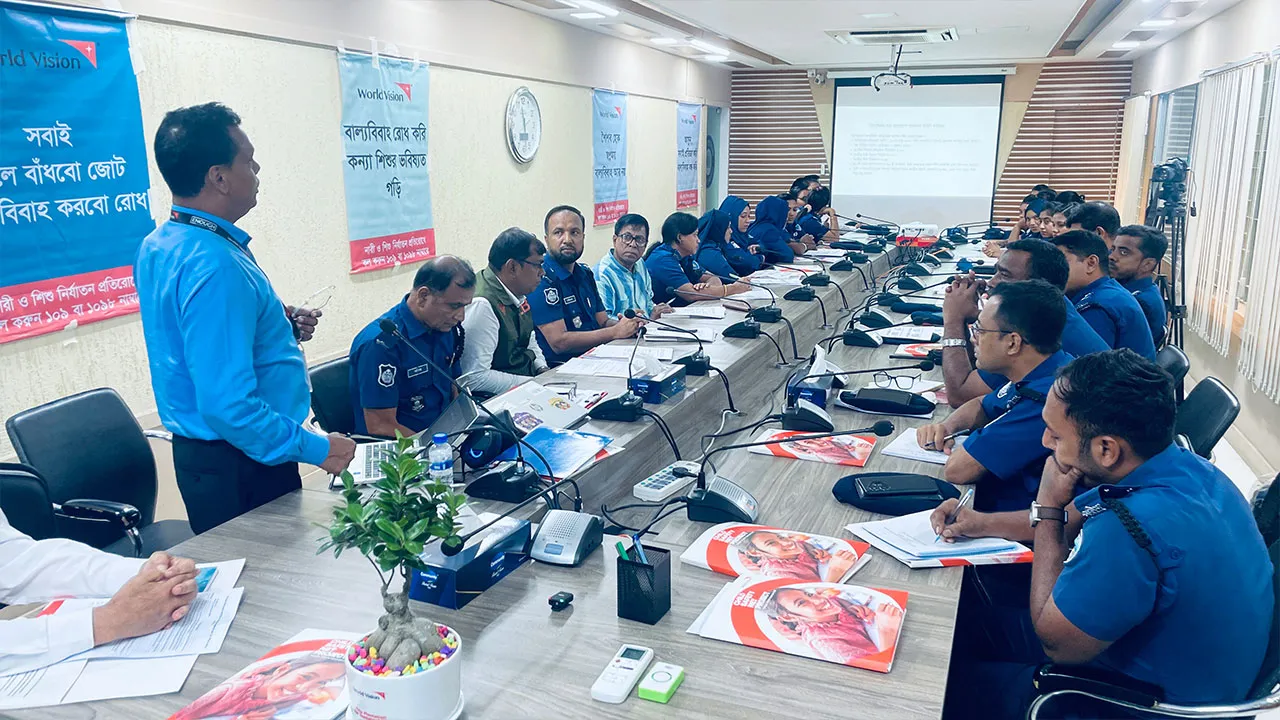
Police officials and child protection experts have called for coordinated efforts by the administration, police, development organizations, families, educational institutions and local communities to make Cox’s Bazar a child marriage- and child labour-free district.
They made the remarks at a roundtable discussion titled “Building a Child Marriage- and Child Labour-Free Cox’s Bazar District to Ensure Child Protection” held at the conference room of the Cox’s Bazar Superintendent of Police’s office at 11am on Sunday (August 23).
The Child Safety Net Project of World Vision Bangladesh organized the event.
Sagar D Costa, Project Manager of World Vision Bangladesh’s Child Safety Net Project, said ensuring child safety is not the responsibility of any single institution; rather, it is a collective responsibility of the state, families and society.
He said child marriage and child labour undermine children’s childhood, education, safety and future prospects. Therefore, vulnerable children and families must be identified early and brought under preventive protection measures.
Ronald Prabir Chisick, Senior Manager of World Vision Bangladesh, said preventive measures must be taken before risks emerge instead of responding only after incidents occur. He stressed the need for coordinated social initiatives to address poverty, social prejudice, lack of awareness and family pressure behind child marriage and child labour.
A detailed presentation on child protection laws, types of offences, preventive measures and the practical challenges of enforcing the law at the grassroots level was made by Mohammad Jamal Uddin.
Chief guest Cox’s Bazar Superintendent of Police A.N.M. Sajedur Rahman said police would take a strict and responsible stance against child marriage and child labour. He said there would be no leniency in enforcing laws to protect children’s rights and safety.
He said police would follow a “zero tolerance” policy to make Cox’s Bazar free from child marriage.
However, the police chief noted that law enforcement alone cannot stop child marriage. If a community faces a risk of child marriage, the local administration, elected representatives, teachers, religious leaders, families, community representatives and law enforcement agencies must work together.
He also stressed the need to identify the social and economic causes of child labour and create alternative opportunities for vulnerable children.
The SP further said stopping a child marriage is not the end of the responsibility; ensuring that the child remains in a safe environment and has access to education and opportunities for healthy development is equally important.
Participants emphasized the need for risk identification at the upazila and union levels, regular monitoring, swift legal action and coordinated awareness campaigns. They also called for expanding social protection, reintegration into education and skills-development opportunities for vulnerable families.
Around 40 senior police officers from different upazilas of the district participated in the roundtable. They shared their experiences, challenges and recommendations for preventing child marriage and child labour in their respective areas.
World Vision Bangladesh officials Partha Pratim Bagchi, Mobilization and System Strengthening Officer, and Shahanaz Parvin, Child Protection, Education and GES Coordinator, among others, were also present.
The participants expressed their determination to strengthen coordination among police, administration and other stakeholders and establish Cox’s Bazar as a “zero-tolerance district” against child marriage and child labour.