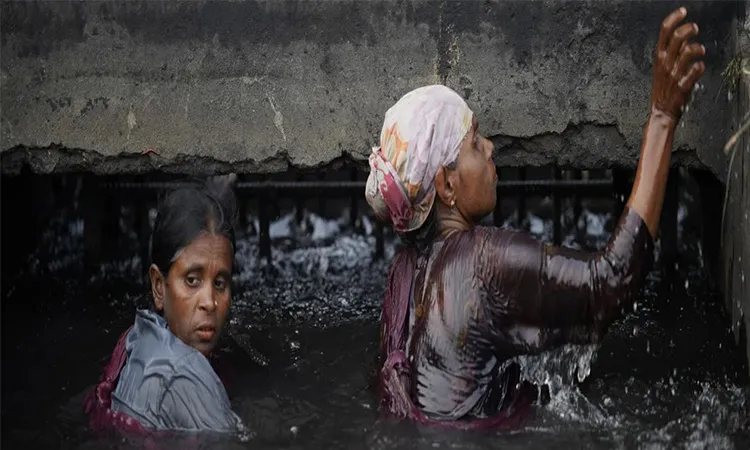
For two decades, women in Dinajpur have stood in a coal mine’s drainage channel, collecting discarded sludge to feed their families — sustaining an invisible economy beside one of Bangladesh's flagship energy projects.
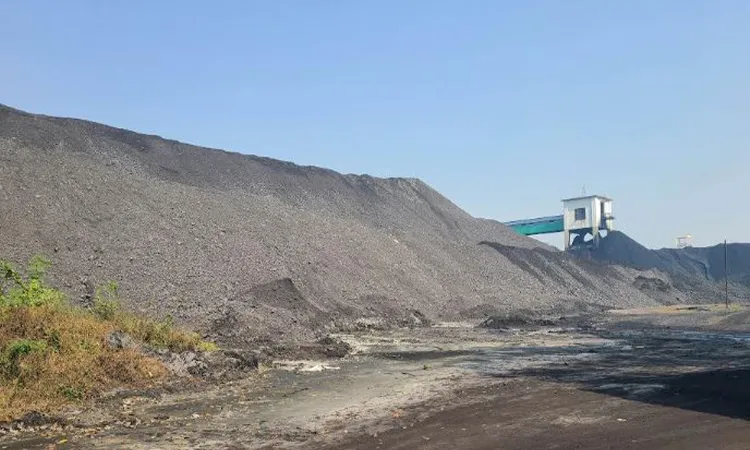
A thick, metallic smell rises from the drainage channel beside Dinajpur's Barapukuria coal mine. The water carries the industrial waste of two decades, yet this channel does not appear on any map of Bangladesh's economic activity.

It is absent from labour registries, occupational health reports, and government workforce surveys. Yet, every day, more than 30 women stand knee-deep in the dark water, pulling coal sludge from the silt.
Morsheda Begum, 58, has worked in this channel since her youngest child was learning to walk. Her hands, stained a permanent grey at the knuckles, move through the water with automatic precision: collect, sift, deposit.
"People think this is shameful work," she says, not looking up. "Let them think so. I have never borrowed money from a neighbour, and I have never sent my grandchildren to bed hungry. Can the people who feel shame about my work say the same?"
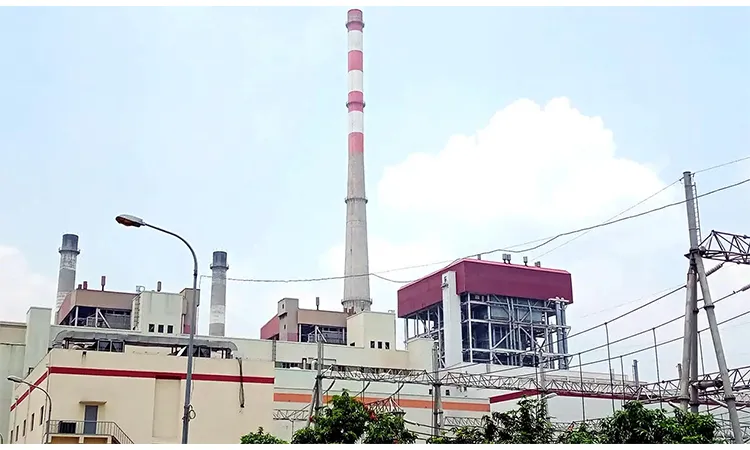
The state-owned Barapukuria Coal Mining Company operates Bangladesh's only underground coal mine. While considered a national development success story, the surrounding villages reveal a starkly different reality.
Each morning before 8:00 am, the women arrive. They work in eight distinct groups of 25 to 30 members, strictly rotating so each group works one 12-hour shift per week. There are no contracts, supervisors, or safety equipment. They rely entirely on a self-enforced system, knowing that if it collapses, their families go hungry.

Rashida Khatun, 47, joined a decade ago after her husband suffered a career-ending back injury. "I didn't know anything about this work at first. Another woman brought me, I watched, and soon I was faster than some of the older workers," she says, laughing briefly. "You learn quickly when you have no other choice."
The women collect fine coal fragments washed out as industrial waste. The mine discards it, but for these women, it is a livelihood. The informal operation runs with strict efficiency. Labour is divided: some stand in the drain holding nets against the current, while others haul the trapped sludge up the banks. A separate team guards the collected coal. To ensure fairness, no member switches roles or groups.

In a single 12-hour shift, one team collects up to 600 kilograms of coal sludge. They sell it to suppliers for nearby brick kilns, earning Tk450 to Tk500 per maund (about 37 kg). A day’s haul yields roughly Tk8,000. Across a month, this female-led workforce injects over Tk2 lakh into the local economy. The daily earnings are split equally, giving each woman Tk250 to Tk300.
Locals say this informal economy emerged 20 years ago when the mine expanded and wastewater volume increased. Women organized the rotation and rules entirely on their own, without government or NGO assistance.
Rina Akhter, 52, helped establish the early structure. "We sorted it out ourselves," she explains. "We made rules and enforced them. Nobody was going to do it for us."
This self-governed workforce is entirely female, ranging in age from their 40s to late 60s. However, their primary grievance is not the grueling nature of the work, but the locked mine gate just 30 metres away.
The women claim the mine consistently hires outsiders for entry-level cleaning and maintenance jobs rather than employing the local community.

Kulsum Banu, 61, has lived 200 metres from the mine entrance her entire adult life. "We breathe its air. Our water tastes of it. Our children grew up with the sound of it," she says. "Yet they bring outsiders to clean their floors, and we stand in a sewage channel to survive. What kind of justice is that?"
A senior Barapukuria Coal Mining Company official, speaking on condition of anonymity, disputed this claim. "To my knowledge, 95% of our 260 workers are local residents," he stated. "We cannot recruit more workers than the mine actually requires, so it is not possible to provide jobs to everyone."
Meanwhile, the health toll mounts. The drainage channel carries industrial effluent and, reportedly, raw sewage. The water is artificially warm due to underground thermal processes.
Feroza Begum, 64, says the warmth keeps her from getting winter colds, but it has damaged her skin. "There is an itching that never fully stops. Sometimes, rashes. But what would talking change?"

Medical risks for prolonged exposure to such water include fungal infections, respiratory illness, and heavy metal poisoning. None of the workers have access to occupational health care.
Amena Sultana, 55, is blunt about the reality. "My feet have had sores for five years. When I can afford medicine, I use it. When I cannot, I put them back in the water and keep working."
Their meager earnings cover essential survival: rice, medicine, school fees, and debt. Several are the sole providers for bedridden spouses or unemployed adult children.
"If I stop coming here, my grandchildren will go hungry," Morsheda Begum says, preparing to return to the water. "I don't need anyone to feel sorry for me. I need someone to explain why the mine next door cannot give me a proper job."