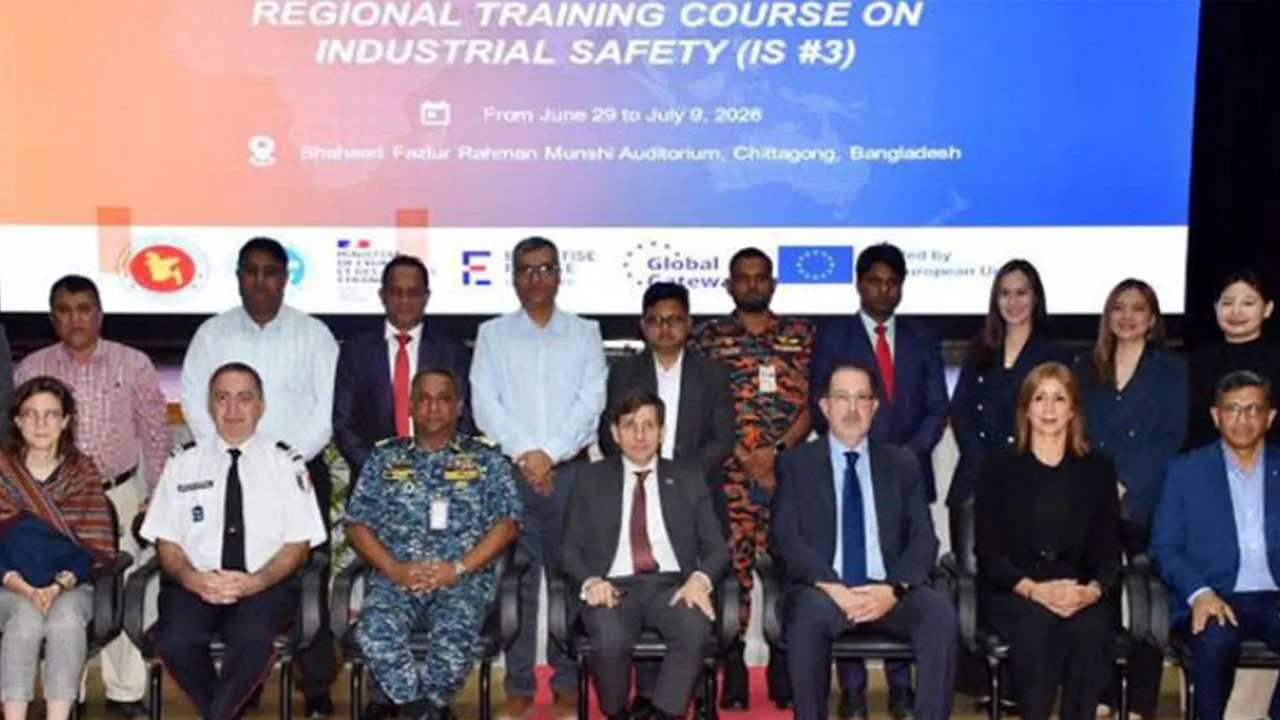
Chattogram Port on Monday launched a two-week regional training program on industrial safety, bringing together 20 officials from Bangladesh, France, Thailand, and Sri Lanka to strengthen safety standards and risk management in maritime operations.
The Regional Training Course on Industrial Safety is jointly funded by the European Union and the Chattogram Port Authority under the Global Ports Safety initiative.
The opening ceremony was held at the Chattogram Port Training Centre and attended by Commodore Ahmed Amin Abdullah, Member (Harbour and Marine) of the Chattogram Port Authority, and French Ambassador to Bangladesh Jean-Marc Sere-Charlet, who delivered the keynote address.
The event was coordinated by Md. Abdul Hannan, head of the Port Training Centre, while instructor Saeed Imam served as master of ceremonies.
Commodore Ahmed Amin Abdullah said the program would play an important role in improving industrial safety standards at seaports and reaffirmed the port authority's commitment to organizing similar training programs in the future.
Ambassador Sere-Charlet said the French government-supported initiative would help participants strengthen industrial risk management and apply safer operational practices in their respective organizations.
According to the Chattogram Port Authority, the course is being led by industrial safety expert Olivier Salvi and focuses on managing complex risks associated with container terminals, liquid hydrocarbon depots, oil and gas operations, and chemical storage facilities.
Participants will receive hands-on training using specialized digital tools, including the ADAM software developed by the European Commission and INERIS' PRIMARISK platform. The software enables users to simulate major industrial accidents—such as pool fires, toxic gas releases, and explosions—and calculate safe evacuation distances and emergency response measures.
The program also includes field visits to local oil terminals and storage depots, allowing participants to identify real-world hazards and develop practical safety recommendations.
Training sessions will cover internationally recognized safety frameworks, including the Globally Harmonized System (GHS) for chemical classification, the United Nations Model Regulations, and the International Maritime Dangerous Goods (IMDG) Code, helping align regional safety practices with global standards.
Officials said the Global Ports Safety project aims to strengthen preventive safety measures, improve emergency preparedness, and protect international supply chains by enhancing the technical capacity of maritime professionals across the region.