- National
- Bangladesh
- Business
- International
- Sports
- Entertainment
- Politics
- Technology
- Life Style
- Religion
- Opinion
- FIFA World Cup 2026
Sunday, 21 June 2026

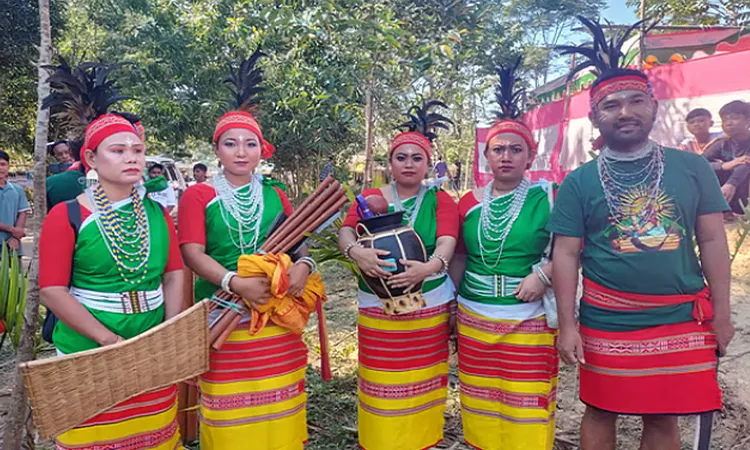
In the Garo language, the word Dak means body and Manda means cloth. Together, the 'Dakmanda' is more than just a garment; it is the living identity of Garo women who grew up in the Shal forests of Tangail’s Madhupur, Ghatail, and Sakhipur upazilas.
Historically, Garo women wore uniform, vibrantly colored Dakmandas during social festivals, weddings, and the Wangala harvest festival, proudly displaying their cultural heritage and camaraderie. Today, however, this traditional attire faces a severe existential crisis due to changing times, modern fashion trends, and a lack of structural preservation efforts. The Art of Yarn and Color
Crafting a Dakmanda requires precision, patience, and time. Garo women weave these garments at home using traditional wooden looms (konk). The designs typically feature mountain motifs, flowers, vines, and geometric shapes woven along the borders. Depending on the complexity of the design, it takes one to four weeks to weave a single piece.
Unfortunately, the cost of yarn, dyes, and loom materials has surged in recent years. A standard-quality Dakmanda now costs between Tk 500 and Tk 4,000, while premium designs can fetch Tk 10,000 to Tk 15,000. With many in the local Garo community living on low incomes, making regular purchases of these garments is difficult. Furthermore, traditional weavers face financial losses due to exploitative middlemen and direct competition from cheaper, mass-produced modern fabrics. Unique Dakmanda Even in Fieldwork
Despite these pressures, elements of the culture survive in remote areas like Gaira in Madhupur Upazila. Many Garo women still comfortably wear the Dakmanda of their ancestors while working under the scorching sun.
Bappi Bedulkar, a Garo teenager from Gaira, views the dress as a profound symbol of her community's identity. "Dakmanda is our traditional dress, worn in a single layer," Bappi and her friends shared. "We grew up watching our mothers and grandmothers wear it. It adapts perfectly to the body, making it comfortable for difficult fieldwork or household chores." New Generation Swaying in Fear and Dreams
Yet, the path to survival for this glorious tradition is steep. Many young people are increasingly reluctant to wear the traditional dress in public spaces.
"When we wear this dress in the city, we face offensive questions and uncomfortable stares from mainstream society," the local girls noted. These social pressures, combined with the high cost of authentic, hand-woven garments, mean that many young Garo women are abandoning the Dakmanda out of necessity or fear of alienation. The Last Fight to Save Tradition
Still, for significant life events, the tradition holds strong. Anjana Nakrek, a local Garo community member, emphasized that brides still choose the beautiful, ancestral Dakmanda over modern or Western clothing for their wedding day.
Sulekha Mrong, Director of the Achik Michik Society in Madhupur, explained that Dakmanda is a vital vehicle for Garo cultural identity. She noted that while migration for employment and assimilation into mainstream society have reduced the daily use of traditional clothing, preserving the Dakmanda remains essential to keeping their roots alive. "Language and clothes are the biggest identity of our existence," she said.