The government’s move to prepare a fit-list of officials from the 30th BCS administration cadre for appointment as deputy commissioners has come under scrutiny, with questions being raised over the selection process and the inclusion of officials whose roles during the 2018 and 2024 elections are being questioned.
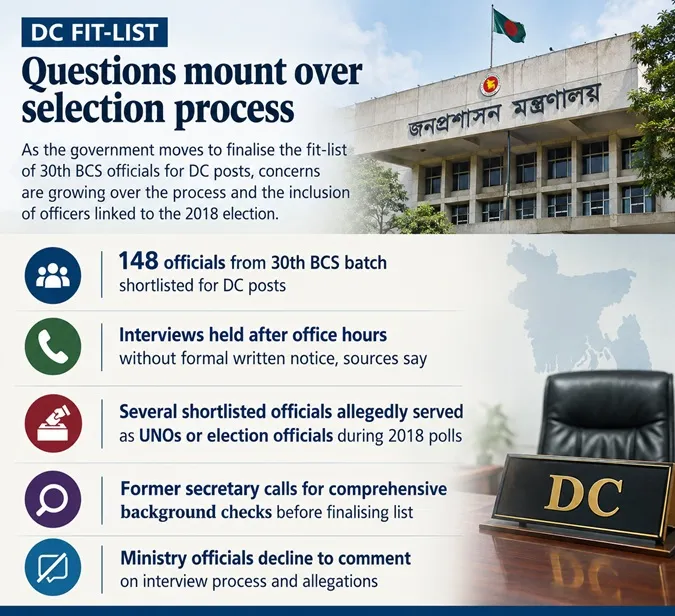
According to documents obtained by this newspaper, 148 officials from the 30th BCS batch have been included in the draft fit-list for appointment as DCs.
The list includes several officials who, according to sources, served in field-level administrative and election-related positions during the 2018 parliamentary election and were subsequently promoted or posted to important positions during the Awami League government.
The interviews of the shortlisted officials were conducted between August 30 and September 17, sources said. However, unlike a conventional selection process, the candidates were reportedly contacted mainly by telephone and no formal written notice was issued to them.
The interviews were also held after regular office hours, according to officials familiar with the process.
One candidate who attended the interview said there were concerns among the candidates that some officials who had served as upazila nirbahi officers (UNOs) during the 2018 election could be considered for DC appointments despite allegations that they had assisted the then government during the polls.
The candidate said appointing such officials to key district administrative positions could undermine public confidence in the process.
The 2018 election saw deputy commissioners serving as returning officers, while UNOs were appointed as assistant returning officers.
The issue has gained renewed significance following government action against officials who served as returning officers during the 2018 election. In July this year, 32 former DCs who had served as returning officers during that election were sent into compulsory retirement after having earlier been made officers on special duty.
Earlier, 33 former DCs who served as returning officers in the 2018 polls were also made OSDs in February 2025.
Against this backdrop, questions are being raised over whether the background of officials who served at the field level during the 2018 election should be examined before they are considered for DC appointments.
Md Aknur Rahman, additional secretary of the Appointment, Promotion and Deputation (APD) Wing of the Ministry of Public Administration, did not deny the allegations regarding the interview process when contacted. He, however, declined to comment further and referred queries to the ministry secretary or senior officials.
Md Quamruzzaman Chowdhury, Secretary Ministry of Public Administration could not be reached for comment despite attempts to contact him.
A ministry official involved in preparing the shortlist said the decision to contact candidates by telephone was taken partly to minimise external pressure on the selection process.
The official, however, did not explain why the candidates were not formally notified in writing.
Former secretary AKM Abdul Awal Majumder said any attempt to influence the selection process should be avoided and that the appointment of DCs should be based on transparent and verifiable criteria.
Officials who say they faced discrimination during the previous government also questioned the absence of a formal notification, saying the process should be open enough to ensure that all eligible officials are treated equally.
The DC is the senior-most civil administrator in a district and plays a key role in coordinating the activities of government agencies at the district level. DCs have also traditionally served as returning officers during national elections.
Several officials from the 30th BCS batch who served as UNOs, assistant commissioners (land) or assistant returning officers during the 2018 election are reportedly included in the draft fit-list.
They include Nikaruzzaman, Bariul Karim Khan, Kazi Hafizul Amin, Nazmul Alam, Habibul Hasan, Al Imran Ruhul Islam, Pankaj Barua, Bikash Bishwas, Snehasish Das, Alamgir Kabir, Shimul Kumar Saha, Abu Raihan Dulon, Kazi Arifur Rahman, Sajib Debnath, Jebun Nahar Shammi and Sejuti Dhar.
Md Shimul Akhtar, Md Masum Reza, Md Nazrul Islam, Chitra Shikari and Arifa Siddika are also named on the list.
Nikaruzzaman, now serving in the Cabinet Division, served as UNO of Ukhia during the 2018 election. Sources have alleged that he later sought favourable career advancement. His family’s political affiliations have also been cited in connection with the allegations, although such affiliations by themselves do not establish any wrongdoing.
Bariul Karim Khan served as private secretary to then public administration secretary Mezbah Uddin Chowdhury before joining the Cabinet Division. Officials familiar with the administration said such assignments can provide access to senior decision-making circles, although the posting itself does not establish any misconduct.
Kazi Hafizul Amin, now a deputy secretary at the Economic Relations Division, previously served as additional deputy commissioner of Dhaka and UNO of Kaliakair. He was also posted to the Cabinet Division shortly before August 5, 2024. He had earlier served as a magistrate in Manikganj during the 2024 election, according to officials.
Questions have also been raised about the roles of some officials who served as executive magistrates during the 2024 mass uprising.
Abdullah Al Zaki, now serving at the National River Conservation Commission, is among the officials alleged by sources to have been deployed in connection with the government's response to the student-led protests. The allegation could not independently be verified.
Former secretary AFM Solaiman Chowdhury told Business Times that a comprehensive background review should be conducted before the fit-list is finalised.
He said the review should cover an officer's service record, field postings, election-related responsibilities, disciplinary history and any documented allegations.
“The Ministry of Public Administration may conduct interviews for preparing the DC fit-list in any appropriate manner. However, five years of field-level work experience and the issue of integrity must be given due consideration,” he said.
“Since questions have been raised regarding some officers who served during the 2018 election, the interview process should be conducted through a formal notice and all concerned officers should be informed accordingly.”
He said the role of officials who assisted returning officers or remained silent in the face of alleged irregularities should also be examined before appointments are finalised.
“Those who assisted those returning officers, or remained silent despite what happened, should also be held accountable for their role,” he said.
“Therefore, the selection of DCs from the 30th BCS batch should be conducted through a transparent process, with a formal written notice issued to all concerned.”
The Election Commission has previously sought detailed information on officials involved in the 2014, 2018 and 2024 parliamentary elections following a request from the Police Bureau of Investigation in connection with an investigation into alleged electoral irregularities.
The draft fit-list is yet to be formally finalised. Questions over the selection process and the backgrounds of individual candidates are therefore likely to remain central to the government's final decision on the appointment of the next batch of DCs.