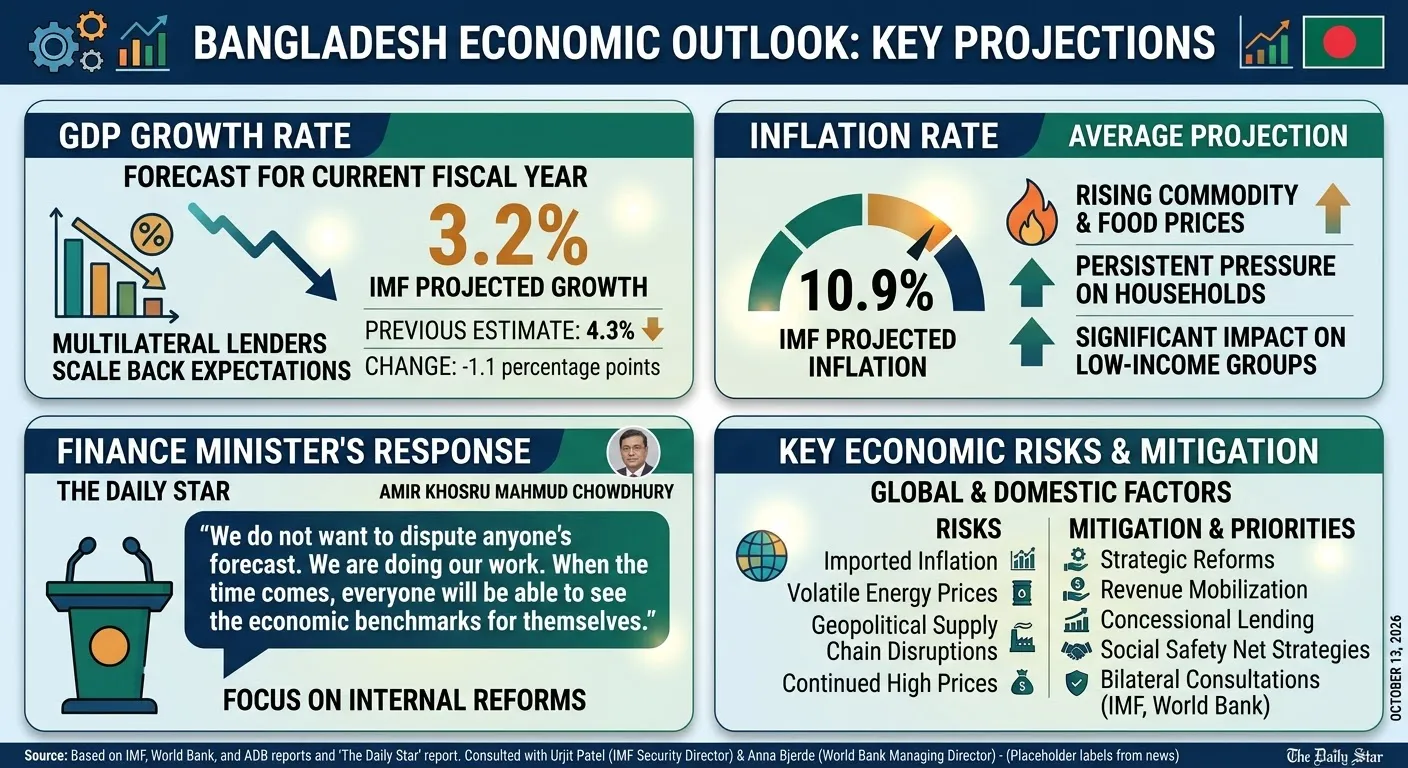
The International Monetary Fund (IMF) has further downgraded Bangladesh’s economic outlook, projecting that Gross Domestic Product (GDP growth) may slow down to 3.2 percent for the current fiscal year—a downward revision of 1.1 percentage points from its previous estimate.
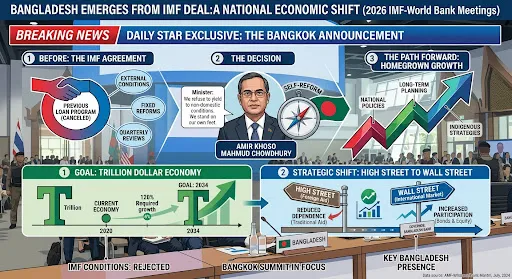
The projection comes as part of the IMF’s latest World Economic Outlook, released on Tuesday at the ongoing Annual Meetings of the IMF and the World Group in Bangkok, Thailand.
The grim forecast compounds mounting economic pressures, as the IMF projects average inflation to climb to 10.9 percent, posing continued hardship for low-income households grappling with persistent high commodity and food prices. Other global lenders have similarly scaled back expectations: the Asian Development Bank (ADB) has forecast 4.0 percent growth, while the World Bank estimates 3.4 percent.
Finance Minister’s Response
Addressing the figures, Finance and Planning Minister Amir Khosru Mahmud Chowdhury adopted a measured tone.
"We do not want to dispute anyone's forecast," Minister Khosru told reporters in Bangkok. "We are doing our work. When the time comes, everyone will be able to see the economic benchmarks for themselves."
A high-powered Bangladeshi delegation—led by Finance and Planning Minister Amir Khosru Mahmud Chowdhury, Finance and Planning Adviser Professor Dr. Rashed Al Mahmud Titumir, and Bangladesh Bank Governor Md. Mostakur Rahman—is attending the week-long global summit in the Thai capital.
On the sidelines of the conference, the Bangladeshi delegation sought closer collaboration and support from multilateral lenders, holding high-level discussions with IMF Security Director Urjit Patel and World Bank Managing Director Anna Bjerde.
Global Context and Uncertainties
The global economic landscape presented at the Bangkok meetings—the first such gathering hosted in Thailand in 35 years—highlights both resilience and mounting vulnerabilities. The IMF projects global growth at 3.1 percent for 2026 and 3.4 percent for 2027, driven in part by robust artificial intelligence investments that offset headwinds from heightened energy and food costs resulting from Middle Eastern conflicts.
However, downside risks remain prominent, with the global lender cautioning that prolonged geopolitical tensions, supply chain disruptions, and volatile commodity markets could prolong elevated inflationary pressures worldwide.