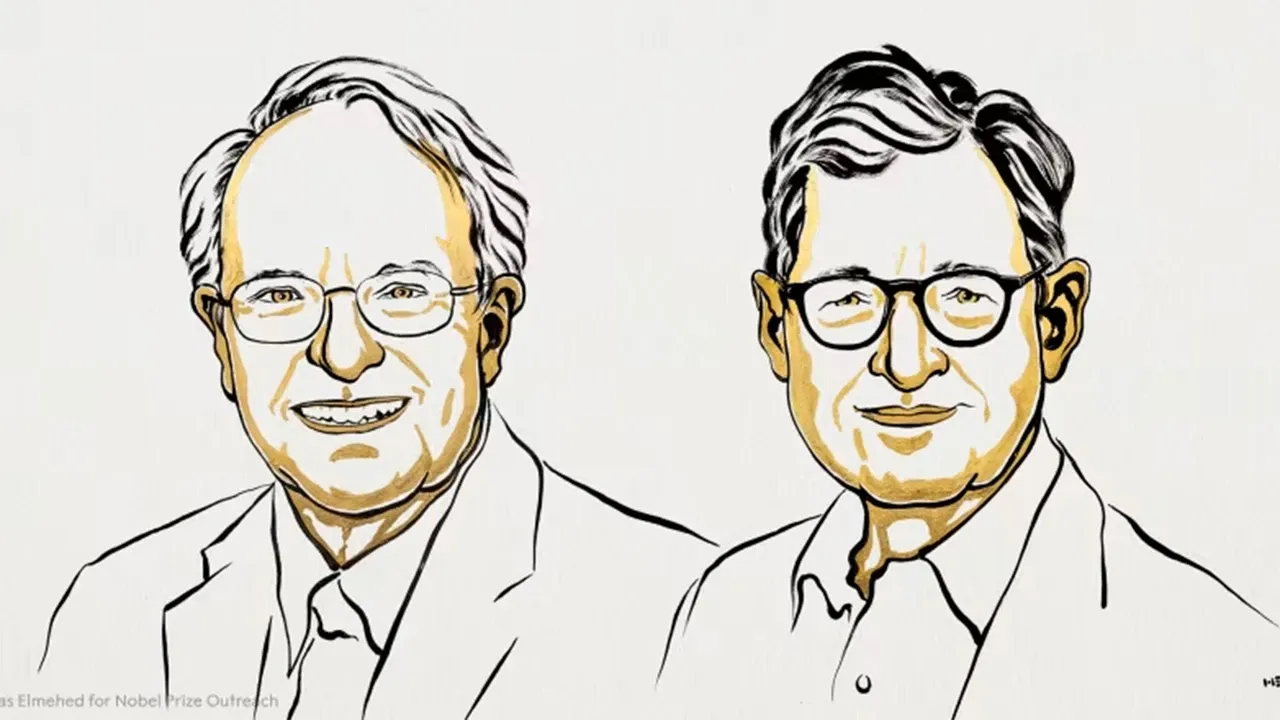
American professors Robert E. Hall and Michael Woodford have won the 2026 Nobel Prize in Economic Sciences for developing economic models that help governments and central banks reduce the impact of external shocks and stabilise economies.
The Royal Swedish Academy of Sciences announced the award in Stockholm on Monday, October 12. In a statement, the academy said the laureates had helped economists and policymakers better understand how to smooth out economic fluctuations. Their models have proved valuable in addressing economic downturns and improving stabilisation policies.
Hall, born in 1943 in Palo Alto, California, is a professor at Stanford University. Woodford, born in 1955 in Chicopee, Massachusetts, is a professor at Columbia University. The two laureates will share prize money of 12 million Swedish kronor, receiving 6 million kronor each.
John Hassler, chair of the Committee for the Prize in Economic Sciences, said their work had provided a stable theoretical foundation for economic models now used by central banks and governments around the world. He said the models help policymakers prepare for economic shocks, including energy crises and sudden changes in household consumption.
Rather than relying primarily on statistical relationships among macroeconomic variables such as inflation, production and consumption, Hall and Woodford developed models grounded in microeconomics. Their approach examines how the decisions of individual households and businesses collectively influence the wider economy.
A central idea behind their models is that households and businesses consider the future when making decisions, including how much to save and what prices to charge for goods. The academy said governments and central banks can influence these expectations by communicating their fiscal and monetary policy plans. Such communication, alongside appropriately timed policy measures, can help guide the economy towards greater stability.
The award’s formal name is the Sveriges Riksbank Prize in Economic Sciences in Memory of Alfred Nobel. It was established by Sweden’s central bank in 1968 and was first awarded in 1969. Unlike the original Nobel Prizes established under Alfred Nobel’s will, the economics prize was created separately in his memory.
The announcement of the economics prize marked the end of this year’s Nobel Prize announcements. Earlier, South African judge and human rights activist Navi Pillay was named the Nobel Peace Prize laureate on Friday, while Canadian writer Anne Carson received the Nobel Prize in Literature on Thursday.