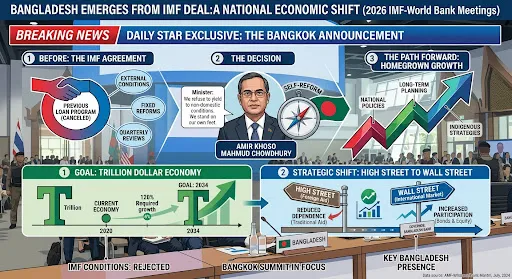
The biggest and most influential policy-making summit of the global economy begins today (Monday) in the Thai capital, Bangkok, with all preparations finalized for the 2026 IMF-World Bank Annual Meetings.
Marking its return to Thailand after 35 years, the prestigious global summit has drawn over 15,000 delegates—including finance ministers, central bank governors, development policymakers, private sector executives, researchers, civil society leaders, and business tycoons from 191 countries. The week-long discussions will focus on global economic conditions, financial stability, and poverty alleviation.
High-profile global leaders attending the summit include Swiss President Guy Parmelin—marking the first visit to Thailand by a Swiss president in 22 years—and Singaporean President Tharman Shanmugaratnam.
A high-level Bangladesh delegation is participating in the meetings, led by Finance and Planning Minister Amir Khoso Mahmud Chowdhury, Finance and Planning Adviser Professor Dr. Rashed Al Mahmud Titumir, and Bangladesh Bank Governor Md. Mostakur Rahman.
Bangladesh at the Center of Discussions: Old Loan Deals Canceled
While global economies grapple with shifting international dynamics, Bangladesh has emerged as a major talking point at the summit. The country is presenting its stance on homegrown economic reforms and a pivot away from rigid foreign borrowing.
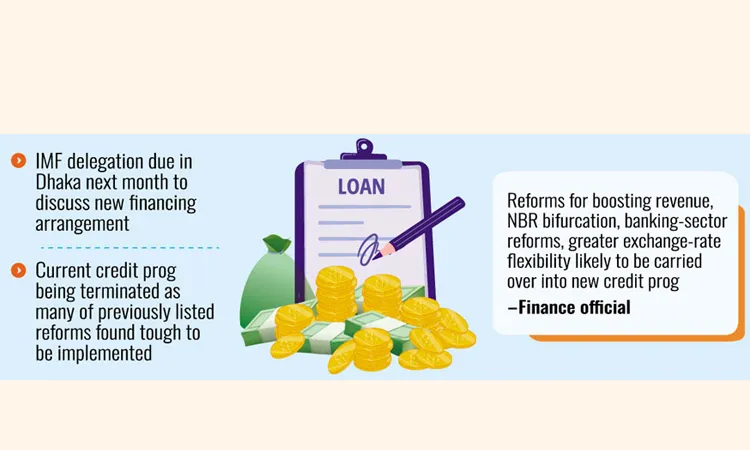
Speaking on the sidelines of the summit, Finance Minister Amir Khoso Mahmud Chowdhury stated that Bangladesh has canceled its previous loan agreements with the International Monetary Fund (IMF), refusing to yield to conditionalities that do not align with domestic ground realities.
“We have canceled the IMF loan agreement to take the initiative of standing on our own feet,” Minister Chowdhury said. He emphasized that Bangladesh aims to reach a trillion-dollar economy by 2034 without heavy reliance on donor agency hand-outs.
Outlining a strategic shift for the nation’s financial ecosystem, the Finance Minister added, “To keep pace with world-class economies, we must now transition from ‘High Street to Wall Street.’ We are placing strong emphasis on the bond market, securitization, and equity markets for long-term financing, reducing our reliance on traditional foreign financing by sourcing funds directly from the international market.”
Mega Logistics and Security in Bangkok
To ease traffic congestion in Bangkok during the October 12–18 summit, authorities have ordered government offices to implement "work from home" arrangements on October 12, 14, and 15. October 13 has been designated a regular public holiday, while October 16 has been declared a special government and bank holiday. Private institutions have also been urged to adopt flexible schedules.
According to Thailand’s Ministry of Finance, the summit is expected to inject between 1.05 billion and 2.25 billion baht into the Thai economy. To curb carbon emissions, over 300 electric vehicles (EVs) have been deployed for delegate transport.
However, weather remains a variable concern, with the Bangkok Metropolitan Administration (BMA) forecasting heavy to very heavy rains in and around the capital, raising concerns over potential waterlogging.
To ensure seamless security, Thailand’s Tourism Police Bureau has deployed approximately 500 officers to secure venues, hotels, and tourist spots using plainclothes surveillance, regular patrols, and drone monitoring. Security details are being coordinated alongside embassies from 39 countries to ensure the safety, transport, and smooth information exchange for all foreign dignitaries.