Forty-one years ago, a baby boy was born into a poor family in Funchal, the capital of Madeira, Portugal's autonomous island region. Few could have imagined that his extraordinary love for football, relentless hard work and unwavering belief in his dreams would turn him into a generation-defining icon and one of the greatest record-breakers in sporting history.
Overcoming poverty, he would rise to become one of the world's wealthiest and most successful athletes.
For more than two decades, Cristiano Ronaldo has remained at the centre of global football. His supporters have divided into rival camps, but his name has become an inseparable part of the sport's history. His career is decorated with goals, records, trophies and individual honours. His rise, struggles, achievements and influence are worthy of an epic in their own right.
Now, however, one chapter is coming to an end. Ronaldo will no longer wear Portugal's national team jersey. On Thursday (November 5), he announced his retirement from international football in a social media statement, bringing an end to his long journey with the national side after 234 appearances and 146 goals, along with European Championship and Nations League titles.
Ronaldo's international career at a glance Ronaldo made his international debut for Portugal against Kazakhstan in 2003. Gradually, he became the team's most dependable figure.
Portugal reached the final of Euro 2004 but missed out on the title after losing to Greece on home soil. Although the defeat ended the country's hopes of lifting the trophy, the tournament offered an early glimpse of Ronaldo's immense potential.
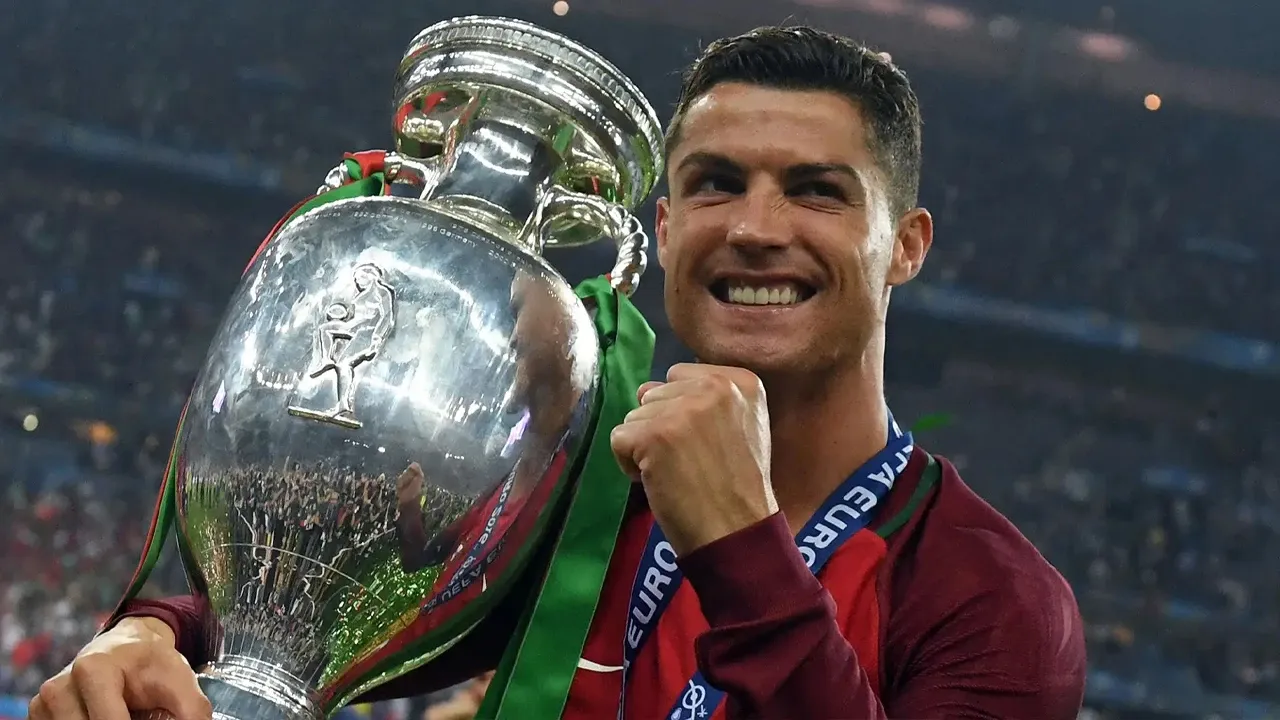
Euro glory and history as captain The brightest chapter of Ronaldo's international career came with Portugal's triumph at the 2016 European Championship.
He suffered an injury and had to leave the field during the final against France. However, he continued encouraging his teammates from the sidelines, effectively taking on a coaching role. Portugal eventually defeated hosts France 1-0 to win the European Championship for the first time.
At Euro 2020, Ronaldo scored five goals to finish as the tournament's top scorer. He retires as the European Championship's all-time leading scorer, with 14 goals.
Under his captaincy, Portugal also won the UEFA Nations League in 2019.
Goal after goal, record after record One of Ronaldo's greatest achievements in international football is holding the record for the most goals in men's international football.
He surpassed Iran's Ali Daei, who had scored 109 international goals, with a brace against Ireland in 2021. Ronaldo subsequently extended the record to 146 goals.
He also holds the record for the most appearances for a men's national team, with 234 matches for Portugal.
At the 2022 FIFA World Cup in Qatar, Ronaldo scored a penalty against Ghana to become the first player to score in five consecutive World Cups.
However, winning the World Cup remained beyond his reach. Portugal's run to the semi-finals in 2006 remains his best achievement at the tournament.
Success at the highest level of club football Ronaldo's achievements extend well beyond international football. His club career has also been filled with major honours.
After moving from Sporting Lisbon to Manchester United, he established himself on the global stage. He won three Premier League titles and one Champions League trophy with the English club. In 2008, he claimed his first Ballon d'Or.
He subsequently enjoyed one of the finest periods of his career at Real Madrid. Scoring 450 goals for the Spanish giants, he became the club's all-time leading scorer. He also won multiple trophies, including four Champions League titles.
Ronaldo later won the Serie A title with Juventus. Overall, he became the first player to win the Champions League five times.
In 2024, Ronaldo scored against Croatia for Portugal to reach the milestone of 900 goals in professional football. His career tally has since climbed to 985.
Reaching 1,000 career goals remains his biggest ambition as he continues playing for Saudi Arabian club Al-Nassr at the age of 41.