


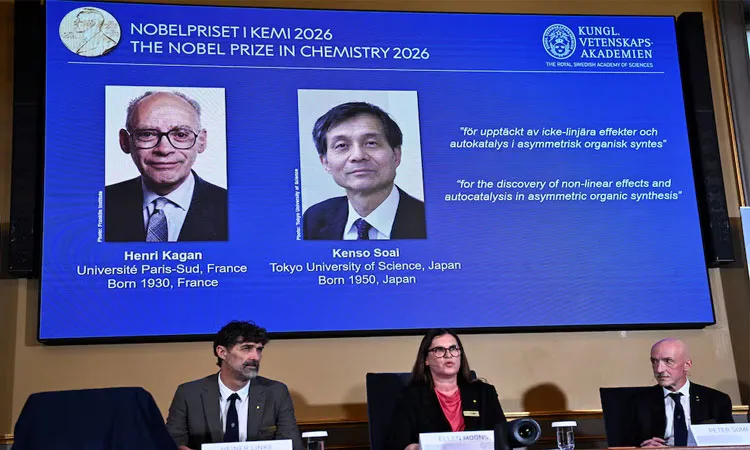
Scientists Henri Kagan of France and Kenso Soai of Japan won the 2026 Nobel Prize in Chemistry on Wednesday for breakthroughs in asymmetric organic synthesis that transformed pharmaceutical development.
The Royal Swedish Academy of Sciences honored the duo "for the discovery of non-linear effects and autocatalysis in asymmetric organic synthesis."
Many essential biological molecules exist in two mirror-image forms known as chiral molecules similar to left and right hands. In nature, living cells almost exclusively use one specific form a property called "homochirality." For decades, producing only one mirror-image variant in a lab was a major challenge, despite being vital for pharmaceutical manufacturing where only one specific form yields the desired medicinal effect.
Kagan took a major step forward in 1986 by discovering non-linear effects with allowing chemists to amplify small imbalances and generate one desired mirror-image molecule over the other. Soai later developed asymmetric auto catalysis where a reaction product catalyzes its own formation with multiplying the target molecule exponentially.
Their groundbreaking work solved a longstanding chemical mystery and provided key tools for producing safer and more effective medicines.
The laureates will share the 12 million Swedish kronor ($1.2 million) prize and receive their medals from Sweden’s King Carl XVI Gustaf in Stockholm on December 10.

