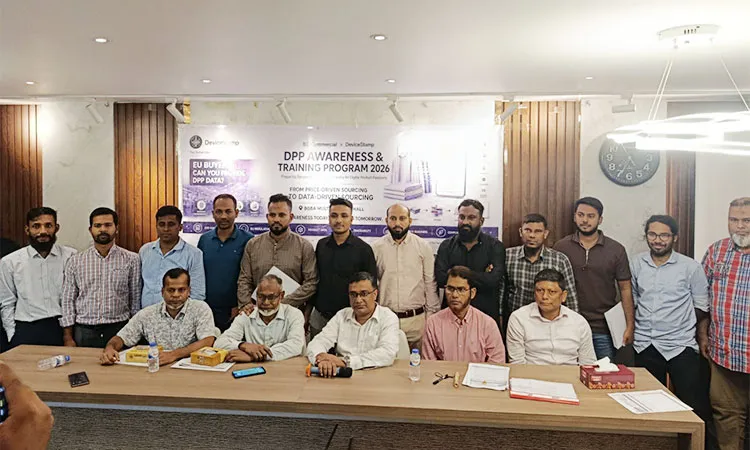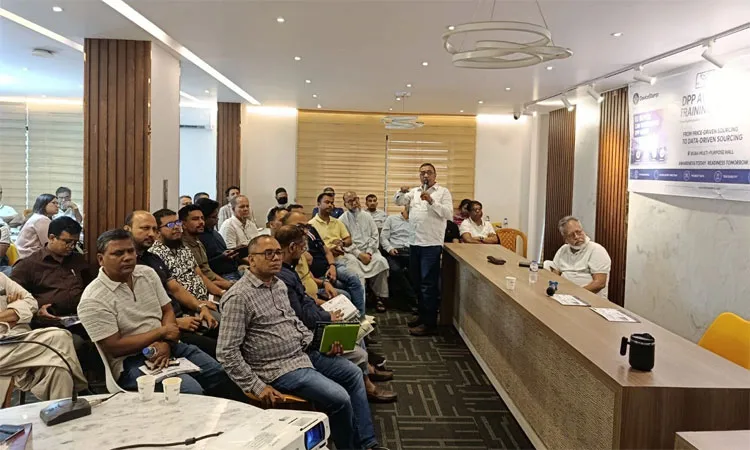
Bangladesh's garment sector took a step toward meeting new European Union regulations as the Bangladesh Garment Buying House Association (BGBA) and DeviceStamp Bangladesh Limited jointly organized a free awareness and training session on the EU's Digital Product Passport (DPP) requirements. The programme held at the BGBA Multipurpose Hall in Uttara, Dhaka aimed to prepare owners and executives of buying houses for upcoming compliance standards.
The event drew strong interest from the industry. BGBA President Md. Abdul Hamid Pintu, Vice President (Finance) Emdadul Haque Miaji and Vice President (Admin) Roman Mia represented the association while DeviceStamp was represented by Global CEO Björn Eriksson, Global Head of Brand Solutions Paulina Kruk and DeviceStamp Bangladesh Country Director Md. Nazrul Islam. Owners and management representatives from various BGBA-member buying houses also attended.

The session comes as the industry prepares for the DPP under the EU's Ecodesign for Sustainable Products Regulation (ESPR) framework. Organizers explained that buying houses play a central role in the supply chain securing international orders, developing products, selecting factories and coordinating quality control and shipments. As the main commercial link between European buyers and Bangladeshi factories also buying houses will need to understand and help implement DPP requirements across their supplier networks.
What Is the Digital Product Passport?
Md. Nazrul Islam, the programme's lead trainer explained that the DPP is more than a simple QR code or IT tool. "A QR code simply opens a gateway to view information" he said "but if that information isn't structured, connected, verified and evidence-backed buyers won't be able to trust it."
He emphasized that buying houses must go beyond their traditional role as order collectors. "They serve as a vital bridge for trust, information and execution between EU buyers and Bangladeshi factories," he said, adding that early preparation could help protect existing EU business relationships while opening doors to new opportunities.

The training covered several key areas: the fundamentals of DPP compliance, the types of data European buyers may request, methods for assessing a factory's data readiness, the connections between product identity and material sourcing, the importance of traceability and sustainability evidence and the coordinating role buying houses must play going forward.
International Perspective on Market Trends
Joining virtually, DeviceStamp Global CEO Björn Eriksson spoke about the global progress of DPP implementation and its growing importance in the European market. He said that in future negotiations between buyers and suppliers, the accuracy, traceability and verifiability of product data will matter just as much as price, quality and delivery timelines. According to Eriksson, Bangladeshi buying houses and factories that prepare proactively can position themselves as trusted strategic partners for European brands.
Paulina Kruk, DeviceStamp's Global Head of Brand Solutions also addressed the session drawing on her extensive experience in the European garment and retail trade including her recent role as Country Leader for Okaïdi in Poland. She stressed that European brands are looking for more than good products they want reliable sourcing partners. "Buying houses and factories that understand buyer needs, provide accurate information promptly and proactively identify data gaps in the supply chain will be better positioned to earn buyer trust and build long-term business relationships" she said.
Strong Industry Response
The training's popularity reflected the urgency many in the industry feel about DPP compliance. All available seats were filled within two hours of registration opening and due to limited capacity, many of the roughly 571 interested organizations could not be accommodated in the first session. To meet this demand also a follow-up session has been scheduled for September 19, 2026 at the same venue and time.
Organizers said such programmes will continue as part of a broader effort to raise awareness about DPP requirements across Bangladesh's apparel and textile supply chains, identify data gaps within companies and help the industry build practical readiness over time.
DeviceStamp Bangladesh Ltd. is a Bangladesh-Poland joint venture that supports export-oriented Bangladeshi companies with DPP readiness, structured product data management, traceability systems and digital product information tailored for the European market.
The initiative's core message was summed up simply understand the DPP prepare the factory and secure and expand EU business.
As the EU moves forward with sustainability-focused trade regulations, industry observers say Bangladesh's garment sector one of the world's largest apparel exporters will need to adapt quickly to maintain its competitive edge in the European market. Programmes like this one are seen as an early but important step in that direction also helping bridge the knowledge gap between European regulatory requirements and on-the-ground manufacturing realities in Bangladesh.