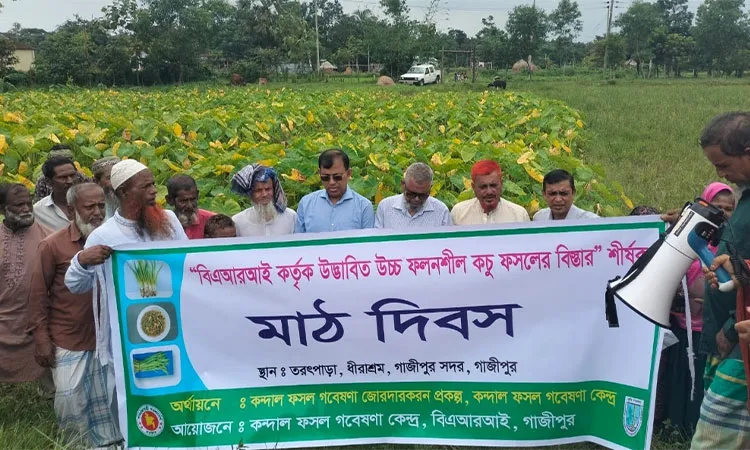
The Bangladesh Agricultural Research Institute (BARI) has developed nine improved, high-yielding varieties of panikachu (water taro). These new varieties are free from throat-irritating galls (acridity) and cook evenly, offering a significant boost to local agriculture.
Dr. Md. Mosharraf Hossain Molla, BARI Director (Services and Supply), shared the development during a field day discussion in Taratpara, Gazipur, on July 16. The event, organized under the Tuber Crop Research Strengthening Project, focused on expanding the cultivation of these improved crops.
Dr. Molla highlighted that kachur lati (taro stolon) is a highly popular vegetable across all demographics, accounting for roughly a quarter of the country’s total taro production. He emphasized that during the monsoon season, when other vegetables are scarce, taro leaves and related crops play a vital role in securing the national vegetable supply.
Project Director Dr. Md. Khorshed Alam, who chaired the event, underscored the crop's public health value. He noted that taro is rich in iron, and consuming its leaves plays a critical role in combating anemia.
Dr. Md. Shamsul Alam, Chief Scientific Officer, attended as a special guest. BARI Senior Scientific Officer Dr. Ferdousi Begum, local farmers, and agricultural extension workers were also present to discuss the practical benefits of the new varieties.