

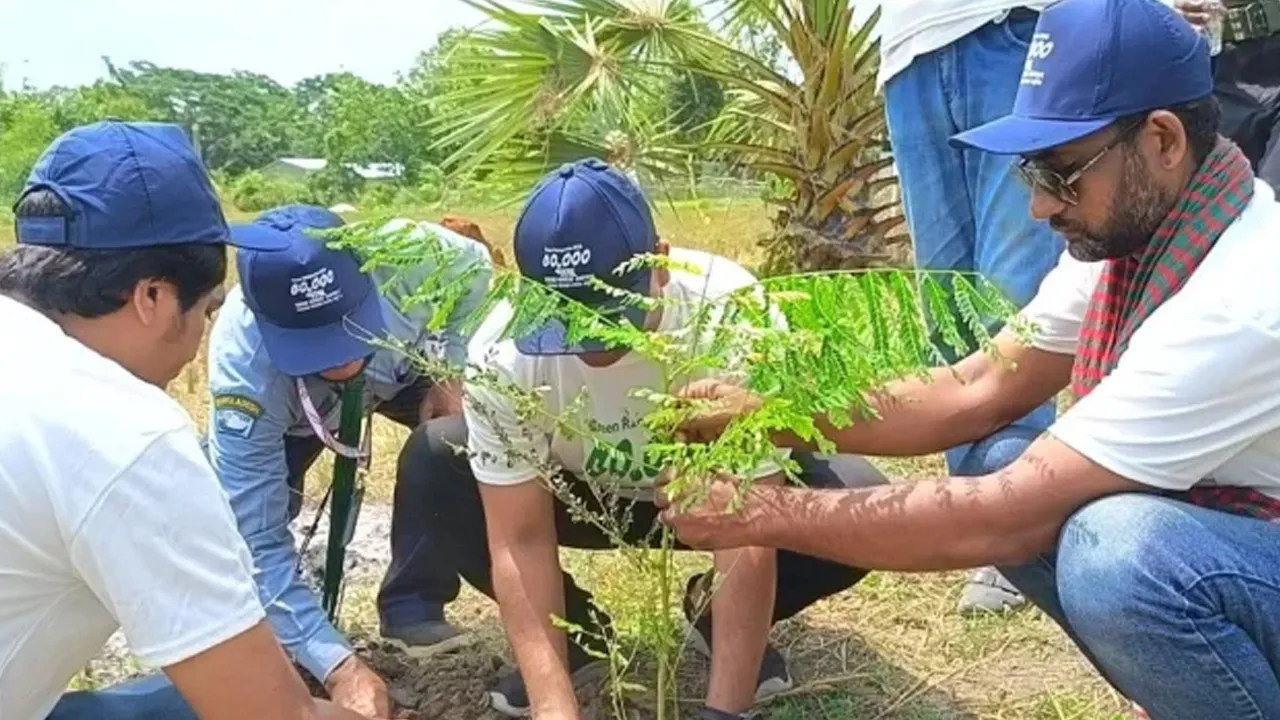
A government progress report in Nalchity, Jhalokathi, has reportedly stated that 18,519 trees were planted under a tree-planting programme, despite allegations that no such plantation took place in the field.
The allegations involve 10 Union Parishads and one municipality in Nalchity Upazila. Several officials and responsible representatives of the institutions have reportedly acknowledged that trees could not be planted at the field level.
Local residents and concerned citizens have called for an investigation to verify the allegations and determine whether false information was submitted in government records. They have also demanded legal action if the allegations are proven.
Thousands of trees on paper, but what is the reality?
The tree-planting programme was undertaken under directives from the Local Government Division to protect environmental balance and increase greenery. Under the programme, the relevant institutions were expected to submit progress reports within a specified period, along with necessary information and evidence of plantation.
However, the report submitted in Nalchity states that a total of 18,519 trees were planted, raising questions about whether the reported figure is reflected on the ground.
Locals say visible and verifiable information is needed on where and how many saplings were planted, who planted them, where the saplings were sourced and how they have been maintained after planting.
‘There was no allocation, so no trees were planted’
Several officials connected with the unions reportedly said they could not carry out tree plantation because they had not received the necessary funds or allocation.
The statements of Acting Chairman of Dapdapia Union Jamal Hossain, Kulakathi Union Administrator and Upazila Rural Development Officer Obaidul Islam, Acting Chairman of Siddhakathi Union Mazharul Islam, and Acting Chairman of Ranapasha Union Labu Hossain were cited in connection with the issue.
Administrators and officials from Nachanmahal, Kushangal, Mollahat and Bairaibpasha unions also said they could not plant trees because there was no required funding or allocation.
They said union parishad secretaries prepared and submitted progress reports quickly after the Upazila Parishad urged them to submit the reports. They added that tree planting would be carried out if allocations were provided in the future.
Issues that need investigation
According to local residents, a field-level investigation, rather than a review of documents alone, is necessary to establish the facts.
They said investigators should verify:
The locations of the 18,519 trees mentioned in the report; The number of trees reportedly planted by each union and the municipality; Documents relating to the purchase or collection of saplings; Allocation and expenditure records; Plantation sites and land details; Photographs, videos and other evidence of planting; The responsibilities of the officials and employees concerned; and The process through which the report was prepared and approved. UNO’s response
Nalchity Upazila Nirbahi Officer (UNO) and municipality administrator Pratik Kumar Kundu said he was unaware of the matter.
However, he said, “If an investigation establishes the truth of the allegation, strict legal action will be taken against those involved.”
‘Responsibility must be established if government reports contain false information’
Concerned citizens have questioned who would be responsible if a government development programme’s progress report contains significant discrepancies with the actual situation.
They said that if thousands of trees were reported as planted without actual plantation, an investigation should determine who prepared the information, whose instructions were followed and who approved the report.
According to them, the objective of a tree-planting programme should not simply be to meet numerical targets on paper. It should involve planting trees in reality, ensuring their survival and securing long-term environmental benefits.
They have therefore called for an impartial investigation and demanded that future programmes include geo-tagged photographs, location-based lists and mandatory field-level verification.
Calls for a high-level investigation
Local concerned groups have called for a prompt high-level investigation into the reported figure of 18,519 trees.
They said an investigation would not only establish whether the allegations are true but would also clear anyone found not to be responsible. If irregularities or submission of false reports are proven, appropriate action can then be taken against those responsible.
Locals have demanded the formation of an investigation committee, field inspections of the unions and municipality, and verification of the submitted progress reports against actual conditions.
The central question remains: If 18,519 trees were actually planted, where are they? And if they were not planted, how did such a large figure appear in the government report?