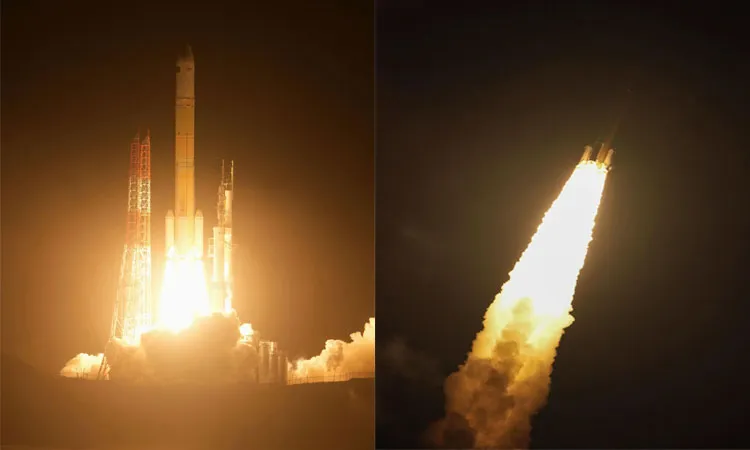
Japan launched a landmark spacecraft on Tuesday for embarking on a five-year international mission to explore Mars’ moons and bring home unprecedented soil samples.
Led by the Japan Aerospace Exploration Agency (JAXA), the Martian Moons Exploration (MMX) mission lifted off before dawn from Tanegashima Island. Mission controllers celebrated as the spacecraft successfully separated from its rocket booster an hour later.

The $578 million project a collaboration involving NASA and the French, German and European space agencies aims to solve long-standing mysteries about the origin of the Martian system and the ingredients for life.

Target: Phobos and Deimos
While NASA and China have previously landed on Mars, no country has ever reached its small moons, Phobos and Deimos or successfully brought samples back from the Martian system.
The 5-ton MMX spacecraft will reach Mars by late next summer. It will enter orbit around Phobos, a lumpy, potato-shaped rock spanning just 22 kilometers. The mothership will deploy a small French-German rover named Idefix.
Designed to navigate Phobos’ extremely low gravity, the microwave-sized rover will spend 100 days scouting the terrain at a cautious speed of 1 millimeter per second to identify safe landing zones.

In late 2028 or 2029 primary lander will touch down for just two hours to drill and collect at least 10 grams of dust and rock. After conducting flybys of Deimos the craft will depart the Martian system in 2030 with samples scheduled to land in the Australian desert in 2031.
Unlocking Cosmic Origins
Scientists suspect Phobos and Deimos are either captured asteroids or debris from a collision between Mars and a massive object. Because debris from Mars likely settled on Phobos with retrieving these samples could offer valuable insights into both planetary formation and Martian history.
The stakes remain high. Exploration of Mars has seen many failed attempts, including past Russian and Japanese missions. However the Japan brings valuable expertise with having successfully returned samples from two asteroids.
China also plans to retrieve Mars samples by 2031, setting up a friendly scientific race. Meanwhile the NASA is refining plans to retrieve samples collected by its Perseverance rover.
If successful the MMX mission will deliver the first-ever samples from the Martian system also offering clues that will shape future robotic and human missions to the red planet.