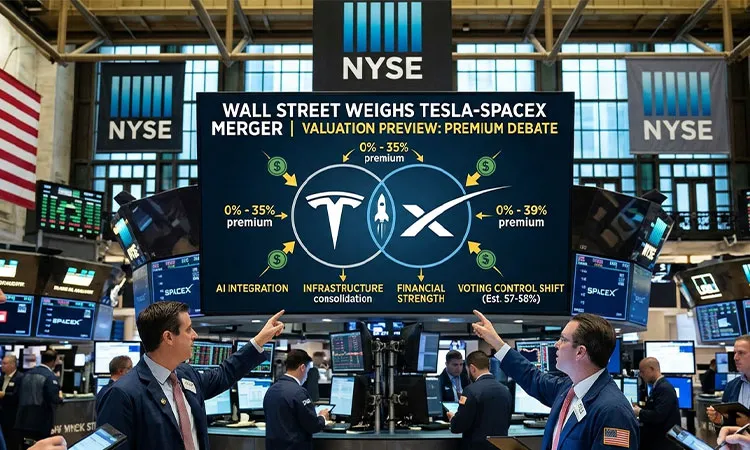
Wall Street analysts increasingly view a merger between Tesla and SpaceX as a matter of "when" not "if." However the industry experts are deeply divided over one crucial detail is how much Tesla shareholders should actually get paid.
Predictions for the payout premium to swap Tesla stock into SpaceX shares range anywhere from zero up to 35%. With Tesla valued at roughly $1.5 trillion even a small percentage shift represents hundreds of billions of dollars. Elon Musk describes himself as a "conflicted party" also stated that board committees have yet to agree on final terms though investors expect a formal proposal in the coming months.
Following the hype Tesla shares climbed over 3% while SpaceX jumped 11% also adding about $210 billion to its valuation.
Strategically, combining the two tech giants makes sense. Both companies are heavily invested in artificial intelligence and autonomous systems with joint projects like the "Terafab" chip plant. SpaceX currently spends heavily on space infrastructure and AI expansion and a merger could ease cash flow strains by pooling financial resources and streamlining corporate overhead.
As Deepwater Asset Management’s Gene Munster put it, "What Tesla needs, SpaceX has and what SpaceX needs also Tesla has. Both operate under Elon’s vision of building a vertical AI company."
Still several big roadblocks lie ahead:
The Premium Battle: Big banks like JPMorgan and RBC Capital think Tesla investors will demand a 20% to 35% premium. However some fund managers argue a high markup would unfairly dilute SpaceX shareholders.
Musk’s Voting Power: Musk holds around 85% of voting control at SpaceX but only 20% at Tesla. Analysts estimate a merger would give him roughly 57% to 58% voting power in the combined empire.
The Voting Hurdle: To pass the deal, Tesla requires a majority vote from all outstanding shares meaning any uncast vote automatically acts as a vote against the merger.
With unproven tech like orbital data centers and humanoid robots requiring years of heavy capital also Wall Street remains cautious about governance and execution risks as official details unfold.