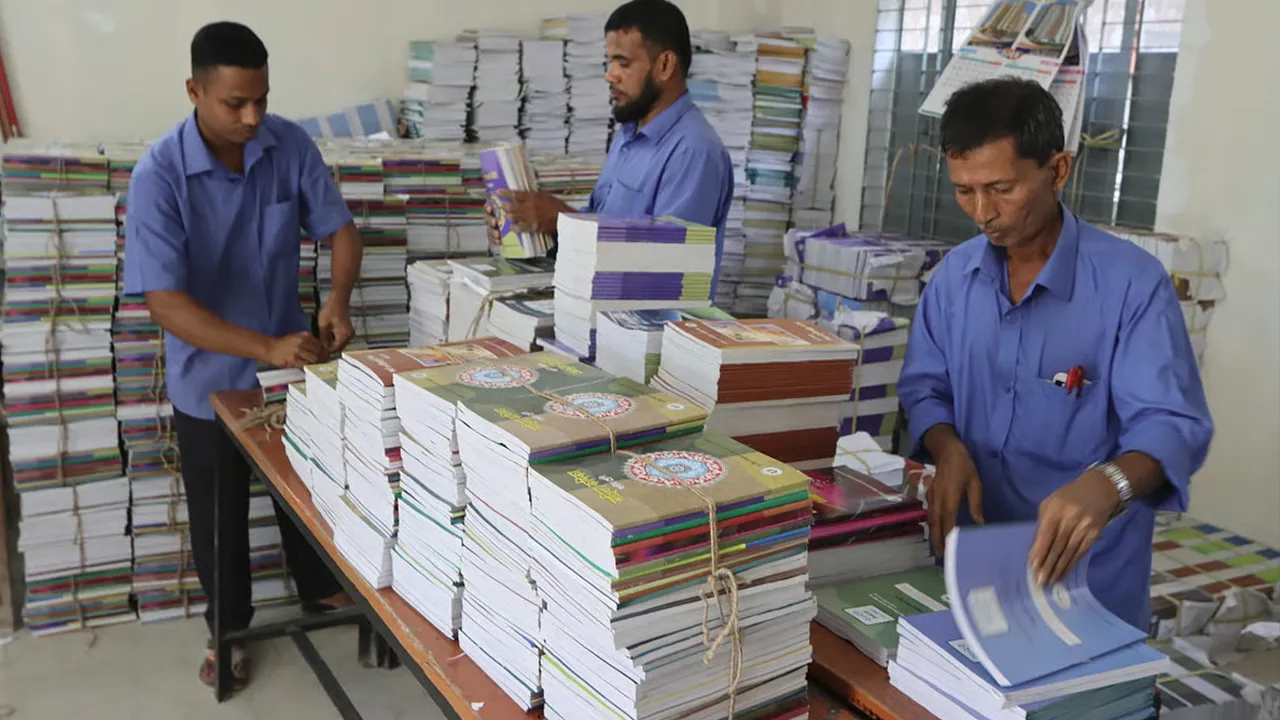
For the 2027 academic year, the government aims to supply a total of 306,198,101 textbooks for primary and secondary-level students. The estimated cost of the programme is around Tk 2,000 crore.
With printing and distribution deadlines approaching, the extent to which production can accelerate in the coming weeks will be crucial to mee
Concerns are growing over whether Bangladesh can deliver all free textbooks to schools by December for the 2027 academic year, as printing presses report power outages and some publishers cite paper shortages.
At a printing press in Savar, machines producing free textbooks suddenly came to a halt because of load-shedding. Production resumed shortly afterwards using a generator. According to printing companies, generating electricity this way costs almost twice as much as using the regular power supply.
Meanwhile, printing presses in Matuail, Dhaka, have reported shortages of paper needed to print the books.
Under printing contracts, publishers are required to supply 50 per cent of their allocated books within 40 days. However, several presses have failed to meet the deadline despite the stipulated period having passed.
The National Curriculum and Textbook Board (NCTB) has set October 30 as the target for delivering all pre-primary, primary and Ebtedayee textbooks to distribution points across the country. So far, slightly more than 65 per cent of these books have reached the field level.
For secondary and Dakhil textbooks, the deadline is November 30. However, only around 25 per cent of the books have been delivered so far.
Tofail Khan, former president of the Bangladesh Printing Industries Association, criticised the NCTB’s handling of the situation, arguing that earlier action could have prevented the problems from escalating.
“If the NCTB had addressed these problems and taken steps to resolve them from the beginning, the situation would not have become so severe and a crisis could have been avoided,” he said.
Khan alleged that the problems were being allowed to persist and warned that they could later be used as excuses to facilitate the supply of substandard textbooks in December.
NCTB Chairman Mohammad Fakhrul Mawla, however, dismissed the concerns and expressed confidence that all textbooks would be delivered to their destinations by December.
“So far, no paper crisis has been reported to me. No printing press has complained to me about a paper shortage. If anyone has made such a claim, it is incorrect,” he said.
For the 2027 academic year, the government aims to supply a total of 306,198,101 textbooks for primary and secondary-level students. The estimated cost of the programme is around Tk 2,000 crore.
With printing and distribution deadlines approaching, the extent to which production can accelerate in the coming weeks will be crucial to meeting the government’s target.
ting the government’s target.