While the World Bank and Asian Development Bank had lowered Bangladesh’s GDP growth forecast due to the Persian Gulf crisis and domestic vulnerabilities, the International Monetary Fund has kept its earlier projection unchanged.
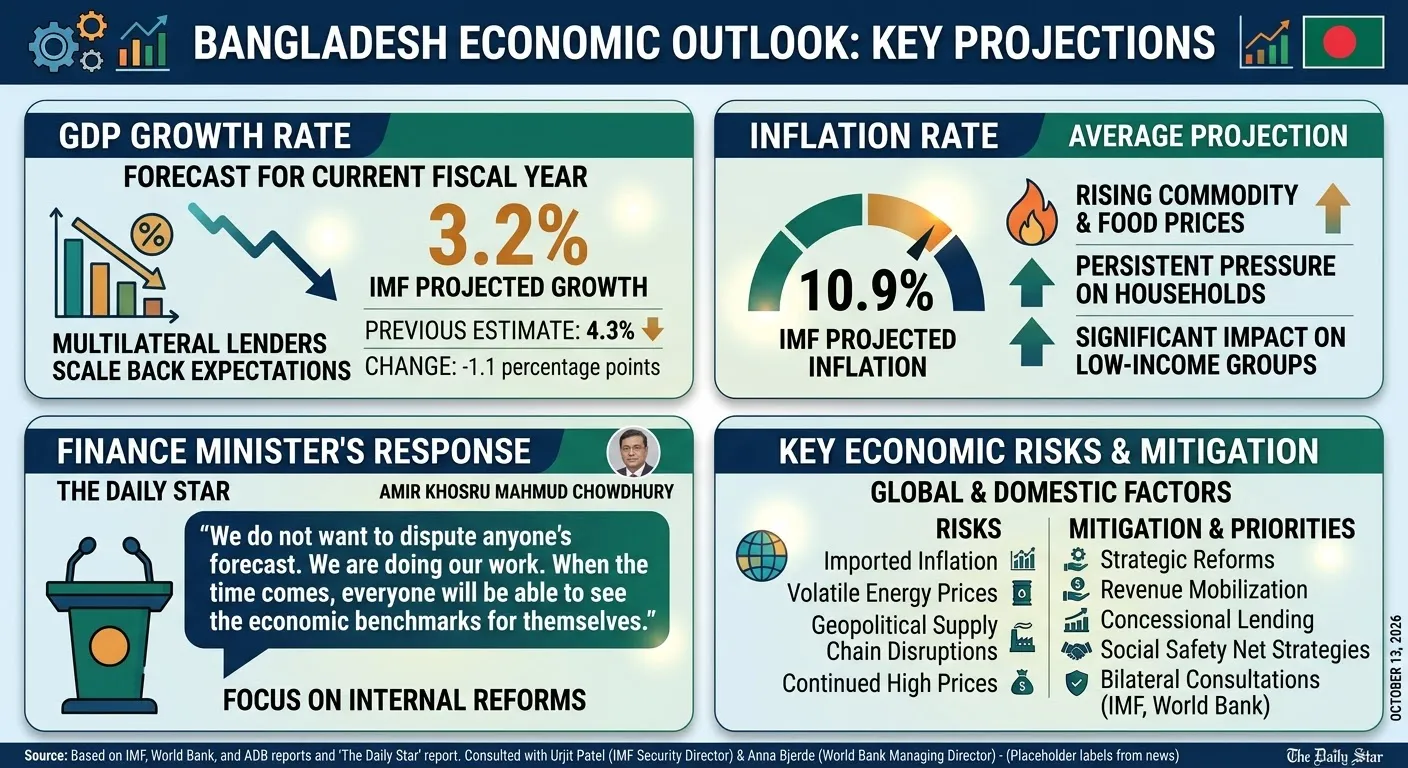
The IMF’s World Economic Outlook released on Tuesday projects Bangladesh’s GDP growth at 4.7 per cent for FY2025-26, which was the same as its earlier projection from January.
However, the IMF’s growth projection is set to dip further to 4.3 per cent in the next fiscal. The World Bank revised its projection down to 3.9 per cent from 4.6 per cent, while the ADB revised its forecast down to 4 per cent from 4.7 per cent.
Former World Bank lead economist Zahid Hussain told Business Times that the IMF’s forecast “appears rather strange,” adding that “it is the same as projected in their Article IV report released in January 2026.” The absence of any impact of the war in the current fiscal year is inconsistent with their own assumption that economies with vulnerabilities and limited buffers are likely to be hit hardest.
Bangladesh is one such economy. He also said that individuals and firms in Bangladesh have been living with the impacts of growth and inflation ever since the war started. There is no reason, in fact or logic, to believe Bangladesh will remain insulated from the impact of the war for four months. Hussain noted that the IMF’s 4.3 per cent growth projection for FY27 is more realistic if its reference scenario, in which the war shock fades by June, materialises. The government, however, remains confident, insisting that GDP growth will reach 5 per cent in 2026.