


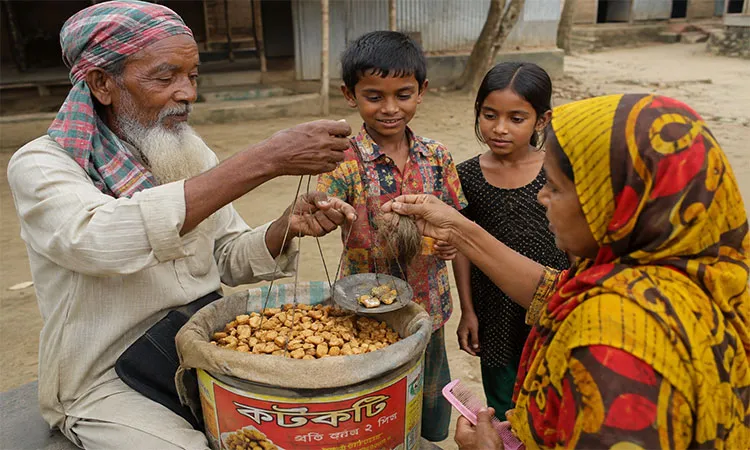
Once upon a time, the familiar call of a travelling vendor could suddenly be heard along village roads, neighbourhoods and courtyards: “Khatkati for sale… Khatkati!”
Hearing the call, children would rush out of their homes. Some would bring old clothes, others scraps of paper, while some would carry hair collected after combing. In exchange, they would receive crunchy and delicious khatkati, a traditional local snack.
Muksudpur of Gopalganj was once familiar with this unique practice. Alongside cash transactions, travelling vendors would also exchange khatkati for hair and various used household items. It was a simple yet memorable part of rural life.
Women, in particular, would often collect the hair that fell out while combing. When the vendors came to their homes, the collected hair could be exchanged for khatkati or other small snacks. For children, the arrival of the vendors was a source of excitement, while for households, it offered an unusual way to make use of otherwise unwanted items.
The Familiar Call Has Faded Away
With the passage of time, people's lifestyles have changed significantly. A wide variety of packaged snacks are now readily available in local markets. The travelling vendors who once moved from village to village have gradually disappeared.
Amid the rapid pace of modernization, the old tradition of exchanging hair for khatkati has also slowly vanished from Muksudpur.
For many members of the younger generation, the practice may sound almost unbelievable. Yet just a few decades ago, it was a familiar and natural part of rural life.
Still Alive in the Memories of the Elderly
For elderly residents of Muksudpur, those days remain vivid memories. They recall a time when life was simpler and more closely connected to traditional forms of exchange. Instead of throwing away things they no longer needed, people often exchanged them for something useful or enjoyable.
Speaking to Bangladesh Bulletin, Rafique, a resident of Ujani in Muksudpur Upazila, recalled those days and said that life was much simpler in the past.
According to him, people would make use of unwanted household items through exchange rather than simply throwing them away. These small exchanges often created moments of happiness, especially for children.
“Today, everything has become modern. Khatkati is now produced and packaged by many companies, so children simply buy it from shops. The old system of exchanging hair or other items for khatkati has gradually disappeared” he said.
Today, there is no longer the familiar call of those travelling vendors, nor the gathering of children in village courtyards. The practice of collecting hair and exchanging it for khatkati has also become a thing of the past.
Yet the memories remain alive among the people of Muksudpur, A handful of hair exchanged for a packet of khatkati, along with a small piece of childhood happiness.
A Story Worth Remembering
The disappearance of this tradition is more than just the loss of an old way of buying snacks. It reflects how rural lifestyles, social relationships and local economic practices have changed over time.
For today's children, khatkati is simply a packaged snack purchased from a shop. Few know that there was once a time when a small bundle of hair or some old household items could bring the same treat to a village courtyard.
Many things disappear with the passage of time. But some memories never truly fade. Instead, as the years go by, they become increasingly valuable as part of a community's cultural heritage.
The familiar voice of the vendor may no longer echo through the rural roads of Muksudpur— “Khatkati for sale… Khatkati!”
But the story of exchanging hair for khatkati will remain a nostalgic reminder of a simpler childhood and a rural tradition that has quietly disappeared with time.

