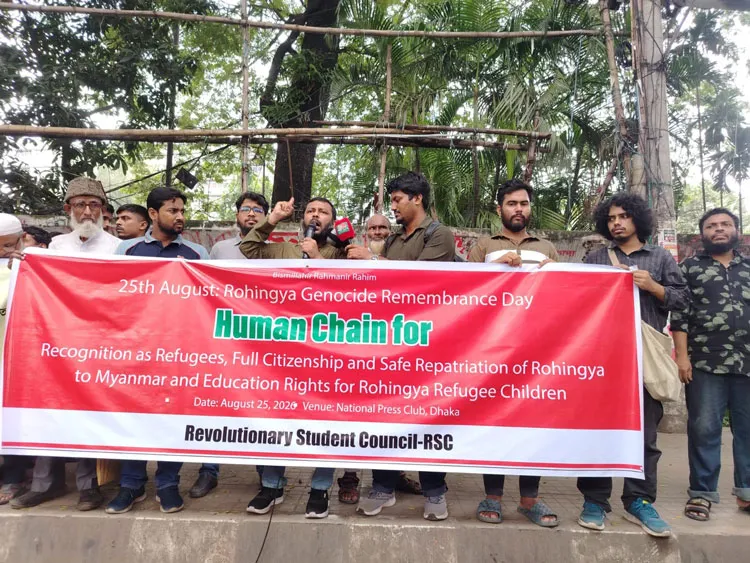
Biplobi Chhatra Parishad, a student organization, has formed a human chain demanding that displaced Rohingya students sheltered in Bangladesh be granted access to study in schools, colleges, and universities across the country, including the University of Dhaka.
The demonstration was held on Tuesday in front of the National Press Club in Dhaka to mark International Rohingya Genocide Remembrance Day.
During the event, the organization raised a four-point demand to secure the rights of the Rohingya community.
Official recognition of displaced Rohingyas as full refugees by the international community and host nations.
Reinstatement of full and equal citizenship rights for Rohingyas in Myanmar under international law.
Guaranteeing a safe, dignified, and international-monitored repatriation of Rohingyas to their ancestral land in Myanmar’s Rakhine State.
Providing quality and full education opportunities for Rohingya youth in schools, colleges, and universities within host countries.
Chaired by Abdul Wahed, Convener of Biplobi Chhatra Parishad, the program was attended by Abdul Jabbar, Chairman of Nawab Salimullah Academy; Khomeni Ehsan, Convener of Jatiyo Biplobi Parishad; Dr. Nabil Ahmad, Member Secretary of Jatiyo Biplobi Parishad; and leaders from various political and student bodies including Pan Islamic Movement, Bangladesh Congress, and Jatiyo Chhatra Mancha.
Addressing the gathering, Khomeni Ehsan highlighted that Rohingyas have been living stateless for nine years after fleeing genocide in their homeland. He noted that without formal refugee status, they lack access to employment, education, and international travel documents. He urged that providing education and allowing Rohingya students to participate in public exams would enable them to pursue higher studies at top global institutions and lead their community toward progress.
In his closing speech, Abdul Wahed emphasized that Rohingya youth are currently confined in host camps without the opportunity to sit for public examinations or enroll in Bangladeshi institutions. He described the human chain as a collective call for justice and human dignity, urging world leaders and international organizations to play a stronger role in restoring the rights of the Rohingya people.