


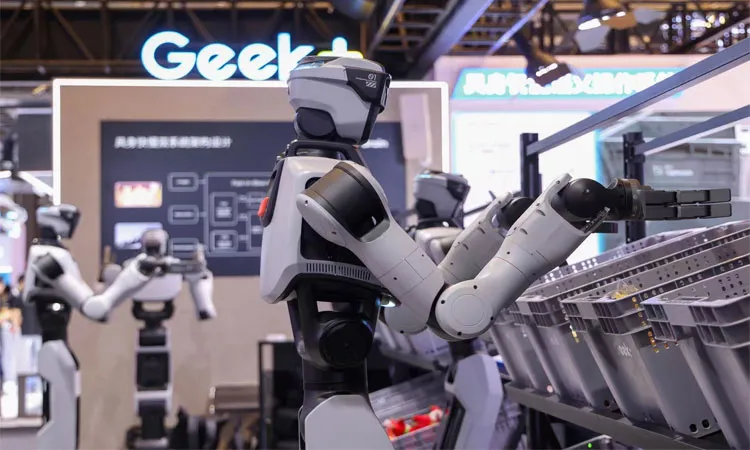
Humanoid robots are stepping into Chinese factories with taking on narrow but useful jobs as manufacturers battle worker shortages. In Zhejiang province the robots built by Aitu can now separate lift and align fabric pieces for sewing with a task that requires delicate handling since fabric easily deforms under wrong pressure. The company reports a 97% success rate in separating fabric with over 98% of sewing work meeting quality standards. Aitu estimates the robot could pay for itself within 18 months.
These robots are already being trialled at major garment makers, including Sunrise Group and Eifini, though their roles remain limited to single tasks like loading machines or positioning material.
Elsewhere, PIABOT Robotics' G2 robot is working in electronics assembly and logistics. In one eight-hour trial, it completed over 2,283 tasks without error and on an automotive line as it cut task time by nearly a third.

China's government is pushing this shift, aiming to scale humanoid robot deployment to 10,000 units by year-end as part of a national industrial upgrade plan. Training hubs in Cixi and Hangzhou are now feeding robots real-world factory data to improve their skills.

Experts say the biggest hurdle remains manipulation with precisely handling varied materials also since a robot trained on one fabric may fail with another. Industry leaders expect 2026-2028 to focus on validating single tasks with broader multi-task coordination emerging only by 2028-2030.
Rather than a sudden leap with a mass adoption is expected to unfold gradually station by station as robots prove reliable enough to justify their cost over a full working shift.
